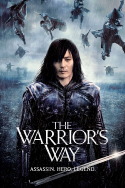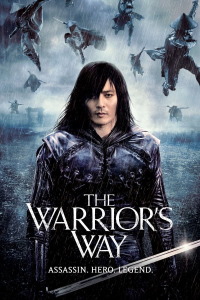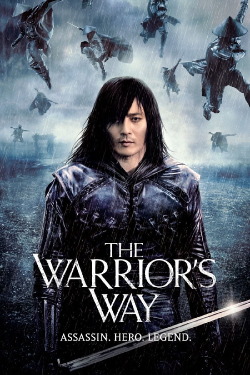
Review of The Warrior's Way (2010) by Shiira — 13 Dec 2010
Ancient...Korean secret? What the Calgon is going on here? Just because the actor portraying the assassin comes from South Korea, "The Warrior's Way" still has a lot to answer for, in regard to the wait it reinforces(or is that reintroduces?) the old stereotype of the Chinese laundryman.
Jang Dong-gun, best known for his role in Kang Je-Gyu's "Tae Guk Gi: The Brotherhood of War", plays a character whose surname just happens to be both Korean, and Chinese, in a film whose audience probably would be hard-pressed to differentiate the two.
Yang, a "Yojimbo"-like anti-hero, formerly of The Sad Flutes(described in the titles as being "the cruelest assassins in the east), is perceived explicitly as a "China man", in spite of the uni-racial name, because his kind(more so than the Koreans and the Japanese) are associated with the Old West, having worked extensively on the First Transcontinental Railroad in the mid-nineteenth century.
Predictably, there's not a train to be found in this frontier outpost, even though the inhabitants who call the desert their home, couldn't possibly survive without infrastructure; in other words, a functional railroad, by which food and supplies could be received on a weekly basis from the cities.
Already straddling the line of political correctness, any sense of realism had to be discarded(a ferris wheel, really?) in order to keep "The Warrior's Way" from crossing that line, so the locomotives had to go, since its presence would damage the filmmaker's ability to cultivate the lie, in which Yang's ethnicity is of an indeterminate origin, what the titles vaguely state as "the east".
A train can't help but signify Yang as Chinese, and the town(with the circus-based economy) he defends against "The Colonel"(Danny Huston) and his gang of desperadoes, as a place that resembles, however faintly, western civilization from out of the past.
Surrounded by circus freaks, among them, a "midget", a guy who breathes fire, and a bearded lady, Yang's otherness, his exotic looks, and way with a sword, makes him "one of [them]", an attraction, as if a "yellow" face was some sort of physical abnormality, which taints the kiss he shares with Lynne(Kate Bosworth), in what should be a taboo-shattering moment(compare this kiss with the tentative one Jackie Chan gives Amber Valetta in Brian Levant's "The Spy Next Door"), but conversely, becomes a spectacle, since the cowgirl is kissing a monstrosity, a freak, somebody from the mysterious east.
When "The Saddest Flute"(Lung Ti) finally tracks down his former disciple, his negative assertion concerns him alone, and not his race as a whole(the implied Chinese), because this is an America untethered from the historical record, and on a filmic level, the western myth created by the John Ford movies, and others of its ilk.
In this world, an Asian may be expected to do the laundry, but the absence of a track suggests that the "Chinese", unlike their real-life counterparts, were never imported from their motherland to help install a railway system, which as a result, undoes the associative stereotype, making the stock occupation of laundryman into a mere business that Yang's friend(also from "the east") just happened to undertake.
"The Warrior's Way" does away with the notion that the east is split into nations and factions as a means for perpetuating race in a brazenly callous fashion that borders on racist.
This review of The Warrior's Way (2010) was written by Shiira on 13 Dec 2010.
The Warrior's Way has generally received mixed reviews.
Was this review helpful?