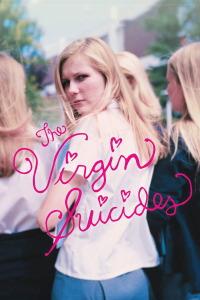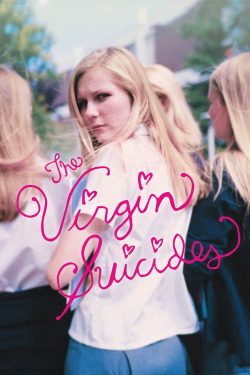
Review of The Virgin Suicides (2000) by Jason R — 19 Jun 2009
By the standards of classical Hollywood style, Sofia Coppola still hasn't made a "real" movie. There are no goal-seeking protagonists with clearly defined motivations, driven to move from one juncture in their life to the next with a definitive sense of accomplishment; rather than ending in marriage, or at least in coupling, Coppola's films typically end by gesturing toward the impossibility of such closure. Syd Field must hate her movies. This is not to say, however, that she's necessarily transgressive. Her films certainly have their pacifying qualities, and both "Lost in Translation" (her best work), and "Marie Antoinette" (her most divisive) seem to want to be read apolitically, especially the latter. But she certainly has an unconventional sense of narrative rhythm and character identity, at least for someone who also wants to make movies with big stars and respectable budgets.
In "The Virgin Suicides," for example, the narrative unfolds with the rhythms of a music video (and the music is supplied here, spectacularly, by two sources: the French duo Air, and a host of better-than-you-realize rock hits from the 70s), and the logic of a dream. Coppola doesn't shy away from the novel's second-person narration. The story is ostensibly told from the point of view of a group of adolescent boys in love with the Lisbon sisters, the virgin suicides of the film's title (which also gives away the ending, suggesting that Coppola may have left-of-center ideas about narrative suspense). The voice-over narration is performed by Giovanni Ribisi, though he's not in the film as an actor. But even this anchoring is essentially abandoned for a long stretch of the film, as Lux (Dunst) explores a romance with the school hottie (Hartnett, who does a really nice job here of making fun of his own good looks while still looking good all the time). But the Lisbon sisters aren't really the authors of their story, either. The boys across the street swoon for the girls not only because they're pretty; they're also mysterious, in part because their parents--religious zealots, we're led to believe--are so prudish they keep the girls under lock and key constantly. Coppola prefers to keep the girls essentially just as mysterious to the audience as they are to the boys.
In a way, there are no characters at all in this film, and the compensation for following such a wayward story is Coppola's unique gift for emotional evocation. She's aided greatly in this film--particularly for a first-time director--by the fantastic cinematographer Ed Lachman (see, e.g., his stunning work with Steven Soderbergh in "The Limey," just before Soderbergh began shooting all of his own films). Together, Lachman and Coppola capture the ineffable, effervescent sensation of teenage infatuation. Based on nothing but suggestion and roiling hormones, the boys across the street from the Lisbon girls fall in love, and Coppola understands that dreamy romance perfectly. The film's aesthetic peak also occurs during the film's tragic turning point: when Trip abandons Lux on the football field where they make love for the first and only time. Coppola and Lachman's framing and lighting in this scene are impeccable, and their use of cool blues recalls Campion's best films, when she seemed to positively own the color blue ("The Piano" and "Portrait of a Lady"). Only time will tell if Coppola will ever really tell a story. In the meantime, I'm fine with her films merely being spellbinding suggestions.
This review of The Virgin Suicides (2000) was written by Jason R on 19 Jun 2009.
The Virgin Suicides has generally received very positive reviews.
Was this review helpful?