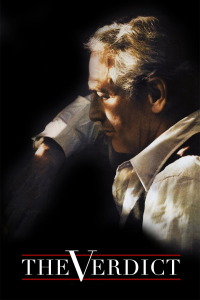
Review of The Verdict (1982) by Philip J — 11 Feb 2013
Frank Galvin (Paul Newman), a once-promising trial lawyer for an elite Boston law firm, is near the end of his career. And he's on a losing streak that would make Lionel Hutz blush. He's lost four cases in a row over the last three years and he's afraid that he would end his legal career on such a down note. Frank Galvin was once a partner at a prestigious law firm, but was forced to resign from the firm after allegations of jury tampering surfaced. Somehow he was never disciplined by the bar association let alone indicted for that serious crime (It turns out he was, "Accused. Not indicted."), but Galvin's career quickly took a downturn...
Frank Galvin has been working as a solo practitioner for the past several years, desperate to take any cases that come his way. He's described as an ambulance chaser, somebody who cares not about the people except for their wallets. To really demonstrate how low Galvin has sunk, we see him attending funerals, pretending to be a "friend" of the decedent. He then passes out cards to the mourners at the funeral. He's obviously only interested in drumming up business for himself and is unaware of his insensitive actions. Yeah, sounds like desperation to me. Lawyers sometimes have a reputation for a lack of scruples and Frank Galvin doesn't do much to shatter that stereotype. With his career in the doldrums, Galvin spends much of his time hanging out at the bar, playing a pinball machine, and drinking booze in order for the time to pass by quickly...
Galvin operates from a dingy office and he's barely making ends meet. He's struggling to afford paying his office rent for crying out loud! Frank's only real friend is his former partner and mentor, Mickey (Jack Warden) who sees how much Frank has hit rock bottom after seeing him passed out drunk on his office's couch.
Mickey tells Galvin that he has worked hard to secure him a great case, a potential moneymaker. However, it's been about eighteen months since Galvin was supposed to be working on this case and Galvin hasn't done so much as even meet with his client. And Galvin has court in just ten days.
Galvin meets with Sally Doneghy (Roxanne Hart), the sister of his client, Deborah Ann Kaye. It turns out that Deborah is suffering from brain damage and is currently in a coma. What happened was that Deborah went to the St. Catherine Laboure Hospital in Boston to deliver her third child. However, she was allegedly given the wrong anesthetic by the doctors and now is fighting for her life. She is barely kept alive as she is breathing through tubes connected to a medical ventilator...
Galvin hasn't exactly been putting forth a lot of effort on this case. He just wants a quick settlement and boom, it's over. Get it done and over with and earn a nice windfall in the process. But when he actually sees the comatose woman and the vegetative state she is in, Galvin experiences a powerful epiphany.
For Galvin, this is a big time medical malpractice case with significant ramifications. It turns out the St. Catherine Laboure Hospital is owned and operated by the Archdiocese of Boston. And the Bishop of the Archdiocese has set up a meeting with Frank Galvin in an attempt to resolve this case expeditiously and amicably, which could be beneficial for both sides.
At the meeting, the Bishop offers Galvin a handsome settlement in the amount of $200,000 if he agrees not to pursue the case any further. But going against the wishes of his client's family, Galvin, being the maverick that he is, rejects the settlement offer. Galvin has always been scared to go to court and try cases. But he decides to put everything on the line and take this case to trial. This case has become personal for Galvin. Because Galvin learns that it's not about money, it's about principle and doing the right thing. Maybe he will emerge victorious. Maybe he will find what he's capable of doing.
The Archdiocese however has some considerable legal firepower of its own. The defense attorney representing the Archdiocese in this matter is Ed Concannon (James Mason), who is described by Mickey as the "Prince of Fuckin' Darkness." He has all the financial resources and manpower of a major law firm behind him. Concannon is also not above using below-the-belt legal tactics like bribing witnesses. And the judge presiding over this trial is Judge Hoyle (Milo O'Shea), who during a pretrial conference in chambers, not very subtly encourages Galvin to take the settlement offer and run. For whatever reason, Judge Hoyle isn't particularly enamored with Galvin and will do what he can to make the trial an unpleasant experience for Galvin And a lot of things which could go wrong for Galvin before trial, do.
Galvin's only semblance of a love life is Laura (Charlotte Rampling), whom he sees regularly at the local bar. The two meet and strike a conversation, and soon enough, the two develop a close relationship. Like Galvin, Laura is herself divorced, only her ex-husband is a lawyer. She is also one of the few who believes in what Galvin is doing and his righteous cause.
Galvin must go up against the might and power of the Archdiocese. Maybe then, can Galvin earn the self-respect that has for so long eluded him. Could Frank Galvin finally live up to his full potential as a trial attorney?
The Verdict is one of the finest courtroom dramas I have ever seen. On one hand, it's a classic David vs. Goliath story about one man going up against a powerful institution. And that man can really earn a name for himself if he slays Goliath. On the other hand, it's about this lawyer standing up for justice as a way of redeeming himself after years of floundering and hard drinking. It's really a powerful tale about a broken-spirited trial lawyer on a personal path to redemption.
The Verdict is one of my favorite movies. It's real. It's honest. It doesn't glamorize the legal profession or put lawyers on a pedestal. It shows the day-to-day struggles of a lawyer trying to stay afloat, barely making a living. It shows some of the desperation tactics lawyers do to try to make business or at least keep their names out there. If anything, this movie may scare people off from wanting to go to law school and become lawyers. For those who had fantasies about lawyers making big bucks and driving the latest brand name cars, this movie will demolish those illusions.
In addition to being a superb legal drama, The Verdict also examines many interesting concepts of jurisprudence. Often times, there are competing interests between lawyers and the courts. The courts are interested in moving the case along smoothly and quickly while lawyers have a responsibility to zealously represent and advocate for their clients. There are also the popular themes of integrity and morality and how they intermingle in the judicial system. Integrity to the courts means that cases move through litigation without any hiccups. Some worry that the integrity of the judicial system can often be compromised by human emotions. These emotions can cause people to go against the established rule of law.
So what happens when an attorney feels that opposing counsel or even the judge himself is not playing fair? Here, Galvin is driven by a sense of morality, to stand up against the bullies of not just the Archdiocese, but even the court system. But both the Archdiocese and even the judiciary have tried to make a mockery of Galvin. That Galvin is a fool for wasting the court's time taking this to trial. Taking frivolous cases like this to trial compromises the integrity of the judicial system. The pressure to "cave in" whether it is having a criminal defendant cop a guilty plea or pushing a plaintiff to settle a civil action case in order to maintain the integrity of this judicial system is one of the challenges that lawyers face, particularly if the lawyer is perceived as an "outsider" or has a seemingly unwinnable case. But our emotions and our morals make these lawyers feel that some cases no matter how tough they seem are worth taking the opposing counsel (and the court) to task. Here, Galvin's sense of right and wrong prevents him from toeing the line. Ultimately, his personal feelings about this case have allowed him to make the right judgment call.
One of the more difficult challenges of being a trial attorney is not letting those same personal feelings get in the way of your professionalism. All of the above means nothing if an attorney cannot at least act as a professional. Sometimes, you feel very strongly about a case, but your personal life shouldn't mingle with your client's. An attorney can be passionate about a case, stand firm in their position, and try to deliver justice, but an attorney is also bound by the rules of courtroom decorum. An attorney has to look credible in court for the sake of public perception. Of course all this can be cumbersome when it seems like your adversary is not playing by the rules, which is what Frank Galvin experiences the hard way. You see Galvin biting his lip for too long and then lashing out at what he perceives as unfair treatment towards him and his client. In short: you can be outraged at the system, but look professional showing your indignation. While The Verdict explores what integrity means in the court system, there is also the issue of personal integrity. An attorney must have that personal integrity in order to maintain their trust with their clients. Frank Galvin makes the mistake of letting it slip and almost losing it completely which nearly costs him.
As lawyers, we are not just representing individuals; sometimes we are representing causes as advocates of justice. We take on controversial cases because we want to make a difference, maybe even enact social change. That's one of the more fascinating facets of Frank Galvin and plays an integral part of his character arc. In the beginning, Galvin was simply worried about keeping his head above water. But as he becomes more involved with the case against the Archdiocese, Galvin finds his personality changing into a more hard-charging lawyer that he was born to be. All it takes is one look at the comatose woman and the condition she is in to galvanize him into action.
Anybody who has been a practicing trial attorney can appreciate this movie and can relate to Frank Galvin's experiences. Galvin goes through the stress of potentially losing a big case. It's not just money that's at stake; it's his name and reputation. Because the latter two are often times the only things you have as an attorney. I like how Frank Galvin is sometimes shown as being unprepared and overwhelmed, at times stumbling through his performance. He makes mistakes, embarrasses himself in front of the judge, and even has the judge berate him in open court. Of course, Judge Hoyle himself doesn't make it easy for Galvin. There's this one great scene where the judge is constantly interfering with Galvin during his direct examination of his expert witness. The judge decides to butt in and question the witness himself, flustering Galvin. It really shows the uneasy tension between the plaintiff's lawyer and the judge. The judge's job is to be a referee and not a participant and one can see how he has crossed that line, much to Galvin's frustration.
The Verdict does a good job of capturing the adversarial nature of the courtroom and how some of the acrimony goes beyond what is said on the record. Galvin navigates the labyrinth of the court system facing many obstacles. His dogged persistence is what keeps him going. Standing in his way is Concannon, who is always well prepared for battle and is highly intelligent. Not to mention he probably has most of the judiciary on his side thanks to his hobnobbing. Concannon knows how to shred witnesses on the stand and destroy their credibility right in front of a jury. He can find the weaknesses of any case and penetrate them.
For a hero to truly triumph, he must defeat a powerful villain. Superman has his Lex Luthor, Batman has his Joker, and Galvin has his Concannon. Concannon makes for a terrific bad guy, whether he is attacking the credibility of witnesses on the stand or making snarky remarks about Galvin's legal abilities or the validity of his case. The two make for a fun match up.
One of the most crucial aspects of being a trial lawyer is preparing your witnesses. But if you can find your witnesses and get them to cooperate with you, you've won half the battle. Here, Frank Galvin has a hell of a time just locating witnesses. Even when the witnesses do show, getting them to cooperate is a whole another story. And one very critical witness just disappears on Frank like that.
One improper thing Frank Galvin did from an ethical standpoint was failing to consult with the client's family before turning down the settlement offer. The family finds out about this and is furious at Galvin for having rejected the settlement offer without consulting them at first. In real life, it is actually not the lawyer's decision whether to accept or reject an offer. It is the client's decision as to where he wants to go with the case; the attorney merely dictates the strategy. The attorney has to respect their client's decision and if the client wants to resolve or settle, the attorney must listen to them.
Most lawyers you see in the movies dress impeccably and drive luxury cars. Frank Galvin dresses in a way that I don't even want to know where he purchased his clothes from. Maybe he obtained them as a donation from the local Salvation Army.
I won't spoil the details here, but Frank Galvin's summation is one of the best I have seen in any legal drama. You can see Galvin pouring his heart and soul into this case, and Galvin tells the jury how much this case means to him, not just on an individual level, but on a much greater, public policy scale. Because it is not just one person's life at stake, it's the entire justice system. How a jury renders its verdict will impact justice on a macro level. It will impact which laws are seen as valid, and which laws are antiquated. It will impact what laws politicians will advance and which laws they will fight against. The politicians, from the local representatives to people working in the state and nation's capital, help write the bills and pass the law. The authorities regulate and enforce the law. But it's the people who have the final say as to which laws are fair and just.
Paul Newman nails it as Frank Galvin. His performance is perfection. It is because of Newman's craftsmanship that Frank Galvin is a cogent and well-developed character. The Academy Awards screwed up here. Paul Newman really deserved the Oscar win for his superlative performance in this movie. Although Paul Newman is ably supported by an excellent cast, Newman really shines in the spotlight.
There is hardly any action in this movie. It is all dialogue. And if anything, The Verdict feels like a stage play. But the script by David Mamet is so well-written that the time passes by rather quickly. And the performances are top notch. Yes, Paul Newman carries the bulk of the weight, but the supporting cast is fantastic and Newman interacts very well with the actors. Jack Warden does a great job as Galvin's mentor who is looking out for his well-being. Warden's character is very sympathetic to Galvin, but sometimes he has to put his foot down, or rather, put his foot up Galvin's arse. I enjoyed James Mason as the cocky, sleazy defense lawyer battling wits with Newman's underdog hero. Mason really makes his character out to be a snake and he seems to takes pleasure in doing that. Milo O'Shea gives a solid performance as a judge on a power trip. Charlotte Rampling adds a layer of stern compassion in her role as Frank's love interest, Laura, who serves as Frank's social contact with the outside world.
From a technical standpoint, the film looks great. Director Sidney Lumet makes sure that the actors know what they are doin.
This review of The Verdict (1982) was written by Philip J on 11 Feb 2013.
The Verdict has generally received very positive reviews.
Was this review helpful?