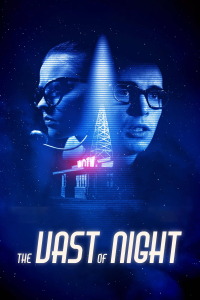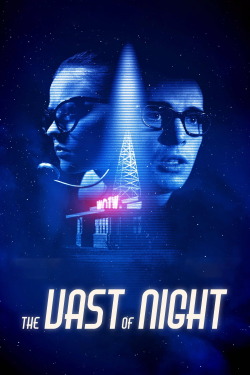
Review of The Vast of Night (2019) by Hnestlyonthesly — 27 Aug 2020
The Vast of Night combines elements of period nostalgia and 1960s tech to tell a riveting story about living in invisible places.
I first heard about The Vast of Night from Matthew Dessem on Slate and his review made enough of an impression that I put it in the calendar. From his review, I was expecting to watch something unsettling and weird, the way that–tease all you want, I went to see it three times in theaters–Under the Skin felt, like your skin was crawling the entire time you watched, like someone was watching you watch it the entire time, gauging your reactions. I like the way that a good UFO movie can do that, the way Personal Shopper can make ghost stories a little bit spooky and strange without a shaky camera or a jump scare. The Vast of Night tells a story worth hearing–sort of a cross between the nostalgic aesthetic of the 1960s Super 8 and Under the Skin‘s skin-crawling filmography.
The film is very simply split into four structural pieces, a single extended opening sequence with our lead man, the radio boy, Everette, and the sixteen-year-old girl, Faye, who goes to high school with him, who works that night’s shift as a phone operator for the small town in New Mexico where they live. Everette is smooth, suave. His mouth runs a mile a minute interviewing people at the big basketball game with Faye stumbling in tow, clearly mooning after him, but also charmed by his willingness to walk her all the way to her job–in what feels like a single shot. Their report is so lively and their chemistry so natural, that you hardly notice how much time has passed until she’s left alone in her booth for a moment of silence.
Faye’s facility with the board, the way it serves so nicely as an analog for the technical skill and fluency that young people these days have with their own forms of technology, is this electric bit of stageplay for the second scene. In terms of storytelling, her ability to weave in and out of conversations, to call on friends and neighbors in town, to receive scraps of calls, have conversations halt mid sentences, makes for an even more tense, even more energized moment of communication than one could imagine with a modern setting, which feels like justification enough for the period. Her call to Everette and the mysterious noise on the switchboard launches us into the third scene: Billy’s story.
Before we get there though, the camera does it’s coolest shot of the whole movie by retracing Everette and Faye’s steps from the door to the operator’s room all the way back to the high school game and out the window to the radio shack. It’s a weird, creepy scene that will make you appreciate the level of meticulous detail to the set, gives the movie a lived-in feel and a vastness that is lacking in other pieces. The way that 1917 felt like a set that–truly was–only as wide as the trench you were standing in, The Vast of Night stretches across a whole town, main street to the high school and the woods beyond.
The way that the direction leaves everything to Billy’s delivery, fading the lights in and out to black with just the sparest of questions from Everette or Faye is such a fun move narratively. Billy’s story reminds me of one of the spookiest pieces of radio I’ve ever heard was an interview that Terry Gross did with investigative reporter and war correspondent Annie Jacobsen about Area 51 awhile back. It’s easy to imagine building a movie around this one story.
The final scene is intriguing because it made some choices. We go to the house of a recluse, who tells us about how her son was abducted. We’re told to recite some lines of magical words that will trigger people who are hyper-sensitive to radio waves–but only while also in the presence of UFOs, which makes for a bone-chilling moment, but doesn’t make a lick of goddamn sense. The slapstick of running versus driving a car gets to be a little monotonous after it’s repeated use, but thankfully, our director makes a choice and sticks to it with our final few shots of the film. The decision to show the ship, in a slow reveal initiated by the ghostly lights over the forest is a throwback to Close Encounters, but at the same time, the main characters’ disappearance feels like it works as metaphor in a way that Scary Stories To Tell in the Dark didn’t quite hit the mark. Kids in a small town who should go far from this place, the old recluse tells us–the kids who have big dreams of moving to the West Coast for a radio job, who can’t imagine paying for college–suddenly disappearing, works well for Vietnam, the invisible folks like Billy, who feel like they were chosen, abducted even, by the US government because no one would miss them to begin with on account of their race. The old lady in her living room tells us, “I think they like small towns… people by themselves” and she projects onto the UFOs the power to make bad decisions, go mad, do evil, make war....
This review of The Vast of Night (2019) was written by Hnestlyonthesly on 27 Aug 2020.
The Vast of Night has generally received positive reviews.
Was this review helpful?