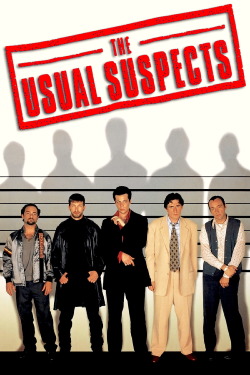
Review of The Usual Suspects (1995) by Blake P — 12 Dec 2015
There are disappointing moments within a film critic's lifetime during which they realize that a specific review won't have much influence on the people interested in, or in love with, a film. Granted, I've never expected to change someone's opinion - more important to me is the art of the recommendation, where a previously clouded masterpiece is able to briefly become new again.
So movies like 1995's "The Usual Suspects" are disheartening. So legendary is it for its shadowy pulp cool and stellar twist ending that most audiences figure it to be a companion piece to the "Pulp Fictions" and "Léon: The Professionals" of the era. But as long as a plot twist defines the success of a movie and is rather predictable, then my reverence can't be bought.
I can see its appeal - audiences tend to like having a plot pulled out like a rug from under their feet so they can feel the effects of a mind explosion - but I, more than once, found myself underwhelmed, confused, or, worst of all, not much interested in what it had to provide. The storyline, so richly complicated and defined by its characters, builds and builds to an ending that feels like a copout.
What is it about "The Usual Suspects" that bothers me so much? Is it its excessive amount of characters, the way it feverishly convolutes its story, the way it never really sells the premise it eventually tries to slip us wholesale? I'm not so sure; it's a lethal cocktail of technical and performative mastery combined with potential that always lets itself be known but never materializes, with audience piano playing that sometimes impresses, but, more or less, hits a lot of wrong notes.
It begins with promise. A catastrophic explosion shakes a San Pedro ship, leaving 27 men dead, $91 million of cocaine gone, and two survivors battling the aftermath. One of them is horribly burned, hardly able to aid investigators; the other, Roger "Verbal" Kint (Kevin Spacey), a talkative cripple, is relatively unscathed, his tendency to never sit quietly heightened by his paranoia. Two detectives with persona agendas, Jack Baer (Giancarlo Esposito) and Dave Kujan (Chazz Palminteri), stalk the scene.
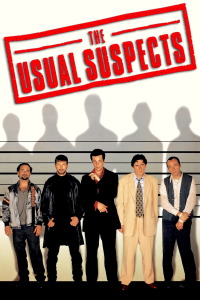
Most of the story is presented through the recollections of Verbal, whose testimony begins five days previously and involves four criminals, including dirty cop Dean Keaton (Gabriel Byrne), suave thief Michael McManus (Stephen Baldwin), the linguistically challenged Fred Fenster (Benicio Del Toro), and hijacker Todd Hockney (Kevin Pollack). The quintet becomes acquainted when they are brought in as suspects for a recent gun shipment robbery; none are guilty, all annoyed at their detaining. When McManus makes them a proposition that includes intercepting the transport of a police-escorted smuggler, swiping his noteworthy loot in the process, support is universal.
The job is completed without a bead of sweat in sight, leading to the group characterizing their chemistry as something finer than most. More jobs with bigger payoffs sounds much more rewarding. They continue on a path of a criminality but are slowed when legendary (and always unseen) Hungarian crime lord Keyser Söze enters the scene with a job that holds great financial reward but also great mortal risk - if unsuccessful, mass murder will ensue.
This assignment, of course, leads to the present day situation, where Verbal is a sole survivor and the police become heavyweights of baffled psyches. Verbal's truths never seem as cemented as we would like them to be (he's a pathological liar and a victim of an unforgiving society), making for mangled narration that puzzles investigators just as much as it puzzles us.
The story is a brand of confusing that rarely works in the movies, the kind where labyrinthine storytelling tactics become too much; we find ourselves furrowing our brow, unsuccessfully trying to recount past details to land somewhere between enjoyability and comprehensibility. To regally follow exactly what's going on is a feat I applaud anyone for mastering. The lauded plot twist (is it that great, though?) is underwhelming because we never cared too much about what was going on anyway.
So while the performances are good and Singer's direction has moments of artful mastery, "The Usual Suspects" doesn't satisfy because we expect it to be so much more than it actually is - it promises to be a twisty story of murder and deceit that ends with an exclamation mark, but conversely proves itself as hysteria with an ellipsis at its tail. But I wouldn't listen to me here; everyone loves "The Usual Suspects" so much that I currently act as the hater that stands on the sidelines cheering for the wrong team, alone. It's all a matter of taste.
This review of The Usual Suspects (1995) was written by Blake P on 12 Dec 2015.
The Usual Suspects has generally received very positive reviews.
Was this review helpful?