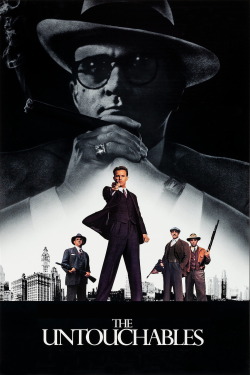
Review of The Untouchables (1987) by Noname — 30 Nov 2014
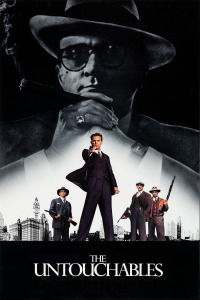
The first few scenes of "The Untouchables" show off director Brian de Palma's skill at creating expectations, subverting them, and manipulating the audience, three modes that he uses to good effect and bad over the course of the film. It is important that we like Treasury Department investigator Elliott Ness, the man who brings down Al Capone, because this is his story. But as the stiff, humorless enforcer of two deeply unpopular laws, Prohibition and the U.S. tax code, sympathy for him is hardly automatic. De Palma creates that sympathy in short order through a series of carefully crafted moments. First, he makes Ness's foe a larger-than-life villain. Robert de Niro's Capone is a grotesque monster, cocky and immature as a school bully, but incalculably more frightening. His first on-screen victim is a 10-year-old girl, and just like that the audience is out of his corner. The camera is always markedly above or below de Niro so that his face and body, swollen by decadence, bulge out in unnatural and off-putting ways. By contrast, Kevin Costner's Ness is quiet, steady, unassuming, and life-size. The camera looks straight at him as he keeps his composure in the face of a news crew's cynical heckling. Their faceless taunting, and his defenselessness, puts the audience on Ness's side even though Costner has far less natural charismatic than de Niro. But de Palma is not through crafting his protagonist: instead of being truly untouchable, a flawless Superman, the first major set piece sees Ness engage in farcical vainglory. He shouts "Let's do some good!" as he drives a truck through a warehouse wall, only to find that his first big bust is a big bust. Seeing Ness humbled is the final piece of de Palma's masterful opening arc. By humanizing him, by refusing to make him simply pure in counterpoise to Capone's simple evil, de Palma makes a killjoy Fed into a hero worth rooting for.
Unfortunately, de Palma's deftness at audience manipulation and his penchant for highly-manufactured staging have their downsides. The plot unfolds in a series of violent vignettes, and while these are exciting and memorable entries in the long tradition of shoot-em-up cinema, de Palma does not always know how much is too much and where to draw the line. The first big showdown takes place on a bridge, and the visuals are great. We see the plan unfold clearly. But the music is all wrong for the moment. It sounds almost comical, and is the kind of music that can only be played after the fact because its tension-killing jauntiness indicates that none of the principles are going to die. The film is scored by universally-acknowledged genius Ennio Morricone, so the fault must lie with de Palma for putting the music in the wrong place. In the next major bloodbath, which involves Sean Connery's quotable Irish cop Malone and a pair of assassins, de Palma switches to first-person view for an extended shot that moves seamlessly through a window and up and down a hallway. This technique is often used in schlock horror, but it works just as well to build tension in a period piece drama. As a bonus, it showcases the movie's excellent set dressing; the 1930-ish furniture and fixtures are museum-display perfect, yet feel authentic and lived-in. The end of this sequence has enough bullets that it really must result in an immediate death, but for the sake of melodrama de Palma stretches out the victim's life in a way that is unforgivably unbelievable. The loss of believability is only compounded in the movie's final act, in which de Palma detaches the film from the realm of physical probability in order to indulge in a slow-motion massacre on a staircase. It is an obvious homage to the famous Odessa Staircase scene in Sergei Eisenstein's "The Battleship Potemkin" (1925), which popularized the telescoping of time as a way to tell several small stories that occur in the same place at the same moment. It looks great, and it's gripping, but when it ends we can feel that we've been played.
The conclusion of the film is too easy, even corny, completing de Palma's drift away from stylized reality and into pure fantasy. Stray elements of the movie-the wife, the determined photographer, the corrupt police chief-never reach their full potential. "The Untouchables" can't be considered a flawless film by a long shot, but as a playground for big, bold personalities like de Niro, Connery, and de Palma, it's absolutely a fun one.
This review of The Untouchables (1987) was written by Noname on 30 Nov 2014.
The Untouchables has generally received very positive reviews.
Was this review helpful?