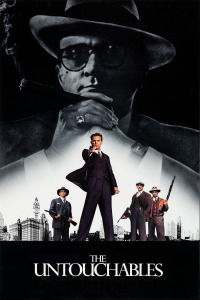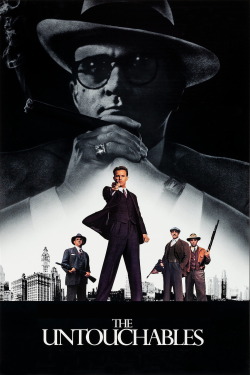
Review of The Untouchables (1987) by Allan C — 24 Dec 2018
A commercial and artistic high point for director Brian De Palma ("Blow Out" "Dressed to Kill" "Scarface" "Femme Fatale"), working from a script by David Mamet ("House of Games" "Glengarry Glen Ross" "Heist" etc.
) and featuring Kevin Costner in his breakout star making performance as prohibition era crime fighter Eliot Ness. There's little historical accuracy to the film, but who really cares about that when there is so many other things to love about the film.
Besides the above mentioned assets, you have an incredibly strong cast led by Coster as an idealistic Ness, who's joined by honest beat cop Jim Malone, a wonderfully over-the-hill Sean Connery, a rookie cop recruited straight from the Academy who hasn't been corrupted yet ("If you're afraid of getting a rotten apple, don't go to the barrel.
Get it off the tree.") played by a young Andy Garcia ("8 Million Ways to Die" was his only other major credit before this), and capped off by Robert De Niro packing on a ton of weight to play Chicago gangster Al Capone.
Incidentally, De Niro started his career with director Brian De Palma well before he made Mean Streets" with Martin Scorsese, so it's a treat to see the two reunite. Besides the strong leads, you also have Charles Martin Smith, Richard Bradford, Billy Drago, Patricia Clarkson, Del Close, and even Clifton James (the tobacco chewing sheriff from "Man with the Golden Gun" and "Live and Let Die") all in memorable parts, so it really is a cast to die for.
In addition to a sharp script, an amazing cast, you have some serious talent behind the camera that includes cinematographer Stephen H. Burum ("Rumble Fish" "Carlito's Way" "Hoffa"), composer Ennio Morricone ("The Good, the Bad, and the Ugly" "The Mission" "The Hateful Eight"), set decoration by the guy who's everything from Disney's "Mary Poppins" to "Back to the Future," and the editor of "The French Connection" "Apocalypse Now" and "Scarface," but the real hero behind the camera is director Brian De Palma.
The sets, costumes, music, and overall period atmosphere are amazing, but it's the visual stylistics from De Palma that make this film a classic. Without spoiling anything, the Pagliacci scene and the Sergei Eisenstein inspired baby carriage scene are moments of pure cinema (meaning they are scenes that would be impossible to capture or recreate as effectively in another medium.
Not written word, not painting, not stage play, not graphic novel, etc.). Although a major studio film, this is unmistakably a Brian De Palma picture. "The Untouchables" is minus his usual obsessions around voyeurism and sexuality, but the film does have his trademark fascination with violence ("They pull a knife, you pull a gun.
He sends one of yours to the hospital, you send one of his to the morgue. That's the Chicago way!"), guilt/betrayal (most all of the characters are motivated by some form of guilt), as well as his many visual hallmarks (camera zooms, slow motion, and memorable POV shots).
De Palma's fingerprints are all over the film, especially the "Battleship Potemkin" inspired train station shootout with a baby carriage bouncing down marble steps amongst a hail of slow motion gunfire.
According to Mamet, the scene was not in the original script and was added by De Palma, but this particular scene ends up being the most memorable of the film. It's De Palma's signature suspenseful build-up that makes the scene so effective.
In lesser hands, this 10-minute sequence might have been a straight forward shootout, but with De Palma it achieves operatic levels, with about a dozen moving parts all contributing to mounting suspense as he turns the screws on the audience, stretching out about 10 seconds of real time action into a two minute slow motion action masterpiece.
Whether it's a bucket of pigs blood above Carrie's head or Tom Cruise trying to catch a bead of sweat, De Palma builds suspense better almost anyone. What makes "The Untouchables" different from many of his other films is its emotional center, which comes from an earnest performance by Coster and Mamet's carefully plotted script.
Many of De Palma's films seem at times mere exercises in cinematic stylistics and explorations of his various obsessions, but his best films have an emotional center, which I would say are "Carrie," "Blow Out," "Casualties of War," "Carlito's Way," and this film.
Overall, from the the stylish opening credits to the soaring finale, "The Untouchables" doesn't have a single false note. This is the film that De Palma will be remembered for and deserves to be recognized as a true American film classic.
SIDE NOTE: Rewatching the film 2018, I was struck by how "1980s" this otherwise very authentic looking period film seemed.
This review of The Untouchables (1987) was written by Allan C on 24 Dec 2018.
The Untouchables has generally received very positive reviews.
Was this review helpful?