Review of The Truman Show (1998) by Theondoris K — 26 Apr 2017
A True Review of The Truman Show.
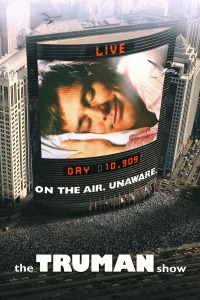
Film reviews nowadays tend to be extremely superficial, its analysis stemming from the surface rather than analyzing it at a deeper level for the presence of ideologies and politics. Peter Weir's The Truman Show is an excellent example of this as on the surface, it is about the main character, Truman Burbank, played by Jim Carrey, whose entire life is a façade that is broadcast on live television. However, analyzing it further, it becomes apparent that it is much more than that. The film explores the politics of reality as well as how mass media influences our perception of it and architectures of containment, may it be archaeological, ideological or psychological. Weir achieves this through both the content via the interactions and power relations between the people as well as the form in the way that the film is constructed in terms of camera shots and the presence of visual metaphors.
The Truman Show is a film that revolves around the life of Truman, which is completely scripted, he is surrounded by professional actors in a fake setting for a tv show that is broadcast around the world. This entire concept is portrayed in a negative light, using the creator of the tv show as the antagonist. In doing so, the film attempts to push forth a certain ideology, one with a clear Socratic binary opposition between artificiality and reality. It also sets in a place a hierarchy where artificiality is below reality and portrays reality as something we should fight for and strive towards. This is explicit when Christof, the creator of the show, says "While the world he (Truman) inhabits is, in some respects, counterfeit, there is nothing fake about Truman himself" (0:0:30, Weir). Here, he admits to Truman's world being fake and contrasts it to Truman himself as completely real and describes this as the reason to why the show is so successful. He proposes that society desires something more realistic through television rather than artificial "reality" shows. As this dialogue takes place at the start of the film, it creates the space 'ex nihilo' (out of nowhere) for the film going forward and foreshadows the exploration of the meaning of reality. The film also implies this idea of the contrast between Truman and his world in terms of reality and artificiality by his apt name - "True-Man". This has the unconscious effect of enforcing the idea that Truman represents reality whereas Seahaven represents artificiality. This shows how although everything he is surrounded by is artificial, the life that he leads is very much real. However, the audience is still filled with a feeling of dissatisfaction as it is implied that real life is in contrast to the one that Truman leads. This arises from our unconscious realization and subsequent denial that the life that Truman leads is eerily similar to the lives that we have become accustomed to. This results in an innate feeling of discomfort watching the façade of a life that Truman leads. The audience in the film also have this feeling however, mass media exploits their unconscious desire to watch Truman's life unravel to employ cynical reason and overcome this feeling of dissatisfaction. This goes to show the extent to which mass media shapes society and the influence that it has over us.
The architectures of containment present in the film also explores the concept of society's repression and emphasizes mass media's control over society. This is achieved by illustrating how Truman is controlled and trapped in Seahaven. The archaeological architecture used here is that of Seahaven being a desolate island, that is separate from the rest of society. However, this is successful in trapping Truman due to its psychological impact via his fear of water that was instilled in him through the staged traumatic incident of his father drowning in front of him during his childhood. This created an unconscious architecture of containment that manifests itself in his conscious fear of water. This idea is also emphasized through the form in which he is portrayed when his fear of water takes over as he is shown through multiple fish-eye lenses in this scene, which forms a visual metaphor of him as a fish stuck in a bowl (0:8:22, Weir). The fish eye-lens is also used in other scenes to emphasize his entrapment in this society. The film also shows that although Truman is trapped, he could escape if he wished to, which is illustrated through him finally escaping at the end. However, what prevents him from escaping for the majority of the film is his fear of the 'Big Other' - a repressive force that establishes control over people by exploiting their unconscious to set in place a symbolic order (iek). The irony in this situation is that there is no such thing. The 'Big Other' is a figment of his own unconscious created to establish order in fear of the alternative - chaos. This directly applies to us as well as we tend to create and give power to the 'Big Other' by fearing it and this, in turn represses us into the constraints of society. In this sense, Truman acts as an effective allegory for our current society as it is he himself who takes away his freedom and in doing so, gives power to the 'Big Other'. Through the film, he also escapes his entrapment by overcoming his fear of the 'Big Other' and in doing so, takes away its power. This provides a feeling of contentment for the audience watching the film as they feel like they too have escaped this entrapment. However, what happens here is due to this feeling, the 'Big Other' in society is in fact empowered as this reduces the desire of the audience to escape their entrapment and further solidifies it instead.
Through its exploration of the politics of reality and containment, The Truman Show is shown to be a political film that's successful in its purpose as it emphasizes the control of the 'Big Other' over society. It also shows how blurred the line between reality and artificiality through our unconscious denial of the parallels between Truman's life and ours. This, in turn, forces us to ask ourselves the ultimate question - are the lives that we lead 'real'?
This review of The Truman Show (1998) was written by Theondoris K on 26 Apr 2017.
The Truman Show has generally received very positive reviews.
Was this review helpful?