Review of The Trouble with Harry (1955) by Christopher C — 20 Aug 2009
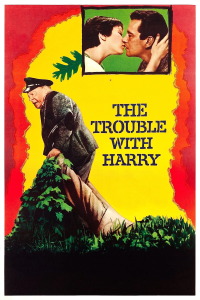
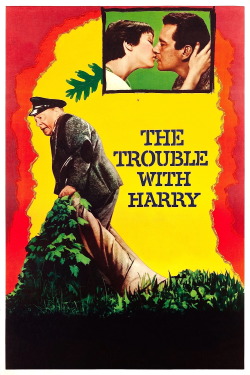
Hitchcock was the Master of Suspense, but he contributed to the genre and films involving some of its particular attributes in many different ways. He was not merely a great stylist but also an ingenious storyteller; his style has been what for which he's been more remembered over time. The Trouble With Harry, his 46th film, is one of his rare comedies, and we see a side of him that could have blossomed with as much fertility as his darker approach. If I were to compare it to anything, it's like a Coen brothers film in spirit despite its O. Henry ending.
The residents of a small village in Vermont are faced with the freshly dead body of a man, which has inconveniently appeared on the hillside above the town. The problem of what to do with the body, and more importantly how and why he was killed, is the eponymous issue. While this turning point develops, we are beating ourselves with the question, "Who the hell is Harry?" Nonetheless, such exposition waits patiently through the very pleasant and otherwise completely benign characters' hilarious nonchalance regarding the corpse and the hiding of it. The way the exchanges are inflected is never overdone. "Better be running along now. You don't want to be an accessory after the fact." "You are a considerate man.".
There is never a dark moment in this film. It is blessed with a great autumn Vermont locale which makes rich use of its color. Indeed, this is the beginning of Hitchcock's highly regarded collaboration with composer Bernard Herrmann, who went on to compose some of the master's most iconically tense scores. Here, Hitchcock makes cartoonishly detached use of Herrmann's music. Still, The Trouble With Harry holds its own with the significance of other Hitchcock movies, because, rather symbolically, he taps into our interest in "digging up" the truth versus complacent surface "planted" over truth.
The director made many classic American films, but he was an Englishman through and through, and this film, which appears so lushly all-American, is driven by a distinctly British sense of humor, imported to satirize American values. It is mostly in the less-is-more timing of certain lines, even when the script is implicitly philosophizing on the possible destiny, justice, right or wrong of accidentally killing the title character. The wryness of it all begins immediately with a nice lesson on the possible effects of hunting, on the human casualties of human errors. The film was considered fairly racy for its time, as there is a hilarious 1950s tip-toeing sexual innuendo: "Cross her threshold," "preserves must be opened someday." There is a conversation with then-newbie Shirley MacLaine, whose earthiness fits like a glove here, concerning her nightie.
Yet in spite of their seeming insensitivity, it is fascinating how such a small, extremely insular community can extemporize their own values. The value of life can hardly be considered one of them. From the little boy carrying around his dead rabbit to tea time with the quaint lady discussing how to dispose of Harry efficiently. Yet all good-natured people! At one point, there is a dispute over who's more grateful in general.
There's the diplomatic and urbane Edmund Gwenn, who is certain that he must have killed the man with a stray shot from his rifle when rabbit hunting. But then maybe not, or perhaps. Studious John Forsythe plays an adventurous and energetic painter, quite unbiased toward the whole deal, willing to help his easygoing friends and neighbors however he can. I don't know why there just happen to be two Mildreds in the cast, both with two-syllable last names ending with "ck," one of them playing a name that rhymes with itself; it must be a simple coincidence. At any rate, eloquent and versatile Mildred Natwick's Miss Ivy Gravely feels that Harry died subsequent to a blow from her hiking boot, not like such a claim inspires curiosity as to how that would've occurred.
Hitchcock himself said, "Everything's perverted in a different way." I think he held to his conviction when making this joyously sociopathic satire about the absurdity of the notion of utopia.
This review of The Trouble with Harry (1955) was written by Christopher C on 20 Aug 2009.
The Trouble with Harry has generally received positive reviews.
Was this review helpful?