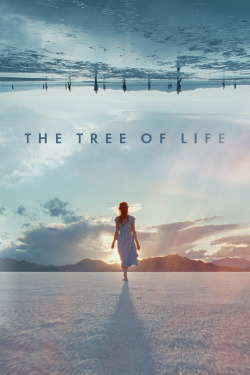
Review of The Tree of Life (2011) by Brock B — 05 Aug 2012
Existentialism on film is a risky proposition: while the theme can be incorporated throughout different types of scenes, it is challenging to construct a conclusion that does not ring hollow. Terrence Malickâ(TM)s The Tree of Life debates the meaning of life well, combining a unique method of storytelling with stunning visuals, but wanders slightly into the realm of clichà (C) as it reaches its climax.
Juxtaposing concrete scenes of life with abstract visions of creation, real-life moments and natural metaphors, Malick captures the attention of the audience without overwhelming them. On one hand, life is precious and fleeting but on the other, it goes on no matter what. Flames battle with shadows, the camera focuses perpetually on the sun and the light it generates. Life can start with a Big Bang or when a sperm fertilizes an egg and it can end suddenly with a comet or an accident.
Previous events in the history of the universe (chronicled in an impressive sequence which is as creative as it is memorable) parallel how humans act on a daily basis. Nature scenes are blended with voiceovers by the filmâ(TM)s main characters, expressing their thoughts and questions about life of all sorts. Malick mixes brief instants, like a glance or a quick word, with longer scenes like a church sermon or a lesson Mr. Oâ(TM)Brien gives his son Jack.
The film is filtered by Jackâ(TM)s memory as he looks back on his childhood, remembering his parents and his now deceased brother. There is no detailed story to follow; Jack simply combines his memories as they pass through his head. He watches the planting of a tree near his office and remembers a tree that his family planted near their home.
The focus on the Book of Job in scenes from the neighbourhood parish borrows from the Myth of Sisyphus about humanityâ(TM)s struggle and the need to cope with twists of fate in a healthy fashion. It is not a matter of getting what one deserves but making the best of what one gets. As a boy, Jack struggles to understand why events happen the way that they do. He experiences some pain early in his life and distances himself from his family and friends.
He later changes his ways and acts more according to societyâ(TM)s expectations although it does not save him from further grief. He may be a successful architect but he has difficulty achieving self-satisfaction. Looking for absolution that he cannot find, he is like the bird flying over the Golden Gate Bridge at sunset: a creature who must persevere irrespective of his regret.
In the end, The Tree of Life is a subjective experience (much like the final scenes of 2001: A Space Odyssey which are referenced in a more down to earth resolution of Jackâ(TM)s inquiry). Malick himself knows this as one scene shows Mr. Oâ(TM)Brien explaining what the word means over lunch. Some audience members will dislike the disjointed narrative and lack of a âtrue storyâ? whereas others feel that it proves films need not be centered on a single. The ending may have drawn some boos at the Cannes Film Festival but it is only a small part of the entire work. In a season of summer blockbusters, it is a pleasure to view a film that stimulates thoughtful reflection.
This review of The Tree of Life (2011) was written by Brock B on 05 Aug 2012.
The Tree of Life has generally received positive reviews.
Was this review helpful?