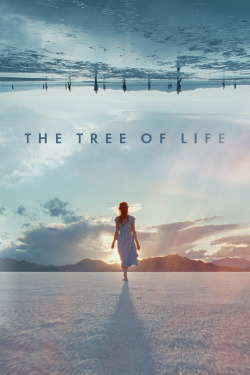
Review of The Tree of Life (2011) by Cameron J — 03 Sep 2014
You know, Cecil Taylor has an album by this name that's about 73 minutes of him messing around the piano, because, come on, it's free jazz, so I guess anything making reference to a concept about the network system of life that is largely associated with biology, religion, philosophy and mythology is likely to be pretentious and boring, as surprising as that sounds. Seriously though, kids, Terrence Malick is back, and after the existential epics about war and the bloody inception of America, he applies his avant-garde atmospherics to a thrilling premise about... some middle-aged architect reflecting on growing up in the Texas suburbs of the 1950s with a somewhat strict father. ...Oh yeah, this premise sounds so thrilling that I can feel a fainting spell coming on, but we can at least take comfort in the fact that this film is still much shorter than "The Thin Red Line" and the extended version of "The New World"... at almost two-and-a-half hours. I just think it's hilarious that Brad Pitt is playing Sean Penn's father, although there would have been a much bigger age gap issue if Pitt's role did, in fact, go to Heath Ledger. I didn't know whether to laugh or cry when I heard an interview with Ledger in which he addressed this film, and that he would be so busy with other films that he would "fall to the ground, dead". I reckon he got his schedule mixed up, but hey, it's all part of the "tree of life", and if he was going to be as busy as he said he was going to be, then Jessica Chastain must have inherited his work load. There's talk of - so help me - a six-hour-long version of this film, so it's a wonder Chastain had time to do the other twenty-two films she was in throughout 2011, but hey, I'm sure she's glad to get respect for this film that is actually pretty well-deserved, because if anyone can make a good movie that's this artistically overblown, it's Terrence Malick, which isn't to say that he doesn't try your patience, or even the film's own coherency.
I reckon the film is at its most jarring when it abandons the central "plot" about some traditional Texas family for almost twenty minutes to portray the Big Bang and subsequent inception and eventual demise of the early eras of Earth and its inhabitants, and when it interrupts the final act to briefly dramatize the "Red Giant/White Dwarf" theory that speculates how Earth will be consumed by the sun long after global extinction, but this is a pretty incoherent affair throughout its course, meditating much too extensively on each individual segment which just ends up getting lost in meditations upon nothing anyways. Lyrical and more thematic than dramatic, the storytelling of this film is defined by abstractionism, with dialogue that is too poetic to be believable, and sometimes a little too grounded to be especially profound, and with intentionally aimless non-plotting that is unstructured in its focus on narrative progression, if anything at all. The bookends of the film are comfortably structured enough to be pretty powerful, almost to the point of making the final product strong on the whole, but throughout its body which, without any real conflict, observes the usual affairs of a boy and his middle-class family as he comes of age, it is too unfocused to hold your focus (I joke about how challenging the fabled six-hour cut of this film would be, but if the highlights of the body were given that much time to flesh out, the final product might be more engrossing, sort of like, say, "The Best of Youth"), and it doesn't help that the characterization is also fairly abstract, defined by grounded, relatable traits whose genuineness goes obscured by the overblown, metaphysical storytelling which leave the characters and conceptually realist dramatics to fall short of relatability, and come off as histrionic devices. The excessiveness of style is typically not so much played over substance, as much as it is imbued into the substance, tainting potentially genuine and grounded dramatics with a surreal, existential lyricism whose sweeping thematic depth establishes a scope which would not be found in a more traditionalist interpretation of subject matter this lacking in urgency, yet which challenges one's investment in the characters and their conflicts as more than just abstractionist devices to an excessively dreamy style whose sheer atmosphere is most problematic. Exacerbating all of the aimlessness and lack of focus and dramatic relatability is Terrence Malick's trademark directorial atmosphere which glazes either deafening quietness, if not silence, or ethereal ambience over an atmosphere which is so meticulously crafted through impeccable sound designs and engrossing visuals that it captures an extreme immersion value which is too prominent over nothingness to recurrently carry a worthy effectiveness, defining the dramatic heights as penetrating, but mostly sobering the hypnotic tone of the film until it becomes, not bland, but dull, perhaps even tedious in its abandoning entertainment value for an overtly dreamy artistic style that would be more forgivable if it wasn't so pretentious. While about as realized as any of Malick's existential epics, the film has the makings of a devastatingly powerful drama, but applies its passion to some sort of lyrical visual journey that fails to gel with narrative value enough to be especially effective in its own regard, and isn't even original, reflecting more of the same focal inconsistencies, excessiveness, abstractionism to characterization, melodrama and visuals, and challengingly cold atmospherics which has inspired anything from transcendence to disdain from those familiar with Malick, a man who still does these kind of films about as well as anyone can. It's so hard to embrace this film, but those who are able to take it for what it is are sure to be rewarded, for although the film is too narratively misguided, stylistically overwrought and altogether dull for me to love it, or even find it solid on the whole, I have a great deal of admiration, if not a bit of love for key aspects of it, even in what story there is.
The film is primarily celebratory of often arguably overly subtle themes regarding the majesty and mystery of life, how the family which raises a boy will define what sort of man the child will become, and even how quickly time passes as it unravels the natural order of life and death, but the narrative vehicle for these themes, no matter how viciously betrayed by storytelling so abstract that it either lightens the accessible weight of the drama, or bloats what characterization and plot there is with theatrics that make realistic attributes feel contrived, is valuable in its analyzing the tribulations of even the most normal family unit. This subject matter may be minimalist, but its human heart is ripe, and although the storytelling betrays the dramatic depth of this character piece for the sake of mere thematic depth, the performances do what they can to compensate, with a nuanced naturalism that could have been bland in its being so grounded, but is accompanied by a rich emotional realization that defines each individual role, the most worthwhile of which being that of a loving mother and vulnerable wife who Jessica Chastain portrays with subtle and sound layers, and that of a troubled adolescent who the young Hunter McCracken portrays so convincingly and with such conviction that he steals the show in an exquisitely effective lead performance. Emotionally realized and effectively naturalist, this cast helps in defining what dramatic resonance there is in this narratively misguided opus, though perhaps not with the consistency of the soundtrack, whose original touches epitomize the great Alexandre Desplat's mastery of light classicism, and whose unoriginal tracks include such revelatory masterpieces in traditional, modern and experimental classical music as John Tavener's "Funeral Canticle" and "Resurrection in Hades", Francesco Lupica's "Cosmic Beam", Gustav Mahler's "Symphony No. 1", Tibor Szemző's "Snapshot from the Island", etc., which are both captivating by their own right, and complimentary to the artistic and, to a certain extent, dramatic value of the epic. The soundtrack is itself complimented by Erik Aadahl's and Craig Berkey's sound design, for although the naturalistically impeccable audio of the film adds to the dully ethereal ambience, the flawless placement and definition of every notable audible attribute of this film joins some very impressive visual effects - at least during the narratively superfluous, but aesthetically breathtaking and transcended sequences portraying the birth and demise of Earth - in helping establish a thorough entertainment value that mostly thrives on the aspect on which the film itself thrives as so very compelling: the visual style, for Terrence Malick's creatively angled and smoothly mobile camerawork carry you into a world rich with lavish imagery of an either naturalist or thematic, but always lyrical style that couldn't possibly be done more justice by Emmanuel Lubezki's cinematography, which is flawlessly defined and hauntingly celebratory of each individual light in this film, thus making the more subdued visuals robust, and the many exuberant sequences so magnificently beauteous that they make most gorgeous cinematographic achievements which have inspired people to boast "has to be seen in order to be believed" seem unworthy of their praise. This is not simply Malick's magnum opus in terms of visual style, but arguably one of the most impossibly beautiful films of all time, a transcendent visual journey that cannot be simply described, and a masterpiece of cinematographic virtuosity whose technically masterful showcase of the vast artistic potential of modern filmmaking, and whose exemplary - nay - immaculate celebration of the depthless beauty of life on most every notable level make the film, from an aesthetic standpoint, an essential watch, despite all of its great shortcomings in substance. Malick's stylistic eye typically runs so deep that it redeems his vision to an extent very rarely reached by filmmakers on this level of experimentalism, but it still frustrates by showing just how much potential for substance and entertainment value are lost for the sake of near-tediously overwrought artistry whose highlights could have made, say, "The New World" outstanding, and "The Thin Red Line" a bona fide masterpiece, and although this portrait on a traditional family doesn't quite carry the story weight of Malick's last two epics (Let's just forget about "Days of Heaven"), it too would have thrived as a dramatic triumph without all of the tedium and pretense, on the back of an aesthetic proficiency, and heights in dramatic proficiency which nonetheless play no small part in saving this film, just as they did in the predecessors, for when Malick finds realization in bonding thought-provoking thematic value, naturalist performances and profound, immersive artistic brilliance, dramatic resonance soars, cutting deep to punctuate meandering storytelling that rarely loses an endearing sense of scope which should be lacking in subject matter so minimalist, and helps tremendously in gracing the film with an immersion value that would be perfect if the engagement value and focus of the drama came even mildly close to very, very, very lightly flirting with almost matching the magnitude of the direction. As usual, when Malick gets down to earth and applies his art, not to lyrical experimentalism, but genuine dramatics, the passion and compellingness is almost tear-jerking in its inspiration, and it's so aggravating watching this film lose its dramatic focus before too long, but to say that this film is as misguided as the efforts of so many avant-garde filmmakers - many of whom try desperately to imitate Malick - is a disservice to a filmmaker as gifted as Malick, who is himself misguided, but effective enough, not in, but in spite of his extreme artistic nature to compel those patient enough to take this ultimately reasonably rewarding challenge.
As the light fades, incoherency and exhausting dragging shake the flow of what focus there is to this, in a lot of ways, derivative existential epic which is too thin with its narrative, abstractly contrived with its potentially realist characterization and narrative, and tediously subdued with its atmosphere to stand a chance of standing out, and yet, there is still something rewarding here, for there is enough intrigue to the valuable themes and "story" concept, power to the naturalist performances, - particularly that of young Hunter McCracken - awe-inspiring majesty to the magnificent classical soundtrack, immersive proficiency to the sound design and other technical aspects, and overwhelming aesthetic value to arguably some of the greatest cinematography dramatic filmmaking has ever produced to reflect an inspiration that Terrence Malick's direction orchestrates with enough endearing taste, immersive value and periodic emotional impact to make "The Tree of Life" a heavily challenging, but ultimately fairly engrossing existential portrait on life, in all of its grace, difficulty and majesty.
3/5 - Good.
This review of The Tree of Life (2011) was written by Cameron J on 03 Sep 2014.
The Tree of Life has generally received positive reviews.
Was this review helpful?