Review of The Tiger of Eschnapur (1959) by Dynamo K — 12 Nov 2010
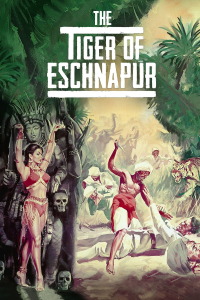
"Der Tiger von Eschnapur" is the perfect example that a bad screenplay and bad acting can be filmed in an extraordinary beautiful way. The movie has a slow screenplay, with little thrills, little interest, little appeal, but everything is lavish about it, the colour is intense and beautiful, the cinematography excels, the set and costume design are fabulous, and the directing top notch.
Yet all this cannot hide the fact that the movie, as a story, has very little to offer. It is perhaps surprising to know that the director of this is the great Fritz Lang, in one of his last outings as a director (he would notably star in Godard's "Le Mepris" in 1963).
He, off course, revolutionized cinema in the 20s and 30s in Germany with such as "Metropolis", "M", or the Mabuse series, and later, in the 40s and 50s, in Hollywood he made noir pictures such as "Fury", "Woman in the Window", "The Secret Beyond the Door" or "The Big Heat", all very good.
But in the end of the decade, back in Germany and with a declining career, and before a last Mabuse picture in 1960, he made a 2-part movie set in India, the first "Der Tiger von Eschnapur" and the second âDas indische Grabmalâ?.
These movies were released in america as âJourney to the Lost City", in a highly cut version (two 90 min films cut into only one of 90 min!). A caravan goes through the forest headed for the city of Eschnapur.
An architect (Paul Hubschmid, a stiff most of the time) is going there at the request of the Maharadjaj (Walter Reyer), to introduce european techniques to the city. A pity that Eschnapur is shown as a beautiful city, perfect, with sumptuous locations, fountains and gardens, so why they need an European architect is beyond me.
The caravan also has a dancer, Debra Paget (who had stared in "The Ten Commandments"), the woman who is the center of the story. She was seen by the Maharadjaj, who instantly fell in love with her, and so sent to his palace.
Basically the plot is that he, always kind and giving her jewels, wishes to engage her love, and often says he doesn't want to force her and that she is free. But when she falls for the architect (and vice-versa), the Maharadjaj becomes jealous and so a bad guy, wanting to kill them both, involving tigers and pagan rituals, etc, etc.
There is also the Maharadjaj's council who are against the girl because they think she will lead the Maharadjaj to a bad track, and so try to kidnap her, and the always present maid of the dancer, beautiful Luciana Paluzzi, in an early performance of her career, where she says only "yes" and "no" most of the time.
There are also some secret underground passages, tiger fights, and a stupid back story for the girl (probably elaborated in the book), and little more. The only thing really interesting is the dance Debra Paget makes when she reaches the palace.
Fabulous! The movie reminded me of those action/exotic adventures of the 30s, such as "The Mummy", "Tarzan" or "King Kong", where the screenplay was lame but it was a slow build up to the real surprise, twist or horror the movie would show.
But here, in the 1950s, or to audiences today, this does not work. The lame dialog becomes lamer, and there is really nothing the screenplay is building up to. No tension, no clever thing, no surprise.
Actually the surprise comes in the end, and the lovers are left abruptly, but with so little finesse that there is no real anticipation to see their fate in the second movie. But actually I am anticipating to see it, hoping to prove myself wrong.
No surprise for me when I found that this was based on a Thea von Harbou's novel (she wrote Metropolis and M back in the 20s), and that the movie had been done in the 20s and 30s. The movie would work then.
Not like this. Probably most of the plot of the book was left out, and what is given to us is beautiful pictures without content. As an independent movie this is a clear disappointment. As a build up to a second it might work, but leaves little interest to see it.
The technic of this one is fantastic. The story is just clearly not up to the test of time.
This review of The Tiger of Eschnapur (1959) was written by Dynamo K on 12 Nov 2010.
The Tiger of Eschnapur has generally received positive reviews.
Was this review helpful?