Review of The Thrill of It All (1963) by Mel V — 22 Apr 2005
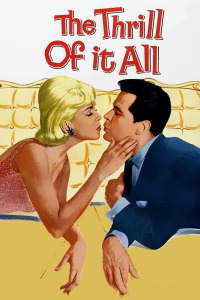
Some films are more notable, and more memorable, not for their entertainment value, or even for their star power, than for the social and cultural subtexts underlying seemingly generic narratives. Case in point, [i]The Thrill of It All[/i], starring Doris Day ([i]Pillow Talk[/i], [i]The Pajama Game[/i], [i]Please Don't Eat the Daisies[/i]) and James Garner ([i]Maverick[/i], [i]The Rockford Files[/i]), a domestic comedy directed by Norman Jewison, a director better known for serious-minded films (e.g., [i]In the Heat of the Night[/i], [i]?And Justice for All[/i], [i]A Soldier?s Story[/i]), with a script by Carl Reiner ([i]The Dick Van Dyke Show[/i]) and Larry Gelbart (M*A*S*H), and released in 1963. At its core, [i]The Thrill of It All[/i] posits an either/or conflict or choice between domesticity and careerism, and ultimately choosing the conservative, traditionalist path (the path of least resistance), an imaginary suburban idyll under a benevolent father/husband figure.
Beverly Boyer (Doris Day), suburban wife and mother of two, inadvertently steps into a lucrative career as a television spokesperson. At a party with her obstetrician husband, Gerald Boyer (James Garner, stepping into the Rock Hudson role), Beverly candidly shares her experiences with the Happy Soap laundry detergent manufacturer. Impressed by her self-confidence and obvious charm, the soap manufacture offers Beverly the opportunity to share her thoughts on television. Her one-shot appearance leads to a lucrative contract offer (with the potential to out-earn her doctor husband). Her frequent television appearances (her appearances are filmed live, rather than taped) take time away from her roles of mother and spouse. Gerald, the exemplar of the anxious patriarchical male, objects strenuously to her newfound career and celebrity.
The comedy centers on Gerald?s increasingly frantic attempts to curb (or end) his wife?s burgeoning career, by either openly challenging her desire for independence, and independent means (given the size of their home, their live-in maid, or Gerald?s new convertible, money is not really the issue), or, when the direct approach fails, by guilt-tripping her into foregoing her career (i.e., raising his own needs or his children?s). Gerald goes as far as obtaining advice from the psychologist who operates his practice in the same office suite. As each attempt fails, Gerald becomes more desperate, to the point of faking the existence of a mistress, arriving home, apparently drunk, Gerald mutters another woman?s name. As Beverly slips out of his grasp, and his marriage appears on the verge of crumbling, the plot switches to fast-paced farce, with Beverly (finally) developing a renewed appreciation of Gerald?s career as an obstetrician.
Where [i]The Thrill of It All[/i] ends, of course, can be easily guessed, with traditional gender roles strongly reaffirmed (there?s even a discussion of Beverly having a third child in the final scene). [i]The Thrill of It All[/i] was made before the civil rights movement had reached the boiling point. Our involvement in Vietnam was more than a year away from escalation. Anti-war protests were still several years away. The women?s movement was more theoretical than actual. With so much social and cultural change still to come, it?s not surprising that the screenplay by Carl Reiner and Larry Gelbart reflects unspoken, unconscious, sexist attitudes better suited to the 1950s than the 1960s (or subsequent decades).
Viewed several decades after its theatrical release, the humor in [i]The Thrill of It All[/i], centered on Gerald?s boorish, self-centered, controlling behavior, often falls flat (the scene involving feigned drunkenness is particularly unfunny). There are essentially two exceptions: a pool scene involving a car (and a truckload of detergent) and the next-to-final scene involving a car jam and a baby delivery. The second scene also draws on the comedic talents of Arlene Francis, in the role of an expectant older mother, and Edward Andrews, as her befuddled, muddled husband. Yes, [i]The Thrill of It All[/i] leaves no cliché unused. Doris Day, an underappreciated comic actress, displays her timing on multiple occasions (that and her ability to pout or throw a temper tantrum). If anything, [i]The Thrill of It All[/i] is still watchable due to the comfortable rapport between Day and Garner (Garner's egocentric, sexist character notwithstanding).
This review of The Thrill of It All (1963) was written by Mel V on 22 Apr 2005.
The Thrill of It All has generally received positive reviews.
Was this review helpful?