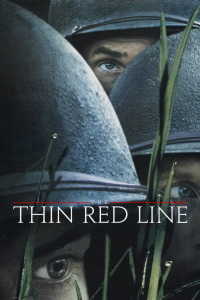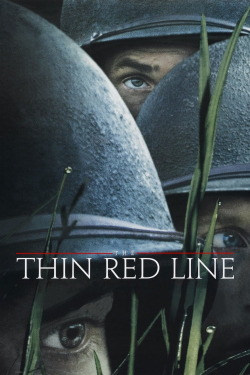
Review of The Thin Red Line (1998) by Gabe E — 08 May 2011
After a 20 year absence, writer director Terrence Malick made a triumphant return with a film that is an evolution of the style we saw in his first two films, Badlands and Days of Heaven. Where these two films were specific stories told in a surreal and subjective way, this movie is a much more of a meditation of war, with no real climax, just a series of interconnecting events.
The focus of the story shifts across a series of characters, but starts and finishes with Private Witt, played in an understated, subtle and totally captivating way by James Caviezel. There are also good performances from various characters that move in and out of the story, the most notable being yet more impressively understated performances by Sean Penn, Ben Chaplin and Elias Koteas. Other characters come and go, with a Nick Nolte offering a more visceral, aggressive but still absorbing performance as Major Tall. Other characters have nothing more than extended cameos, coming and going briefly, the most obvious ones being John Cusack, John Travolta, Woody Harrelson, Adrian Brody(who doesn't utter a word of dialogue in the movie!) and George Clooney. It is impressive to see Malick working with these actors to keep their performances very grounded and subtle, but totally absorbing. This is mainly due to Malick's supreme skills as a visual storyteller, and it is clear that he has lost none of his skill despite this 20 year break. He composes scenes with long duration shots that involve a lot of improvisation, and he requires his actors to tell a lot of the story with expressions, using significant amounts of voice-over that is clearly added later and also improvised. The telling of this very emotionally and psychologically involving story is hugely assisted by some tremendous technical contributions. John Toll's photography, Jack Fisk's production design and Hans Zimmer's score (which seems to have been composed as a series of suites rather that to specific cues in the action) all have huge positive impacts on the film, and take the experience of watching it to another level. While the film deals with war, Malick's approach to the violence is tactful and diplomatic, but still visceral. While the film has long stretches of characters mediating, philosophising and reflecting on their experiences these sequences never drag and the action sequences, when they come, are brilliantly directed, technically amazing, and hugely involving emotionally, making you feel what the characters are going through, rather than a more detached view of 'that was a big explosion!'. There is some tremendous crane and Steadicam work ( the latter by Brad Shield), and it shows that Malick is one of those few directors who understand how to use these camera processes in a way that integrates it into the storytelling, rather than as a problem solving tool to shoot certain sequences, or to show off to the audience. The only other director who uses these approaches this effectively was the late Stanley Kubrick.
There are some interesting inferences made in the film. There seems to be this subtext of the spirituality of life, as shown by the capacity of the wonderfully created natural environment to create harmony and peace, the more caring characters' appreciation of the natural environment, and the care of that some of the characters have for each other, including Captain Staros(played by Elias Koteas), and most notably the Private Witt character, who undergoes a transcendental experience through the story - there seems to a spiritual parallel here; and the questioning of the reason for this nonsensical violence by the some of the characters. Fascinatingly this is contrasted with the more brutal aspects of nature such as the fact that humankind is instigating violence on its own species. The selfish, personal motivations of Lt Colonel Tall's determination to achieve (who is driving the instigation of the violence, and points out his prospective brutal interpretation of nature during the film), the selfish barbarism of some of the US soldiers on their Japanese prisoners, and the individualistic motivation of the Mirando Otto's character towards her husband, played by Ben Chaplin, while he is bravely battling at the front. These 'Ying' and 'Yang' elements in the story seem to balance out very well, but even the characters who survive this story, all have scars to bear at the end. The only character who reaches inner peace and enlightenment is Witt, who of course despite his bravery and calm in the face of battle is essentially a compassionate pacifist.
These subtexts, as well as the tremendous polished nature of the filmmaking, means that providing you are patient, you will have a terrific experience watching this film. Furthermore you will still be thinking about the themes raised in this film long after you have finished watching it.
Overall, a wonderful experience from a genius of a filmmaker.
This review of The Thin Red Line (1998) was written by Gabe E on 08 May 2011.
The Thin Red Line has generally received very positive reviews.
Was this review helpful?