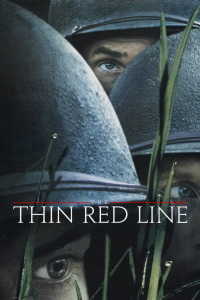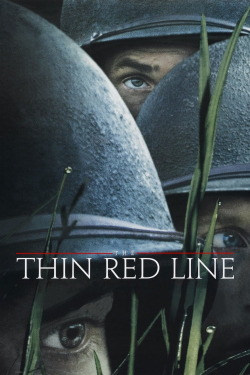
Review of The Thin Red Line (1998) by Jesse B — 01 Apr 2012
About half way through watching writer/director Terrance Malick's "The Thin Red Line", I asked myself quietly, "Does this movie really qualify as a war movie?" Well, clearly the answer is "yes," but not necessarily in the way that one might expect.
"The Thin Red Line" is set in the WWII battle of Guadalcanal Island, a pivotal event in the history of the war. Yet the goal of the film is not to reenact the battle to the degree of precision which we saw that same year of 1998 in Steven Spielberg's "Saving Private Ryan," and his D-day account. No, this is a very different depiction of war indeed. Yes, there is blood and there is something of a body count by the end, but this is just as much, if not more a film about the soul and nature of man, than the often times over emphasized spectacle of war.One of the many key themes of the film is natures war within itself. Throughout the picture we are bombarded with images of the beauty of the natural world which acts almost as a character within the story itself, waiting like a snare to eat the young soldiers up like a lion devours its prey.
This, of course, is a highly existentialist concept which is being portrayed. It is the first war film I've ever seen which takes a good 46 minutes before the first shot is ever fired. This is because it is not one of the many guts-and-glory Rambo films which we are so keenly aware. It is not about the kill, but more of what the kill actually means.
A ways into the film, a young soldier crouches in the brush, looking down the long barrel of his rifle up to the crest of a hill which is closely guarded by Japanese soldiers. After spotting a group of two or three carrying a piece of equipment across it's grassy face, he opens fire, dispensing with three or four bullets in order to pick off the one. His aim is dodgy but his spirit is relentless. The soldier falls to the ground, presumably dead. At this point we enter into the soldiers mind: "I killed a man. Worse thing you can do. Worse than rape. I killed a man, nobody can touch me for it.".
This is a constant theme which we are reminded of throughout the picture: what does war do to the soul of a man. At some point this beautiful world around us must have gone wrong, somehow. Is this the directors argument for original sin? Perhaps. All that I am aware of is that there is something disjointed in this world which is presented to us. Are these Japanese really the enemy? Or are they men, just like the American's and Allied Forces who have been placed in the middle of a situation which they would rather not be in -- afraid; alone; clinging onto the last tender bits of the conflicted hope that they have. Where does war come from? Who invented the killing of another human being? Who takes pleasure in it enough that they would game of such dire word consequence?
This movie gives us no answers. It is not our war, but a war which we watch as does the disembodied camera which floats here and there, passing like a wind over the brush. It is as if G-d is looking down upon this destruction and asking himself, "Where did things go wrong with this beautiful creation?".
Yet by its end, I found the film very life affirming. With constant speech concerning the nature of life, and good, and evil, and life after life, I could not help but feel slightly elevated. This film does not preach, it contemplates. It is not a war film, but a meditation on life and the chaos which is produced therein. This is a film which has the courage to be what it wants to be and does not have the need to please an audience, but take the time to challenge the audience. This is a very, very good movie indeed.
This review of The Thin Red Line (1998) was written by Jesse B on 01 Apr 2012.
The Thin Red Line has generally received very positive reviews.
Was this review helpful?