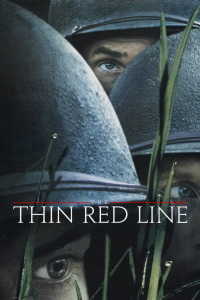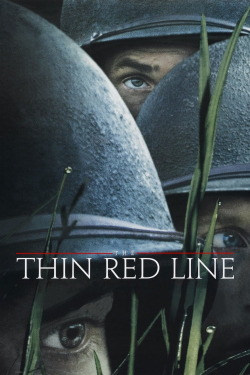
Review of The Thin Red Line (1998) by Cameron J — 19 Jul 2012
I once heard someone say that this film got on his "thin red nerve", and quite frankly, while such a statement was clever, I must that it... well, pretty much summed it up for me, because I'm not one of those critics who loves this film just because of, well, who knows? Maybe it all comes back to that critic nostalgia thing, because by the time you finish the film, you'll feel as though fifty years have passed, which is just long enough for this film to be considered a masterpiece, and I suppose it is, though only as a masterpiece of insomnia cures. I suppose that makes this film one of those medications with potentially fatal side effects, because if being bored to death is possible, then you might want to proceed with caution when watching this film, because if you pass out, when you come to, I can't gurantee that it will be red, but the last thing that you'll ever see might very well be a thin line on a monitor. No, but seriously though, this film is still actually pretty good, which is more than I can say about Terrence Malick's preceding effort (He did this film twenty years later; maybe "Days of Heaven" put even him in a coma), and I think that a huge reason why is because this film has a lot more celebrities, and more stars make everything better. Eh, maybe not, because the final cut of this film lost Billy Bob Thornton, Martin Sheen, Gary Oldman, Bill Pullman, Lukas Haas, Jason Patric, Viggo Mortensen and Mickey Rourke, because even Malick must have felt that the film was getting to be too long and slow to be saved by as many celebrities as he had. Well, in all fairness, the original cut reportedly ran for about five hours, and no amount of talented celebrities would have saved five hours of a film like this. Well, maybe it still would have been good, largely because I'm of the opinion that five hours of a film like this better be good, but also because the star-studded cast isn't this film's only high point, yet no matter how high this film hits at points, potential still goes squnadered by the simple fact that this film is just blased boring, which isn't to say that slowness is this film's only flaw, because if you thought that war dramas were preachy enough, then brother, just wait until you see Terrence Malick hop on board.
Terrence Malick has always been an overbearingly meditative filmmaker who draws much too much lyricism from the subject matter that he works with, to the point of really overwhelming things, and with this film taking on a message as heavy-handed and, of course, done-to-death as "War is Horrible", it should practically go without saying that Malick gets really carried away with this film's themes, while what is worth mentioning - being that it's not that common of an occurrence - is the fact that Malick breaks his rule of having not much more than one central theme, which is an action that's partially worth mentioning because Malick doesn't break that rule with a lot of ease. The film is particularly emphatic in its focus on such themes as spirituality, environment, humanity and fellowship, and when you toss all of that on top of the aforementioned central theme of "War is Horrible", you're left with a lot of thematic material that really could have worked, yet where Malick first slips up is in his tackling of too many themes, and messily so, to where, after a while, things become thematically uneven, with one of the only consistencies between almost all of the themes being overbearingness, as Malick really lays things on thick with his coating the film in relentless thematic meditativeness, to the point of not only creating some pretty severe cheesiness - made all the worse by a couple of moments of pretty improvable dialogue - and unsubtlety out of too much subtlety, but also to the point of drowning out the story - such as it is - behind the themes, thus leaving some of the film's messages to ring false here and there. Sure, you can say that about any Terrence Malick film, yet it's especially problematic here, as the story concept doesn't entirely warrant extremely meditative lyricism, something further made clear by the long periods in which Malick really does decide to shut up with his blasted preaching and actually tell a story, though not particularly well, as his tonal jumps between meditative and traditional storytelling are almost as messy as his jumps between character focus, and I'm a little bit surprised to say that, becase as much as all of the many "story" arcs fall into many of the same tropes, you'd think that there would be some evening consistency in the sub"plots", and yet, there's not, just a lot of "story" repetition. Whether it be because he was out of commission for two decades by the time this film came out or simply because he just doesn't know how to tell a story, Malick makes quite a few glaring mistakes in his overbearing meditativeness, yet that doesn't stop him from tainting this film with his usual pretentious arrogance that may not be terribly overbearing, yet still gets on your never after a while. Still, with all of this messy "story"telling and overbearing meditativeness, it all leads back to the main issue, which is the simple fact that film is [b][u]"just so doggone slow"[/u][/b], which is another thing that you can say about every Terrence Malick film, yet what makes it especially problematic here isn't so much because Malick is unraveling this film particularly steadily or because such slowness doesn't gel well with this "story" concept, but because, well, the film is almost [b][u]"three hours long"[/u][/b], and forcibly so, going padded out to no end by redundant, repetitious material that slows everything to a crawl, while the intense dryness of everything finally brings this film down to an overwhelmingly boring - nay - just plain tedious state, and if I'm not selling you on that enough, then pull a chair up kids, because it's story time. I've seen this film before, as my introduction to Terrence Malick, so I first went in not knowing what to expect and was admittedly pretty tired (Uh oh), and sure, I powered through to the end of this film, yet may I be struck down if I wasn't actually vividly hallucinating from exhaustion by the end, as the film really does get that excessively dry and boring, and while I have revisited this film fully awake and fully aware of what to expect from Malick, I still always find myself disappointed with how this film squanders such high potential for the sake of a, well, tedious unconventional style that just doesn't work. However, with all of my complaints - of which, there are countless -, this film's potential would not be as illuminated as it is were it not for the fact that it still boasts many strengths that may certainly belong in a better film, yet still give Malick's vision so much juice, to the point of drowning out the film's faultiness just enough for the final product to somewhat engage, if not somewhat reward by its own right, and certainly deliver more than any preceding Malick film, even as far as style is concerned.
I could never really dislike Terrence Malick, because although the man just can't keep potential or, well, anything together when it comes to telling a worthy story, he is quite undeniably a master artist (Lord knows that fact kept "Days of Heaven" from being total garbage), and while many of the obnoxiously overly nostalgiac critis hate to admit it, stylistic sensibilities have advanced considerably since Malick's disappearance in the '70s, and what we were left with by the late '90s, alone, was a filmmaking world with stylistic sensibilities more befitting to Malick's taste, so sure enough, with the help of cinematographer John Toll, Malick makes this film, if nothing else, visually stunning, with lighting and color being constantly played with over incredible imagery to create a relentless barrage of breathtaking visual artistry, which isn't to say that Malick doesn't also make this film audibly beautiful, as strange as that sounds. Malick knows how to paint a pretty motion picture, and there's no denying that this film's cinematography and art direction really do take your breath away, yet what almost calls your attention away from the visual artistry of the film is its musical artistry, for Malick has a great taste in music and really does get some great orchestral pieces for this film's soundtrack, while going as far as to bring the best music man in the movie business in to compose the original tunes this time around. Hans Zimmer might very well be my standalone favorite film score composer, so it should go without saying that this film really does deliver on the musical good will extremely high quality, for although the score is often very soberingly meditative and used to heavily exacerbated the film's slowness, it's still such a hauntingly poignant composition, with awe-inspiringly inspired grandness and emotional resonance that, when played, often keeps the film reasonably engaging and sometimes leaves the film to cut core-deep. The film is not at all the general masterpiece that the obnoxiously snooty praise it to be, yet it is, like all modern Terrence Malick films, a masterpiece of style, so much so that the style will sometimes bleed over into being viscerally gripping, as well as aesthetically, with another aspects that earns enough of your investment being, of course, the acting. The cast is bloated to the ends of the earth with stars, perhaps to an exhausting degree and certainly to an uneveningly messy degree, yet it's hard to mind this film's cast bloating too much, as most every star hits the scene reminding of us of how he got the notoriety, as most everyone is charismatic and inspired, with a distinctive presence and strong emotional range - which goes from broad, intense emoting or a subtle, thoughtful atmosphere - that keeps you locked into the film when material arises and summons some powerful shining moments of standout acting from such talents as Jim Caviezel, Adrien Brody, (There are a lot of stars, so get comfy), Nick Nolte, John Cusack, Elias Koteas, John Travolta (He's on for, like, one scene, and doesn't have anything to do, but come on, it's Travolta, so of course he's charming), Kirk Acevedo, the great Sean Penn, the great Woody Harrelson, the great Jared Leto and, of course, the underappreciated John C. Reilly (Wow, there are a lot of Johns attached to this film). Hold on, let me catch my breath, because there are so many mentionable names that I'm winded just from "typing" them out, so one can imagine what the five-hour-long extended cut's cast list would do to me (I'd rather not find out, because as much as I like watching cool long stuff, they can keep that cut). There's plenty about this film that raises standards for Terrence Malick, yet the man who really does do the most in leaving this film to stand as, not just enjoyable, but genuinely good - even with its flaws and overall potential squandering - is, well, Terrence Malick himself, believe it or not.
Certainly, direction and storytelling go hand-in-hand, yet directing and storytelling can almost easily rest on two entirely different levels, as made clear by good Terrence Malick films such as these, because where Malick is an overambitious and immensely faulty storyteller, he is a good director who may have - woah boy - a lot of flaws, yet will hit potent points in his direction where he really does leave the film to ring true. Both the aestheic value of the film is often used to further exacerbate the limpness in Malick's extremely dry storytelling, yet there are still quite a few points where Malick does manipulate the level of quality in the artistry to actually breathe life and effectiveness into this film, which isn't to say that the technical value isn't surprisingly manipulated in the same way for the same remarkable, when not, well, detrimental results. The sound design, in particular, is very broad, being used by Malick to absorb the environment and atmosphere in order to really pronounce white noise that further lulls you out amidst all of this dry tedium, yet the fact of the matter is that the sound design really does capture the depths of this world, and while you'll be left hearing more than you want to, the detail in the film's sound design really does leave this world to spring to life and pull you in at points, particularly when we get to the action. The war sequences are truly impressive, not only in their being well-concieved, well-edited and well-shot, but also in their being well-manipulated by Malick, who marries with the aesthetic and technical sides of the film together through a visceral center that plants you in this world and creates actually pretty intense moments of action, with a sharp touch of style and substance that really does keep you engaged for a golden moment. However, the golden moments in which Malick finally wakes up and delivers on undeniably genuine resonance doesn't simply end with the moments of tension, for although this film gets to be an emotional mess, with heavy-handedness, occasional unsubtlety and even some overbearing arrogance, when Malick does strike an emotional note, it rings pretty deeply, especially when it comes to the final act. The film is an absolute mess with some high points, some low points and a whole lot of points where it's respectable enough to get by as a good watch, but the final act truly is a thing of brilliance, for although this film's final moments remain plagued by the flaws that haunted the rest of the film, they're still backed with immense inspiration by Malick, so much so that everything begins to fall into place with relative comfort and thoughtful subtlety with no real arrogance or forcefulness, but instead real genuineness that wraps this film up smoothly and creates a buzzing emotional surge that pierces deep, and by the time the film cues up Zimmer's "God U Tekem Laef Blong Mi", one of his greatest compositions ever, just in time for the credits, I truly did find myself almost in tears, yet part of the reason why was because I couldn't help but think about how moments such as those deserved to be in a much better film. It was Janet Maslin of the "New York Times" who really summed things up when she said that the "heart-piercing moments that punctuate [the film's] rambling are glimpses of what a tighter film might have been", because as good as this film is, it stands to be great, and were it not so wrapped up in its tediously overbearing and pretentious artistry and overambition, make no mistake, it really would have been a general masterpiece that could very well have topped a certain other WWII dramatic epic from 1998, yet as things stand, the poignant moments are just a few of the fair deal of undeniable glowing bright spots in this film that can keep you going through thick and thin if you're willing to go with the flow, and no matter how much the film wastes potential, it ultimately rewards as a generally worthwhile experience, vastly improvable though, it may be.
At the end of the line, the film gets to be messily overbearing and even rather uneven in its themes, with a story - such as it is - that is just as messy in focus, yet that doesn't stop Terrence Malick from drenching this film in a kind of shameless arrogance, though not as much as he drenches the film in dreadfully intense dryness that, when married with the excessive padding, nothingness and overall overbearing lyricism, creates an experience that is all too often incredibly dull, overlong and altogether, well, just plain tedious, thus leaving the final product to emerge having wasted high potential, yet still not to where it collapses as a total disaster of an overambitious misfire, as the film still strikes with stunning art direction and John Toll's phenomenal photography direction, as well as with mostly cleverly manipulated technical.
This review of The Thin Red Line (1998) was written by Cameron J on 19 Jul 2012.
The Thin Red Line has generally received very positive reviews.
Was this review helpful?