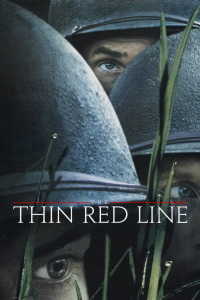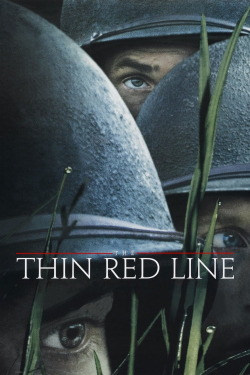
Review of The Thin Red Line (1998) by Garry M — 13 Apr 2014
"What's this war in the heart of nature?
Why does nature vie with itself?
The land contend with the sea?
Is there an avenging power in nature?
Not one power, but two?".
The Homer-esque musings of an unseen protagonist that begin The Thin Red Line, spoken against the backdrop of the Guadalcanal jungle.
It took more than a decade for Hollywood to fully digest the cinematic significance of Terrence Malick's first two films, Badlands and Days of Heaven, such was the audacity of his approach to their narratives. Culminated with an extended 20 year hiatus, Malick garnered something of a phantom mystique, and for many this was wrapped in the esteem of Hollywood's greatest filmmaking auteurs. His return to the directors chair was met with an insatiable eagerness by studio executives out to make a mark on the 1998 award season, and fortunately this allowed Malick a blank cheque for budget, cast and creative control. Anything, anywhere or anyone he wanted for his vision, he got.
The result is a profound modern allegory on war, and one of the most important pieces of American cinema ever made.
The challenge it presents to the viewer is obvious from the opening frame. Scenes are often scattered and disconnected, characters are disposable and narratively removed, and there's no definable story ark. Long philosophical voiceovers that may provide needed insight are often mumbled and overtly abstract, and flashbacks often confound more than they provide exposition.
It's a bold, daring piece of cinema that unapologetically ignores convention. And it's infinitely better for it.
Set in the World War II conflict between incumbent Japanese forces and an advancing US battalion, Malick serves as a tour guide to the internal and external tribulations of war. He draws parallels to nature and wants us to consider the significance war has for our species. What's the point of it? What does it say about us, about men?
Most war films are primarily concerned with destruction, and though The Thin Red Line has a wide spread of virtues, the battle scenes are at least as compelling as any I've seen. Long panning shots take us deep into the thick of violence, gliding in and out of explosions and gunfire alongside frantic soldiers more desperate to survive than to kill. In one scene, two of them advance up a hill to scout an area and are suddenly shot by an unseen enemy. Once they fall, all becomes quiet, and the remaining troops look on with a fearful apprehension. Cloud cover clears and sunlight slowly sweeps across the hillside where they were once standing. All is quiet, and the contrasting beauty makes the statement that much more profound.
Malick isn't just a filmmaker, he's a philosophical poet. We may find difficulty in accessing his message at the literal level, particularly on a first viewing, but it's hard to deny the emotional power and beauty of his presentation. Removed from plot, the combination of narrative lyricism, visual poetry and Hans Zimmer's unbelievably powerful score makes the work feel more like a meditation than a movie.
"What difference do you think you can make, one single man in all this madness? If you die, it's gonna be for nothing. There's not some other world out there where everything's gonna be okay.
There's just this world. Just this rock".
Sergeant Welsh's short but classic speech to Private Witt amidst a desecrated battlefield is perhaps the most telling of all.
The eloquent and thoughtful monologues of the cast have been subject to criticism, with many feeling them to be unrealistically deep-thinking for young soldiers, so I want you to consider the alternative: If you were really sent to war, to kill other people you've never met, and find yourself under the imminent threat of death, what would be going through your head? Really think about it. What psychological impact would war have on you?
It's important to remember the film is set in 1942 - long before our use of the English language was degradated by SMS and online social media, when being articulate was a basic skill rather than a sign of intelligence. The film was first introduced to me by a veteran of the Vietnam war, and like many real soldiers of earlier eras, he said it was more representative of the turmoils they faced than anything else he'd seen.
Conscripted warfare isn't full of cigar-smoking patriots with their chests puffed out, it's full of fearful and conflicted men being forced to directly face their own mortality.
The Thin Red Line is a meditative commentary on our darkest behaviour painted over a canvas of nature and human existentialism. Aesthetically beautiful, emotionally charged and thematically profound, it's more than a masterpiece of cinema, it's a masterpiece of our culture.
This review of The Thin Red Line (1998) was written by Garry M on 13 Apr 2014.
The Thin Red Line has generally received very positive reviews.
Was this review helpful?