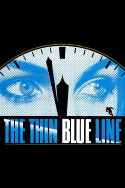
Review of The Thin Blue Line (1988) by James M — 13 Feb 2011
From a desolate prison cell, Randall Adams explains âYou get numb. Itâ(TM)s like a bad dream. You want to wake up, but you just canâ(TM)t do it." The lack of emotions in his delivery contrasted with tightening cutaways of an electric chair accentuate the vigor of Morrisâ(TM) ambitions and the grave severity of the subject matter: this man is going to be executed for a crime he did not commit. Though it may seem a daunting task to indict and overturn a ruling that the Supreme Court had already unsuccessfully attempted to retry, Morrisâ(TM) film is indeed directly responsible for the subsequent release of Randall Adams. From foreshadowing and subtle character development to dramatic reenactments and subtextual stock footage, the film collectively utilizes a vast amount of plot devices within the classical narrative structure, hence the reasoning that Morris called this film ânonfictionâ? rather than a âdocumentaryâ? upon its release. Morris astutely realized the importance of making The Thin Blue Line accessible to moviegoers who are more interested with film as a form of escapism rather than education, thus the filmâ(TM)s story structure follows an engaging narrative. Given the universal acclaim and judiciary response to Morrisâ(TM) powerhouse, perhaps sheer enjoyment is more necessary than purely didactic documentation for broader acknowledgment and reactionary intervention. The Thin Blue Line exemplifies the encompassing aptitudes of film, the radical influence that a pleasurable narrative with investigative sincerity can invoke.
Morris chooses a directorial method that attempts to distract the viewer from his own artistic intervention. While he is never heard or pictured onscreen, it is clear that he has chosen a side from which to support. The way in which Morris develops this support is gradual and monolithic, mysteriously presented out of chronological order and with interviews from all three combating sides: Randall Adams, the accused; David Harris, the actual culprit; and the incompetent police academy responsible for the mix-up. The opening act sees each party represented equally so that the audience is to believe that the film is mostly unbiased. As the film progresses, however, we see an emphasized credence for Adamsâ(TM) accounts that develops within a narrative structure surreptitiously crafted by Morris.
To further gain the trust of his audience, Morris cleverly goes into detail about David Harrisâ(TM) past and represents him sympathetically and relatable (even though he confesses to two murders throughout the film). The viewer is thus more trusting of Harrisâ(TM) recollections when he eventually corroborates Adamsâ(TM) side of the story and claims that he âonly told the police what they wanted to hear,â? when first testifying that Adams was the actual assailant. In this sense, the villain becomes the court system and the wheels of the American judiciary machine more so than even the murderer himself. By choosing to vindicate the courts and police academy while portraying Harris as mostly insane and incapable of understanding the severity of his violent crimes, Morris deftly appeals to the proletariatâ(TM)s âus verses themâ? mindset to further underscore the injustices that have befallen Randall Adams.
Though mostly subtle and purposely hidden from the viewer, the methods in which this injustice is underscored are multitudinous and become more abundant as Morrisâ(TM) narrative begins putting the puzzling pieces of the crime together. While the swelling musical score seems to be constantly foreboding and vigilant, it is actually omitted during interviews with the police academy and court officials involved with the case. The lack of music ingeniously represents their lack of apology while also making their ignorance and incompetence more egregious. Antithetically, evidential accompaniments are intercut with Randall Adamsâ(TM) interviews to corroborate his explanations and stories, from close-ups of TV Guide listings and newspaper quotes to written testimonies and police reports. More importantly, the viewer is only allotted clear reenactments of the actual murder when Randall Adams is the one describing it, as accounts from David Harris and the police are more hazy and ambiguous. The audience is subconsciously siding with Adamsâ(TM) point of view, following his gaze as the protagonist in Morrisâ(TM) narrative.
It is noteworthy that The Thin Blue Line is the first form of video media to use such reenactments for a crime. This dramatic style of eerie representation has been emulated ever since, now being a staple for murder-mystery television shows like Unsolved Mysteries and The Forensic Files. Unfortunately, the overly presentational style of acting in these reenactments is just as prevalent in The Thin Blue Line as it is in such television shows. Still, the reenactments create an ongoing narrative that the film follows to lure the viewerâ(TM)s attention, each reenactment progressing in length as more facts are uncovered on the crime and illustrated through details from the interviewees. The viewer thus feels apart of the investigative search for clarity and is gradually allotted snippets of the crimeâ(TM)s intricacies so that closure becomes increasingly insatiable and addictive.
To make the narrative even more satisfying, Morris draws from classical plot structures to add suspenseful interest to the plot. After the correct car from the crime is discovered in the second act of The Thin Blue Line, the viewer learns that the brake lights that were repeatedly shown with close-ups throughout the search were actually foreshadowed images of the officerâ(TM)s mistaken recount of the vehicle. The usage of such foreshadowing, as well as the jumping between time frames (from the night and preceding days of the crime to the investigation and trials after the crime), adds a distinctive mystery to the onscreen clues that demands the viewerâ(TM)s devotion to the narrative in order for thematic resolution.
Morris also chooses to omit title cards and formal introductions for the characters so that the audienceâ(TM)s attention is obligatory in order to figure out who this person is and how they fit into the narrative (as well as avoiding any distractive self reflexivity for the viewer, as that may suggest further artistic intervention from Morris). Oftentimes the characters will talk at great lengths on a technicality involved with the crime before their identity and relationship to the investigation is ever even hinted at. While some characters ultimately are either too nebulous (the third eye-witness who garbles about cheating on his wife) or unnecessarily overdeveloped (Dr. James Grigson and the other two eye-witnesses), the ambiguity of their initial presences creates a suspenseful distrust with the viewer. The viewer must constantly consider the subjectâ(TM)s stakes in the manner and thus negotiate a compromised understanding of their accounts.
These methods of visual storytelling make Morrisâ(TM) b-roll footage (shots of the surrounding areas that are inconsequential) seem far less arbitrary than the usual excesses of stock footage in most documentary films. By incorporating visual cues into his narrative and accenting them with Philip Glassâ(TM) ominous score, Morris encourages the audience to attach metaphorical meaning to his cutaways of inanimate objects and scenery. Stagnant shots of the ambivalent business buildings in downtown Dallas are intercut with Randal Addamsâ(TM) lonely, defeated interviews as if to punctuate the cosmic indifference of the âreal worldâ? outside of prison, the lack of response and attention that cases like these receive in our utilitarian society. More practical visual metaphors are occasionally seen as well, such as the dramatic spilling of a milkshake to represent Robert Woodâ(TM)s murder, or the pendulous swinging of a pocket watch to mirror the dwindling days before Randall Adamsâ(TM) execution. The transitions of these images feel awkwardly truncated sometimes, as the screen will occasionally fade to black to close a segment before the audio track completes. There are a number of other spotty sound bites that reoccur, but sound-editing issues are generally common in documentary films and sometimes are intentional to enhance their realist demeanor and gritty investigative journalism.
The hybridization of investigative journalism and narrative cinema is what ultimately defines The Thin Blue Line. Not unlike fictional filmmakers, Errol Morris went into this project with something provocative to say and created a narrative vehicle to dramatically say it. It has been argued that The Thin Blue Line is one of the most socially significant films ever made, as it presented testimonies and confessions that were never heard prior to its release and, admitted by the courts themselves, would later be directly responsible for Randall Adamsâ(TM) release. Many documentary filmmakers have since cited Morris as their primary inspiration, so The Thin Blue Line can also be credited for indirectly inciting other changes provoked through cinematic acknowledgment. While Morrisâ(TM) name has gone on to epitomize the documentary filmmaker, there is a reason The Guardian magazine recently listed him as the seventh best filmmaker in the world; his films are more than just documentations. Like The Thin Blue Line, they are challenging and calculated, provocative yet intentionally subliminal, all within the narrative umbrella. Obviously there is no standardized formula on how to incite change, but perhaps The Thin Blue Line proves that no system is beyond inspection and no cause is devoid of a narrative capacity; that change is at least palpable.
This review of The Thin Blue Line (1988) was written by James M on 13 Feb 2011.
The Thin Blue Line has generally received very positive reviews.
Was this review helpful?