Review of The Thin Blue Line (1988) by Burak A — 30 Oct 2013
Truth Out of Fiction: The Thin Blue Line.
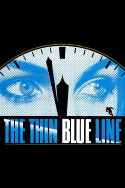
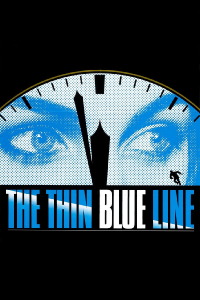
The Documentary film, The Thin Blue Line, reveals the murder of a policeman named Robert Wood. Homicide took place just after Thanksgiving on 27th of December 1976 in Dallas. There are two primary suspects for the murder. One of them is Randall Adams and the other is David Harris. In the film, we see series of interviews with Randall Adams, David Harris, trial judge, attorneys of the client and witnesses. Beside interviews, there are reenactments of the important events about the murder based on the account of the witnesses and suspects. The Director of the film, Errol Morris, pursues the truth in which he interferes with the documentary as much as needed through employment of some cinematographic properties like sound and mise-en-scene.
The movie starts with interviews with Randall Adams and David Harris. We see their accounts of the incident. That is they explain what happened before the incident. Then we step into reenactment of the murder scene based on their accounts. After that, there are three primary events in the documentary. First, we follow the police's investigation. We see number of interviews with police officers. Based on their evidence, we see reenactments of the crime scene. Secondly, we focus on the prosecution of the one of the suspects. In this part, we see interviews with attorneys of the client, trial judge and witnesses. In the third part, we focus on one of the suspect's life. We, again, encounter interviews with suspects and police officers. Throughout the film, the director presents reenactments of the crime scene depending on the revealed new evidence. In this way, through interviews and reenactments, the director investigates who is innocent or guilty.
The filmmaker employs sounds to provoke emotions that make audience skeptical about the truth of the murder. Those are generally non-diegetic sounds which imply filmmaker's direct involvement with the film. One instance of those sounds being used is when one of the primary suspects of the murder is sentenced to death row. When he is sentenced to death row, the filmmaker cuts to an electric chair and sound starts off. Sound is a devastating music at that scene. It is as if something terrible is going to happen. In the shot we see electric chair. We start from the top of the chair and camera tilts down to bottom of the chair. In this scene, music and the shot complement each other. The music pattern is AB at the start. The volume of the music is high. Within AB, we hear the sound of French horn, which dramatizes the situation. These sounds convey that electric chair would be devastating for a person whose guilt is not fully proven. The director, then, cuts into an interview with the convicted suspect. In the background, the AB pattern of the music still remains but with much less volume. Instead we hear piano music overtly, which dramatizes the situation without interfering with the speech of interviewee. All in all, those sounds make us feel that something that isn't fair going to happen. Now, we feel that an innocent man is going to be executed without complete evidence. Since we feel in this way, filmmaker directs us to a direction, which is his verdict of the murder.
Reenactments are solid visual images that help viewers to imagine what happened at the real time. Throughout the film, there are many staged creations of the murder scene all of which is depicted through different people's account. These are edited very much like parallel editing. Instead, simultaneous events at different location, we have an account and we go directly to the reenactment of the event. This technique of editing improves what we visualize from the interview. For example, when we encounter with the first witnesses interview, we see a reenactment of the murder based on her account. She tells that it was very dark and cold. The director cuts into crime scene which is totally dark. She tells that driver's window was rolled down, the director cuts into crime scene where, within complete dark, we see the open window. She describes what she saw in the car. The director cuts into car and depicts what she described. The director creates those reenactments without any distortion of accounts. In this way, he adds a vivid picture of the interviews through editing and mise-en-scene.
The filmmaker's sole purpose in the film is to show who is innocent and who is guilty. Although there are some glimpses of miscarriage of justice in the film, it does not deal with anything but truth. As Linda Williams put forth it, "What we see in The Thin Blue Line and Shoah, and to some degree in the other documentaries I have mentioned, is an interest in constructing truths to dispel pernicious fictions, even though these truths are relative and contingent"(9). As Linda Williams states, in this film, Errol Morris constructs a truth through interviews and reenactments. It isn't important which fictional techniques he employs in his documentary. Important idea is he shows the truth with valid arguments, which is filmmaker's purpose in the film.
All in all, The Thin Blue Line is a great documentary especially for the ones who like mystery, detective stories and puzzle. As a documentary film, The Thin Blue Line is my favorite. If you are looking for a mystery or a detective story, you shouldn't miss this film. When I first watch the film, it seemed to be a bit complex. It was difficult for me to solve the links between the scenes. At first half an hour, it really bored me because events were seemingly not related to each other. Therefore be patient while you are watching the film. It would worth to be patient. After that half an hour, it really strikes you and draws you in. When I watched it again, it was more enjoyable because I could link the scenes more easily and make more sense out of the film. For this reason, I recommend to viewers that watch this documentary twice. At some point, I got bored with the reenactments, because there are many of them throughout the film. Except those weaknesses, which can be applicable just for me, The Thin Blue Line needs to be on your list to watch.
Works Cited.
The Thin Blue Line. Dir. Errol Morris, American Playhouse & Miramax Films, 1988. Documentary.
Williams, Linda. "Mirrors without Memories Truth, History and The Thin Blue Line" 1993. PDF file.
This review of The Thin Blue Line (1988) was written by Burak A on 30 Oct 2013.
The Thin Blue Line has generally received very positive reviews.
Was this review helpful?