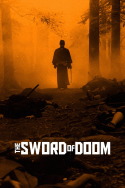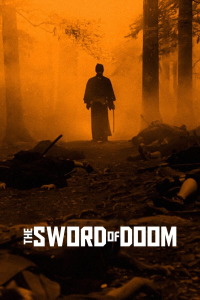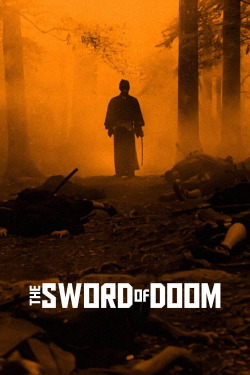
Review of The Sword of Doom (1966) by Eric F — 14 Aug 2009
"An evil sword is an evil soul.".
"The Sword of Doom" is the 1966 epic by Kihachi Okamoto, based on a novel by Kaizan Nakazato which, at the time, was considered to be the largest novel in Japan. The film comes to a strange conclusion, leaving many threads in the plot untouched. It was originally intended to be a three-part trilogy, but the sequels were never made. Instead, the bizarre conclusion is instead the violent slaughter of seemingly hundreds by the film's deranged samurai.
Taking place in 19th century Japan, the film focuses on a lone samurai warrior, Ryunosuke Tsukue (Tatsuya Nakadi), a master swordsman who has adapted a style of his own. Early on, without reason, Ryunosuke murders an old man praying on a mountain pass. His daughter, Omatsu (Yoko Naito), discovers the body not long after.
Ryunosuke is to compete in an upcoming tournament, and his first round opponent is Bunnjo Utuski (Ichiro Nakaya). Bunnjo's young wife, Ohama (Michiyo Aratama), sleeps with Ryunosuke in order for him to take the fall and retain Bunnjo's pride. Instead, however, Bunnjo learns of his wife's plot and tries to kill Ryunosuke during the match for sleeping with her. Ryunosuke kills him instead, and takes his place as the caregiver for Ohama and her child.
Bunnjo's brother is Hyoma (Yuzo Kayama), who wants revenge on Ryunosuke following Bunnjo's death. He trains under one of the most talented swordsman in Japan, Shimada (Toshiro Mifune), who teaches Bunnjo several finishing blows for their eventual conflict. Ryunosuke doubts his talents when he sees Shimada slay a handful of gang members in a botched assassination.
In the film's chilling climax, Ryunosuke becomes haunted by the ghosts of those he killed. They surround him in his room, and in a nearly-ten minute scene he starts slashing at the ghosts, the walls, and finally his fellow gang members. The actual bloodshed is more implied than extravagant, but the level of violence surpasses almost anything.
The film, despite having a number of surprising turns, is easy to follow and very involving. Each performance is a good one, and the cinematography is especially memorable. Despite having such an odd conclusion that leaves so many gaps in the story, it remains a fascinating and completely unique samurai film.
This review of The Sword of Doom (1966) was written by Eric F on 14 Aug 2009.
The Sword of Doom has generally received very positive reviews.
Was this review helpful?