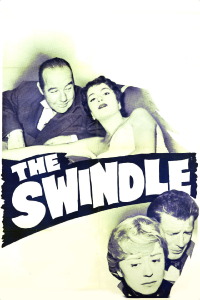
Review of The Swindle (1955) by Budge B — 13 Apr 2009
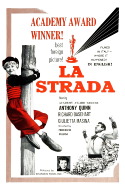
"Il Bidone" ('The Swindle') is the second in Fellini's so-called trilogy of loneliness ('La Strada' and 'Le Notti di Cabiria' are the other two). Often dismissed as one of Fellini's lesser works, "Il Bidone" is a thoroughly engaging gangster film with a moral. Shot in black and white and released in 1955, its opening nevertheless captures the feel and texture of a 1930's Cagney or Edward G. Robinson movie. The setting is clearly post-war Italy, undergoing the economic uncertainty of reconstruction, but the 1930's echoes establish a timelessness to the story.
Broderick Crawford, an American actor who appeared in numerous 'B' movies before making his name in the television series, 'Highway Patrol', plays Augusto, a middle aged conman who preys upon the gullibility of the peasants and urban poor. Dressed as a Church dignitary, or playing the part of an a rich man or a State functionary, he dupes the poor of their savings as Fellini makes the obvious point about the victimisation of the poor by Church, State, and aristocracy.
But Augusto is troubled. He appreciates the emptiness of his life ... or at least his vulnerability. He has no savings, no real home, no friends he can trust. He can only envy others. He has no pension plan, no savings, no prospects of any way of life other than duplicity and conning others out of their money. His prospects seem restricted to imprisonment and death in poverty. He tries to delude himself that he is happy, that he is in control; he lives a life of bonhomie, drinking and carousing all night, constantly searching for the next trick by which to rob the poor. Then his daughter re-enters his life, bringing into perspective the emptiness and loneliness of his existence.
Fellini contrasts the decadence and materialism of the upper classes, the amoral hedonism of the underworld, and the gullible honesty and backbreaking work of the peasants and industrial classes. Augusto is a parasite, but no more so than the Church or State or decaying nobility. Is change possible? Can the conman find redemption? He can certainly recognise the idealism and hope portrayed by Richard Basehart as his co-conspirator, Carlo, a man who aspires to be an artist. But Augusto can also recognise that the world he inhabits is morally bankrupt, and he frankly lacks the skills or experience to change, to find his own salvation.
Crawford and Basehart had their lines dubbed in Italian, but they both deliver charismatic performances. Fellini apparently struggled to manage Crawford, whose drinking caused daily problems on set. But the performance is directed with compassion and energy as Broderick Crawford portrays a big man whose age and emotions leave him vulnerable and exposed. He warns Carlo that he must choose between crime and family life, warns him not to make the mistakes he has. Is Carlo the Augusto of twenty years ago? A man with ideals, a man with an imagined future?
But the Augusto of today must paint his future with a very limited palette. He watches his other criminal colleague, Roberto, a man with no morals and a hedonistic pleasure in duping and robbing others, and he recognises that he is not like this any more. The scene is set for epiphany ... but Fellini delivers us enigma. Is Augusto finally able to deliver up a selfless act ... or is it wholly self-centred and motivated by his own delusions that he can con anyone?
A commentary on the morality of Roman society, a generous tribute to American gangster movies, and a wonderfully observed, humanistic study of loneliness and disillusion, this is a well-plotted, evenly paced film in which the character of Augusto is ruthlessly exposed and dissected. Not normally recognised as one of Fellini's major works, "Il Bidone" is nevertheless a thoroughly engaging and entertaining film which deserves better respect and attention than it has received. Highly recommended!
This review of The Swindle (1955) was written by Budge B on 13 Apr 2009.
The Swindle has generally received very positive reviews.
Was this review helpful?