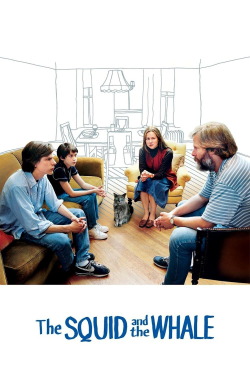
Review of The Squid and the Whale (2005) by Daniel M — 24 Sep 2010
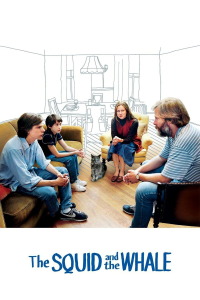
Ordinary People has got a lot to answer for. Ever since Robert Redfordâ??s terribly smug debut won the Best Picture Oscar in 1980, there have been a string of films from Hollywood which consist of rich, successful people complaining about how hard it is being rich and successful. But very few of these films are as annoying, or grating or wretchedly self-obsessed as Noah Baumbachâ??s The Squid and the Whale.
To give credit where itâ??s due, The Squid and the Whale is technically well-directed for a film of its size and budget. The lighting is decent, the camerawork is fairly professional and the sound quality is okay. You clearly arenâ??t just watching a collection of home videos with all the colours drained out in a desperate bid to look arty. And the film does manage to evoke its period setting rather well: there arenâ??t any obvious errors in the cultural references, and the costumes do look the part.
But really, you know youâ??ve got a stinker on your hands when a film billed as a gripping family drama can only be praised for its lighting and costumes. If you want a film thatâ??s technically well-shot and evokes its 1980s period setting, go back and watch Back to the Future, or Gregoryâ??s Girl, or if youâ??re really desperate, Dirty Dancing.
Whereas these films gave us families which felt genuine, with characters you wanted to spend time with, The Squid and the Whale has you hating the characters after ten minutes and the relationship goes downhill from there. Waltâ??s family of uptight, pretentious pseudo-intellectuals never stop complaining about how difficult their lives are â?? despite the fact they have enough money to rent two houses, can afford to send their kids to nice schools, and live in one of the richest parts of New York City. When Laura Linneyâ??s mother gets published in The New Yorker, she reacts with all the enthusiasm of someone who found some chewing gum on her shoe.
It is perfectly possible to make films about characters that are completely detached from the real world and make their stories interesting or compelling. On the one hand, we have all the best work of Woody Allen or Nicole Holofcener, who peel through the neurotic anxiety of the American elite to produce genuinely moving and poignant drama. On the other hand, we have something like Savage Grace, which uses the distance of its characters to savage the lifestyle which produced them, using Barbara Baekelandâ??s mental and sexual decay to illustrate the horrors of a world governed by limitless wealth and limited responsibilities.
But because the story of The Squid and the Whale is semi-autobiographical, Baumbach actively celebrates the artistic detachment of his adolescence. Jesse Eisenberg, clearing standing in for Baumbach, is the annoying intellectual kid who spouts off nonsense about Kafka and Fitzgerald having never read a damn thing by either. He has the arrogance to pretend that he wrote Pink Floydâ??s â??Hey Youâ??, explaining to the schoolâ??s psychiatrist that he was good enough to write it, and the fact that it was already written was â??a technicalityâ??. For all the arrogance that surrounds The Wall, and all the flaws with Alan Parkerâ??s adaptation, Pink Floydâ??s work has acres more to say about the traumas of growing up than this self-indulgent piece of waffle.
Having already wrecked a great Pink Floyd song, the film proceeds to trash a couple of other great works. At one point Walt and his dad go to a screening of David Lynchâ??s Blue Velvet; we are shown the climactic scene in which Dorothy Vallens turns up naked at Jeffrey Beaumontâ??s house, shocking his girlfriend Sandy and frightening the life out of the rest of us.
That would be fine, but as the following scenes play out it becomes clear that Baumbach is trying to stage his own version of Blue Velvet. Sophie, Waltâ??s girlfriend, is the safe refuge that Sandy is to Jeffrey, while Anna Paquinâ??s student is the darker-haired, more risky option that Dorothy represents. The fact that Walt ditches Sophie later in the film is a smug attempt by Baumbach, not just to put him up there with one of Americaâ??s greatest directors, but to point out where he went wrong in the process. Add in a backhanded reference to the Eraserhead baby and you get one very irritated film fan.
The dialogue in The Squid and the Whale is just as irritating and off-putting as the actors who deliver it. Almost every line could be construed as a snooty put-down, and the family has a very low opinion of anyone who is neither a family member or a writer of some kind. Bernard keeps telling his son Frank that he shouldnâ??t aspire to be a tennis player. He calls his tutor a philistine, and when asked what that means, he answers: â??a guy who doesnâ??t care about books or interesting movies and things.â?? Later, he uses his last moments before being loaded into an ambulance to call his wife a bitch, and decry her reservations about Jean-Luc Godardâ??s A Bout de Souffle.
In the midst of all this hoity-toity bitch-slapping, the film attempts to play to a broader crowd by introducing bawdy subplots about the boysâ?? emerging sexuality. Walt gets a hand-job off-screen from Sophie and apologises for â??finishingâ?? so quickly, while Frank humps a shelf and smears his locker and library books with semen. At least when Porkyâ??s or Lemon Popsicle tried such gross-out nonsense, it was within a deeply adolescent context, and could at least be tolerated as being within the expected tone. In a film like The Squid and the Whale, which tries desperately to prove how clever and sophisticated it is, itâ??s completely misjudged and deeply embarrassing.
On top of all that, the film lacks any positive depictions of women. Joan Berkman, played by Laura Linney, has abuse heaped on her throughout; her eldest son likens their home to a brothel and blames all their problems on her. We also have to believe that someone as beautiful and intelligent as Anna Paquin (Rogue from the X-Men movies) would be instantly attracted to Jeff Danielâ??s ageing, arrogant lothario.
Girlfriends come and go as the men please, and Sophieâ??s affections are rebuffed by Waltâ??s constant desire to seem on a higher intellectual plane.
The bottom line in all of this is: why would you want to spend time with these people? Why would you want to spend time with characters who do nothing but argue, moan and complain about things which are either irrelevant or insignificant? Film reviewers spend years of their lives persuading people to be adventurous with their film choices, choosing films which donâ??t reflect their circumstances but which might appeal on a higher level. The Squid and the Whale is the kind of film that would make people reconsider, lower their expectations in life, and go back to watching Michael Bay â?? because hey, sometimes stuff blowing up is more entertaining.
The Squid and the Whale is one of the smuggest, most self-satisfied films in living memory. It seems to have been made entirely for the intellectual has-beens it depicts, which probably explains its level of acclaim in America. For the rest of us, who canâ??t sit around complaining all day, it has nothing which is remotely engaging, or relevant, or emotionally involving: it doesnâ??t even have a proper ending. Like its characters, it has a bunch of ideas, none of which are its own, but no heart and very little soul.
This review of The Squid and the Whale (2005) was written by Daniel M on 24 Sep 2010.
The Squid and the Whale has generally received very positive reviews.
Was this review helpful?