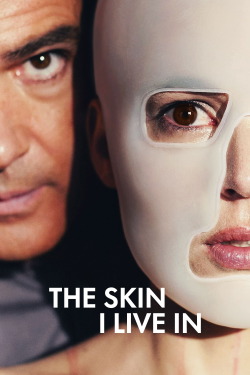
Review of The Skin I Live In (2011) by Harry W — 28 Feb 2016
Bringing Pedro Almodovar back together with Antonio Banderas, The Skin I Live In sounded like a promising contemporary vision from the director.
The plot structure in The Skin I Live In is brilliant. The film begins by introducing viewers to many strange characters and situations while maintaining enough genuine drama to keep them intrigued and determined to keep watching before later taking a trip back through time to explore the context of the story. It the film wasn't interesting enough before, by that point it most definitely is. Bringing back themes explored in Pedro Almodovar's prior films, The Skin I Live In touches upon concepts such as body transplants which he touched upon in The Flower of My Secret (1995) and All About My Mother (1999). It's a major plot device used as a means of establishing artistic imagery and the mindset of the main characters. Yet the familiarity of the themes hardly replicates his prior work since he takes a completely different approach this time around. Having spent years refining his style as a director, The Skin I Live In displays that the man has lost none of his talent. For me, I consider it to have only increased with his many years behind the camera.
What's more impressive is the fact that Pedro Almodovar brings back his fondness for exploring transgender characters and puts it into the context of a psychological thriller. Amid the current trend of body horror films along the lines of The Human Centipede trilogy (2010-2015) or Tusk (2014), The Skin I Live In offers a more realistic look into the premise within the context of a character-driven psychological thriller. The horror in it doesn't rely on jump scares, screams or grotesque imagery but simply the reality of the situation. The film focuses on the psychology of its characters while using subtle imagery to build atmosphere. It is a very much in-depth film which goes to a new level of edge for Pedro Almodovar within the context of a new genre while retaining many of the themes he is iconic for, creating a balance between what fans have grown to love about the director while fulfilling their desire to see him innovate himself. Since The Skin I Live in fuses both so brilliantly, I consider it to be the director's finest work to date.
The scope of the narrative is much smaller and offers Pedro Almodovar a chance to fit many themes into a more confined story. But to ensure that he doesn't come up short on anything, the running time for The Skin I Live In ultimately reaches for two hours. This gives him more than enough time to explore his profound vision without stretching things on for too long. There are some occasional moments where the heavy reliance on thematic implications prove to drag things on at a rather slow pace, but most of the film is a richly atmospheric and engaging psychological thriller which provides insight into just how deep the rabbit hole of Pedro Almodovar's mind goes.
From a stylish perspective, The Skin I Live In is still a brilliant experience. The life in the scenery is brought out by a colour scheme which is able to turn the monochromatic colours into brightness, maintaining both a grim nature and a touch of spirit at the same time. The cinematography captures this all with brilliant grip over the atmosphere, finding claustrophobia in its technique during the more intense moments while capturing a larger spectacle of things at scenes which really require a larger feeling of context to be established. The musical score helps to add the same effect to the ears of viewers, effectively reaching all the major senses.
After years spent building up a larger-than-life Hollywood persona in predominantly action films, The Skin I Live In offers Antonio Banderas an opportunity to return to his roots in terms of native language and collaborating with Pedro Almodovar. In the perfect role for him, Antonio Banderas is given a chance to divert the hard edge he has depicted in his many action films into the role of a vengeful surgeon. Capturing the insane nature of the character on a subtle level while conveying the passionate genius of the man. Whether or not to sympathise with him is one of the great complexities of the narrative, but whatever side the audiences chooses they can definitely admit that Antonio Banderas supplies one hell of a performance. I would go so far as to call it the best role of his career, a role which capitalizes on what he is best at while pushing him to break new ground. In the same manner of thematic exploration Pedro Almodovar takes on the entire film, Antonio Banderas finds a brilliant balance between hopes and expectations. Antonio Banderas hits a career highlight in his post-Hollywood heyday and shows just how truly impressive his acting talents are, as well as how much more he still has to offer.
Jan Cornet delivers a strong effort as Vincente Guillen Pineiro. Capturing a selfish and careless nature in the beginning, Jan Cornet progressively fuels his role more and more with fear and anxiety which makes him slowly a more sympathetic character. The deeper he seeps into the narrative, the more the character gets lost in his own psyche before transitioning into a woman and being played by Elena Anaya. Elena Anaya manages to continue on what Jan Cornet has built and convey it to viewers all through the simplicity of her facial expressions. It's made better by the quality of her line delivery with its sense of mystique. Jan Cornet and Elena Anaya contribute brilliant performances to The Skin I Live In, and both work brilliantly alongside Antonio Banderas.
The Skin I Live In can occasionally be a rather slow film, but Pedro Almodovar's brilliant grip over the depth of its themes and maintaining the intensity of its atmosphere brings out a rich and engaging psychological thriller bolstered by the finest acting talents of Antonio Banderas.
This review of The Skin I Live In (2011) was written by Harry W on 28 Feb 2016.
The Skin I Live In has generally received very positive reviews.
Was this review helpful?