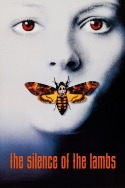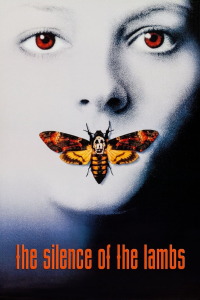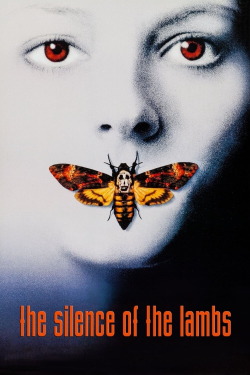
Review of The Silence of the Lambs (1991) by Blake P — 21 Sep 2015
The sign of a good horror movie is to leave the theater looking over one's shoulder in meager paranoia. "Psycho" (1960) left the viewer hesitant to take a shower, to go to small town motels, to enter basements; "Halloween" (1978) made one want to check the backseat of their car with lightening quick speed before driving away into the night. As a cinephile only willing to find his adrenaline helpings within the constraints of film, there's nothing I like more than to turn into a laughable nervous wreck following a better-than-usual thriller. I like to look under my bed to check for maleficent monsters like a six-year-old; I like to bolt up to my bedroom and lock my door to ensure that harm cannot reach me; I like when my pet cat appears out of nowhere and causes me to think that, maybe for a second, Norman Bates, Michael Myers, or Hannibal Lecter, is standing before me, ready to make me their next victim. It's not so much that I get a thrill out of blatant, high anxiety; it's the thrill of knowing that I've just watched a successfully frightening movie, that I can turn back to it again and again without it losing its initial disturbances. A license to thrill never expires.
You don't need me to tell you that "The Silence of the Lambs" is among the finest horror films ever released. It was the very first straight chiller to sweep the Oscars, winning in all five major categories. Hannibal Lecter was named the most iconic villain in film history by the American Film Institute. Today, not a horror top-ten list goes by without its name making an expected arrival. And yet, it is timeless, so completely in touch with our fears (we don't have to be a former patient of Lecter nor a stocky young woman fixated on by Buffalo Bill to be frightened by them) that we can't help but notice that it burrows under our skin and finds a new, permanent home there - a mere mention of its name can conjure flashes of its high danger ambience.
It tells now famous story of Clarice Starling (Jodie Foster), an FBI trainee tasked with profiling brilliant serial murderer Hannibal Lecter (Anthony Hopkins) in hopes to gather insight on Buffalo Bill (Ted Levine), a deranged madman growing increasingly infamous for his slayings and skinnings of plus-sized young women. At first, Lecter brutally reverses Starling's analytical advances - but after a fellow prisoner is "discourteous" to her (Lecter, for a psychopath, is obsessive when it comes to a polite demeanor), he decides to help her, in ways more cryptic than one would hope for. But in a situation so dire, enigmatic clues are better than nothing. And when Catherine Martin (Brooke Smith), the daughter of a senator (Diane Baker), is kidnapped by Bill, Lecter may be the FBI's only hope in tracking her before it's too late.
"The Silence of the Lambs" wasn't the first time Hannibal Lecter was introduced to audiences - that would be Michael Mann's "Manhunter" (1986) - but the film isn't so much about Lecter himself as it is about Lecter and Starling, and how their unconventional partnership rings with a terror and intrigue that ultimately cements "The Silence of the Lambs" as a spellbinding horror show. It lives in a downtrodden world where murderers are kept at close quarters and terror roams freely - and in a true crime sort of way, we can't help but become fixated on the macabre plot twists and unraveling of clues.
Ted Tally's screenplay, fraught with suspense and convincing in its each and every characterization, effortlessly hypnotizes the audience into becoming dangerously involved in the plot, so much so that the simple (and expected) act of closing one's eyes during the most adrenaline focused of scenes turns into an unmistakable impossibility - who knows what thrilling delicacy we would miss in the blackout? Jonathan Demme's haunting direction is as iconically extraordinary; he doesn't so much follow his actors as he does watch them, as if he knows the truth about their fates but refuses to tell them. Just look at the final interrogation between Lecter and Starling - notice how Lecter challenges his verbal opponent to confess her biggest childhood trauma, the camera zooming closer and closer to his face as the questions grow progressively confrontational, while cuts to Starling remain steady, far away. From Starling's point-of-view, the criminal is reaching into her soul, closing in on her most kept secret. But Lecter, emotionless and eager to tear someone down, sees Starling at a distance, only willing to look at her as a piece of meat he can fry with a mere series of vicious words. Most of the camerawork in "The Silence of the Lambs" is like this - looking directly at faces of the characters, it concentrates on their expressions like an analytical psychologist, noticing every wrinkle, every twitch, as if to disintegrate the walls they have emotionally set up for themselves.
Comparably remarkable are the performances of Anthony Hopkins and Jodie Foster, who one could say give their career defining characterizations here if they didn't have such outstanding careers to begin with. Hopkins pulls off the impossible and makes a monster likable; his immaculate manners (notice how he stands erect before Foster even descends upon his prison cell, as if waiting to present her to guests at a dinner party) make him such an eccentric charmer that the true terror (before, we're solely creeped out) we should feel when confronted by him only becomes apparent when he escapes his makeshift cell in-between a prison transfer. Foster's Clarice is multidimensional in ways few film heroines are given the chance to be; where most movies would choose to focus more on the manhunt and look at the law enforcement figures as spitfire placeholders for the ever-mounting intrigue, Starling is as important as the capturing of Buffalo Bill. The brave face she consistently puts on in the face of danger is admirable, and as her male counterparts either look at her as a sex object or an incapable agent because of her gender, we sideline with her as everyone brushes her off as an amateur. The chemistry between Hopkins and Foster is so eerily believable because they share the same predicament of being looked down upon, constantly having to prove themselves in some way or another.
One could look at "The Silence of the Lambs" as a straight horror-thriller ready to send shivers down the spine, but like "Psycho", it is both a seminal moment in mainstream filmmaking and artistic filmmaking; it is as entertaining as it is visually and tonally stunning. It wouldn't have the same effect without Demme's careful direction, and we certainly wouldn't care so much about the storyline if not for Foster and Hopkins. "The Silence of the Lambs" is ageless. Like all unforgettable thrillers, an adrenaline rush can never get lost in the sands of time.
This review of The Silence of the Lambs (1991) was written by Blake P on 21 Sep 2015.
The Silence of the Lambs has generally received very positive reviews.
Was this review helpful?