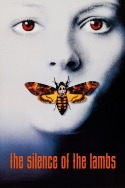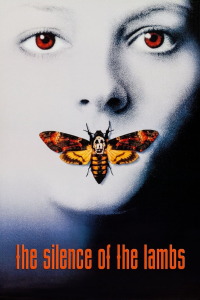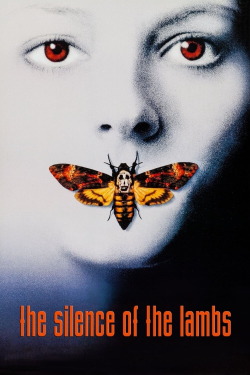
Review of The Silence of the Lambs (1991) by Simeon T — 15 Dec 2015
People often argue about exactly what kind of film Silence of the Lambs is. Is it a horror movie? It certainly has content in keeping with the genre, but I don't think it is. Is it a crime movie? A suspense thriller? For sure, but is it more than those things? I see it also as a dark fairy tale, in the mythological vein: a little girl wanders into the dark forest, Theseus into the labyrinth with the minotaur. I've been fascinated by stories about the search for depraved killers in part because of how it seems as if it is a sortie into the heart of darkness, so dark that it seems almost elemental. Although stories of the supernatural still sell like hot cakes, we have in modern time become more fearful of the darkness inside human nature, because we've had so much of it imprinted into our brains. From the Nazis, to death squads, to John Wayne Gacy's grotesque clown face, to the supreme depravity hiding beneath Ted Bundy's handsome features, mass media has saturated us in the worst of ourselves. We see evil differently these days. We are more afraid now that we'll meet a strange person alone in the woods than we will a supernatural evil, but it is generally the same fear and fascination that Thomas Harris tapped into when he created Hannibal Lecter.
But this story isn't about Hannibal Lecter. What makes Silence of the Lambs a different type of film is that it is the story of Clarice Starling, a frightened little girl inside a small woman, someone with promising talent as a detective but at present a nobody. She is not merely the main character, she is the defining feature. The movie is seen through her wide deer eyes, immersed in the dread of a person desperate to escape by proving her worth, rather than the hysterical panic felt in horror films. The whole world is scary to Clarice, it always has been since her Daddy died, and this is what makes her oddly perfect for the task: if she can face the suspicious blue wall of big, macho cops, she can face down the killer in his lair. Jodie Foster is amazing in the role. Though nowhere near the chameleon he is, she is like Philip Seymour Hoffman in that she seems to find something deep inside herself in roles like this, but she is more steely than that late, brittle genius. Her's is more a mission of the heart than a personal ambition. She knows what she needs to do and she will do it, even if it seems beyond her. She is Little Red Riding Hood lost at the Wolf's Door, she is Frodo venturing into Mordor. Wide-eyed, tremulous, over-matched but not beaten.
That this story has something in common with dark fables is evident early on, in a scene in which Clarise walks down a staircase into a dark dungeon which houses a collection of deranged killers, one in particular. It is one of the all-time character introductions, and one which I won't spoil. Anthony Hopkins brilliance in the role of the not so good doctor is a frequent subject of debate when this film is brought up. There is a vocal minority who decry his portrayal as too theatrical, and instead point to Brian Cox's glib, understated take in Manhunter. I agree the Manhunter interpretation is a good one, and it is more forensically sound, but I maintain the criticism misses the point. Hannibal Lecter was never meant to be a psychopath like any other, and as far as I know it is not in the nature of serial killers to cannibalize victims for gastronomic reasons. A realistic profile will not do with Hannibal Lecter; he is, as critic Richard Roeper said, modern culture's version of Dracula: a magnetic bogeyman who both repulses and attracts; flesh and blood but with an inhuman sort of manner; a gentleman and a bloodthirsty beast. Anthony Hopkins created a Dracula for the age of temporal horror, a union between the era of Bram Stoker and the Penny Dreadful, and the era of True Crime obsession.
It is not Hannibal Lecter who Clarisse hunts, however. Here we are brought back to a more common, abject sort of villainy, grotesque but so recognizably human. Dubbed "Buffalo Bill" in the classic, bad-taste cop manner, a man is killing women then removing entire sections of their skin before dumping the bodies. The killer turns out to be in some ways the opposite of Dr lecter: furtive, self-loathing and above all pathetic. In a film with knockout acting, Ted Levine's performance is amongst the most haunted and unhinged in all of cinema. In particular, the dance he does for his own camera is at once disturbing and utterly pitiable. In spite of his crimes, you can feel sorry for this monster, who merely wants to end a perceived curse (another fairy tale motif). Yet he is a monster who must be confronted. As Clarise descends into his lair in utter darkness, she is indeed like Theseus in the Labyrinth, confronting the beast in black of night, because she cannot wait for the sun to rise.
This review of The Silence of the Lambs (1991) was written by Simeon T on 15 Dec 2015.
The Silence of the Lambs has generally received very positive reviews.
Was this review helpful?