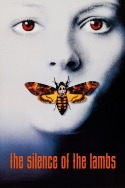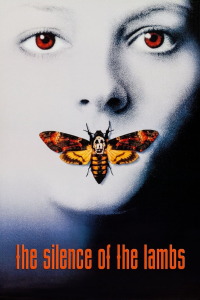
Review of The Silence of the Lambs (1991) by Moviemastered — 22 Mar 2016
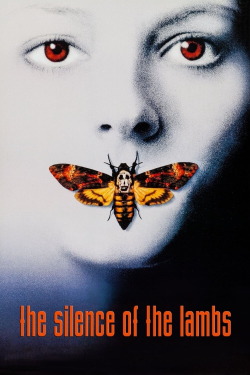
When The Silence of the Lambs took the Academy Awards ceremony by storm in 1992, winning in five major categories (Best Picture, Best Director - Jonathan Demme, Best Actor - Anthony Hopkins, Best Actress - Jodie Foster, and Best Adapted Screenplay - Ted Tally), it beat the odds in more ways than one. Granted, 1991 was a slow year for movies, and many pundits have remarked that the Oscar field was among the weakest ever (the other contenders were Disney's Beauty and the Beast, Bugsy, JFK, and the overrated The Prince of Tides), but the strong showing of The Silence of the Lambs was a surprise to almost everyone. In the first place, it was released in February 1991, a date thought to be beyond the short memories of the Academy members. Secondly, it is a dark psychological thriller - the kind of movie that occasionally receives a Best Picture nomination, but almost never takes home the statuette.
Although The Silence of the Lambs is brilliantly constructed and powerfully acted, and became one of the most recognizable thrillers of the '90s, it was neither the best movie of the year (a citation I would award to Beauty and the Beast) nor even the best thriller (overall, Dead Again impressed me more). The Silence of the Lambs contains a number of inarguably great scenes, but the screenplay, adapted from Thomas Harris' novel, suffers from a split personality. The scenes featuring Hannibal Lecter (Anthony Hopkins) are the stuff of legends. However, the rest of the movie, which concentrates on the pursuit of serial killer Buffalo Bill (Ted Levine), has a familiar, derivative feel. In truth, the climax couldn't be more mundane.
There is little doubt that the most memorable aspect of The Silence of the Lambs is Anthony Hopkins' incomparable performance as Lecter. Taking over for Brian Cox, who was effective, but not especially memorable, as the good doctor in 1986's Manhunter, Hopkins instantly makes the role his own, capturing and conveying the charismatic essence of pure evil. To his dying day, no matter how many roles he plays in the interim, Hopkins will forever be known for this part. (It is a credit to Hopkins' ability as an actor that this part did not result in stereotyping. His post-Silence career has been greatly varied, with roles as widely diverse as a stodgy butler in Merchant-Ivory's The Remains of the Day and an action hero in The Edge.) I can throw out any number of superlatives, but none of them do justice to this chilling performance, which I labeled as the best acting work of the '90s. Want to feel the icy fingers of terror stroke your heart? Watch this mixture of brilliant eloquence and inhuman cruelty. As portrayed by Hopkins, Hannibal is both a suave, cultured gentleman and an unspeakable fiend. He is gracious and monstrous at the same time. (Hopkins also provided one of the most quotable lines in recent film history with "I ate his liver with some fava beans and a nice Chianti", which was followed by an inimitable slithering slurp.).
The Silence of the Lambs consistently looks good, builds suspense, and does not outstay its welcome. Many two-hour thrillers have dead patches, but that's one characteristic of the genre this movie avoids. Instead of using the common tactic of priming an audience by employing "boo!" moments (fake scares, such as when an animal darts out from behind trash cans), Demme uses what he calls "deceptive cutting" to enhance the tension. There are also little cues that hint at bigger dangers, such as when Clarice receives a nail prick while sliding under the partially-closed door to the garage where she finds Gumb's first victim.
Since its 1991 release, much has been written about The Silence of the Lambs, Hannibal Lecter, Clarice Starling, and the relationship between them. Thomas Harris was so intrigued by the characters that he wrote the sequel, Hannibal, which soared into the top spot on best-seller lists countrywide as soon as it was released. The motion picture follow-up, directed by Ridley Scott and starring Hopkins and Julianne Moore (replacing Foster), is set to open on the 10th anniversary of the release of The Silence of the Lambs. If it's half as involving, it will be a success. The Silence of the Lambs may not have been the best thriller of the year, but it was the most chilling and creepy, and there's no denying that the most celebrated aspect of the film - the Clarice/Hannibal connection - could not have been accomplished with greater skill.
This review of The Silence of the Lambs (1991) was written by Moviemastered on 22 Mar 2016.
The Silence of the Lambs has generally received very positive reviews.
Was this review helpful?