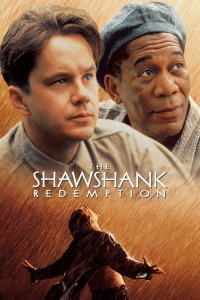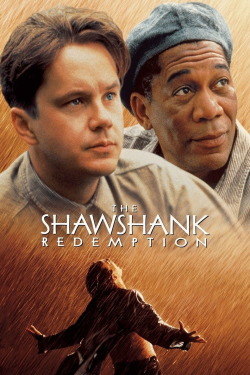
Review of The Shawshank Redemption (1994) by Mahmood B — 22 May 2016
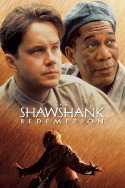
Frank Darabont's The Shawshank Redemption (1994) focuses on both physical and mental architectures of confinement, as well as the role of religion in terms of human behavior. The movie tells the story of Andy Dufresne who gets sent to Shawshank Prison for a crime he hasn't committed, meets Red, struggles through the prison life, and finally manages to escape only to be reunited with Red later at Zihuatanejo. With these three themes brought together, and using camera angles, music, and narrative dialogues, the movie transcends a view of how life is really like be it within, or without, the walls of Shawshank.
The inmates of Shawshank prison are put in physical confinement the moment they enter. Their autonomy is taken away, and they become like animals in a cage. This is made clear when Hadley tells the inmate, "You eat, when we say you eat. You shit, when we say you shit, and you piss, when we say you piss" (00:13:45). The inmates forget what it's like to be free. This is further implied when Red explains to the others how Brooks became "institutionalized" (00:59:12), and that the walls of the prison were all what he knew. Institutionalization is a concept that is not necessarily witnessed when inside prison. It happens whenever there is some sort of deprivation of freedom, which leads to people forgetting what it's really like to be free. When Red is released, he asks for permission to go to the bathroom, which is something that no human can be deprived off, yet this is just the case with the inmates. Institutionalization can sometimes occur to people without them noticing it as they simply "go with the flow", only to realize later that they are nothing but machines following a certain routine dictated by a higher system. In addition, Red also says, "They send you here for life, and that's exactly what they take," (01:00:17) indicating that the physical confinement didn't merely act at the level of freedom, but rather at the level of simply existing. In a metaphoric way, this is how many people actually "live" their entire lives. They spend their lives first worrying and fussing about studies, then work, then marriage, then children, only to reach the end of their lives realizing that they haven't been really "living". Again, they were only following the physical limitations of an already-dictated system.
The inmates are also put in a more serious mental confinement. Their spirits have no hope and they are filled with fear, which holds them prisoners. This line between fear and hope is drawn elaborately in the movie. Andy's character is nothing but the rock that Red dug under the tree at the end of the movie (02:14:00). Andy was the "rock that had no earthly business in a Maine Hayfield" (01:56:44); he "had an invisible coat that shielded him from this place" (00:28:50). He tries to instill the idea of hope within the spirits of his friends, especially Red and Tommy. He goes on to play the Mozart piece sung by the 2 Italian ladies, depicting a sign of fearlessness, all the while adding a sense of mental freedom to the inmates. This diegetic music brings all inmates, along with the audience, to a tentative and soothed state. Andy's hope is the reason to his eventual physical and mental freedom. An important scene where a line is drawn between fear and hope is towards the end of the movie, when the warden is seen to have given up on hope, and that did not work out well for him. He fills several bullets in his revolver and points it at the door in hopes of fighting off the police. However, the light of hope is shut inside him, and he shoots a bullet through his head (02:03:48). At this scene, the camera focuses on his face, and sweat is seen leaving his forehead, taking with it the last drips of hope. Another scene where a clear distinction is made between fear and hope with aid of camera angles is the scene where the camera focuses on the gun then shifts to the compass (02:10:30). The audience first thinks that Red is going to commit suicide; however, the compass indicates his search for his friend. Also, the frame shot of "Brooks was here, so was Red" (02:16:45) draws a fine line between two characters with opposing views of hope and fear. The ultimate mental realization of hope is what allows the characters to be set free from their confinements. The calm elevating music during Red's search for the tree, and his journey to Zihuatanejo, helps in indicating that Red has slowly managed to fill his spirit with hope.
Another important aspect of the movie is its frequent references to religion when it comes to Warden Norton's character. His first rule to the inmates is "No blasphemy" (00:13:26). He's a good reader of the Bible, and has most of its verses memorized. These are traits of a pious man of good will; however, the warden is the most evil character in the movie. Why does he do it? It is known that throughout the history of mankind, and ever since the dawn of civilizations, religion has often been used as means of justifying evil deeds, or protecting those who commit the evil deeds. The warden does exactly that. He uses the Bible in order to shield his dark side, or perhaps to justify his evil deeds. Towards the end of the movie, Norton drops the Bible on the floor (02:02:30), and the camera view focuses on where the Bible lands: right next to his feet, indicating disrespect, degradation, and blasphemy! This can come as a surprise to some people, but this is the case with Jules Winnfield in Quentin Tarantino's Pulp Fiction, which was released only a few weeks after The Shawshank Redemption. Jules also uses references to the Bible and acts pious, when in fact he is nothing but a cold-blooded murderer.
More than 20 years later, The Shawshank Redemption still stands as one of the movies that set a mark in the world of cinema. By diving into issues of confinement and religion, the movie manages to portray aspects that are present all around the world. These are aspects that were, are, and will remain in play throughout the course of humanity.
This review of The Shawshank Redemption (1994) was written by Mahmood B on 22 May 2016.
The Shawshank Redemption has generally received very positive reviews.
Was this review helpful?