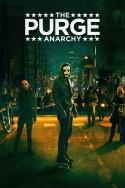
Review of The Purge: Anarchy (2014) by Nightreviews — 23 Jul 2014
“Just remember all the good the purge does.”.
Some purge for money, some purge for revenge, and some just purge for the fun of it. Whatever it is one is purging for, one can’t help but be drawn to this crazy and maniacally satisfying cinematic story concept.
Stock brokers hang from the front doors of banks, people are killed for being caught cheating on their spouses, and those with repressed feelings are all questioned as to why they are out on the one night of the year where all crime, including murder, is legal in 2023 America.
The Purge: Anarchy is story-telling brilliance. Outdoing its predecessor in narrative, character building and spectacle, the sequel reveals the many questions audience members were thinking during The Purge. Such questions include; what happens to people who are caught outside unwillingly on the streets on the scariest ‘holiday’ in America, what happens to the people who cannot afford to protect themselves the same way the rich can, and just how far are good people willing to go for vengeance?
Unlike the original Purge, director/writer James DeMonaco decides to do what every good director would have done with a story idea like this, and that is multiple-character narratives that eventually intersect.
As the evening is coming to an end and the 12 Hour Purge period begins, the world that DeMonaco created does not seem as far away from our own as we are introduced to an array of different relatable characters. Single-mother Eva (Carmen Ejogo) and her daughter Cali (Zoë Soul) along with her ailing father Rico (John Beasley) are a hard working family. Eva, who works as a waitress at a local diner in the projects of Los Angeles, asks her boss for a raise on the eve of the Sixth Annual Purge that will help with her father’s piling medical bills. Denied, Eva makes her way back home to lock-down her little apartment with very little means of security. Meanwhile, on the other side of town, Shane (Zach Gilford) and Liz (Kiele Sanchez) are having their own problems in their relationship, as well as being following by a gang of anxious masked maniacs who follow them upon learning that their car is stalled on the side of the road due to ‘accidental’ mechanical problems. Both pairs of people, unprepared and scared of participating in the purge, try to survive the night on their own, until they luckily stumble across the Sergeant (Frank Grillo), a man who is justifying his night by killing the man who took his son away from him.
Hours before the annual commencement, people flood the streets, searching for last minute ‘protection’ from their partners, their bosses, their disgruntled family members or friends and say goodbye with the words, “stay safe”. They treat the purge as a holiday; some as a patriotic day of cleansing, others as a religious right of passage. Some call it “releasing the beast”, others refer to it as “enjoying the cleanse”, but one thing becomes clear, it reminds us of the crazy times of the year where people are uninterested in your feelings or concerns, a time that could be compared to the holidays, where the ‘dog-eat-dog’ attitude of people becomes ever more apparent. Purging could easily be compared to practically every holiday we experience where people are animals on the road and on the streets, but perfectly behaved citizens in their homes and within the walls of church halls and religious centres and perfectly adequate images in social settings.
I believe DeMonaco has crafted a story idea and made a film that is a lot deeper and more complex than people would like to admit. After all, the film is a free-for-all excuse to have people watch just exactly what people are thinking of doing to others that hurt them, without ever getting their hands dirty. Anarchy really goes with the idea of what people would actually do if that little thought in their head of killing their boss, could actually be materialized in the real world, without any consequences.
In addition, Anarchy shows the very faint hints of social, racial and economic inequality that is plaguing DeMonaco’s America of the future. Unemployment is less than 5% and poverty is at 1%, and the purge is to thank for this tremendous social statistic, yet, the rich hide and buy their way to an American tradition of cleaning through their heavily-secured houses while the poor help deliver homeless people, hostages found on the street and ‘martyrs’ who offer up their bodies as a bloddy canvas for rich families while their next of kin receive momentous amounts of money. In any direction you put it, the ones who suffer the most are the poor and lower class, and Anarchy spends most of its time showing this obvious and super disturbing truth of an American society whose idea of ‘cleansing’ is no different than the idea Adolf Hitler had in the 1930′s.
This review of The Purge: Anarchy (2014) was written by Nightreviews on 23 Jul 2014.
The Purge: Anarchy has generally received mixed reviews.
Was this review helpful?