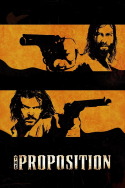
Review of The Proposition (2005) by Rhys G — 31 Aug 2012
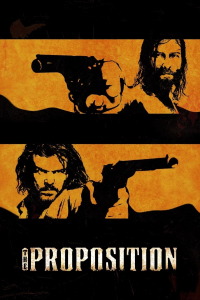
I find it strange that Australia - one of the harshest, most rugged landscapes the world has to offer - has seldom been used a setting for the western. Writer Nick Cave and director John Hillcoat evidently capitalised on this drought, delivering a taut and macabre film that combines our favourite Western stories and tropes with the sweeping outback panoramas of the Australian outback. What Cave also manages to weave into his film is the complex and brutal relationship of the â~civlisedâ(TM) whites and the Australian Aboriginals, paired with a unique puzzle of intricate moral relativity.
After an initial gun-fight we learn of brutal murders of a family in the outback. These deaths were committed by the notorious Burns gang, a trio of grisly Irish Brothers; two of whom have been captured (Charlie (Guy Pearce) and Mikey (Richard Wilson). The third brother, the â~leaderâ(TM) and most sadistic of the three, Arthur (Danny Huston) manages to escape. The titular proposition comes from Captain Stanley (Ray Wintstone): Charlie must find and kill his brother within seven days, or his younger Mikey will be tortured and hanged for the heinous crimes. The premise sounds like myriad other Westerns, but a startling difference comes to the fore: itâ(TM)s Australia in the late nineteenth century, where the British flag flies high over Captain Stanleyâ(TM)s home and his promises of conquering the land sound sensible and somewhat feasible. An array of oppositions present themselves here: man vs the environment, white man vs the aborigine, the law vs the outlaw, the old vs new. In fact, the predominant theme is the conflicting forces of violence and loyalty, and the film constantly ponders the question: how does cyclical violence end? How long will the â~eye for an eyeâ(TM) mentality pervade humanity? For me, the prevailing notion is that we need to recognise the bad within society, others, and ourselves - irrespective of shared bonds or ties. The final scene is profound: Captain Stanelyâ(TM)s Christmas feast is interrupted by violent revenge, exemplifying a sense of justice will find those who practise the aforementioned mentality.
While Cave employs many conventions of the archetypal Western, he manages to craft the story as uniquely Australian without making it obsess over a â~collective identityâ(TM) or sell it as a commodity for tourism. The treatment and portrayal of the Aborigines is historically accurate and startling, and what I believe makes The Proposition exceptional is the amalgam of successful collaborations. Nick Caveâ(TM)s poetic and desolate screenplay is brought to life by stunning and convincing performances from all of its actors. Pearce embodies the stoic Eastwood persona and Winstone manages to elicit both disgust and pathos. Watson is the perfect representation of the â~old Englandâ(TM), a woman living in the extreme outback whose psyche still resides in Europe. This is personified through her costume, her home with its flowers, white picket fence, paired with her penchant for pouring tea from fine china. John Hunt does what he does best: the loony and spiritually anguished man, and Danny Huston lives up to his fatherâ(TM)s reputation by purveying a ghastly and gruesome outlaw.
However, the cinematography, sound design and direction cannot be forgotten, and the three ensnare so perfectly to deliver an uncompromising Western of the highest calibre. Benoà (R)t Delhommeâ(TM)s beautifully lit countryside make the performances elicited from Hillcoatâ(TM)s direction breathtaking. The filmâ(TM)s unrelenting eeriness is sure to linger long after viewing, and one particular line of dialogue in particular: â~Ah, Australia ⦠what fresh hell is this?â(TM).
This review of The Proposition (2005) was written by Rhys G on 31 Aug 2012.
The Proposition has generally received very positive reviews.
Was this review helpful?