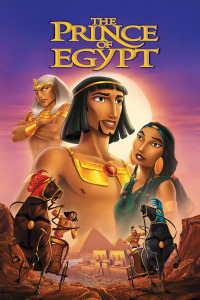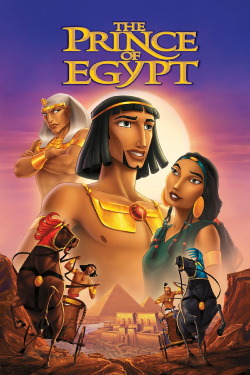
Review of The Prince of Egypt (1998) by Moviemastereddy — 03 Apr 2016
'Prince of Egypt': Tale of a Hero.
Is "The Prince of Egypt" a good movie or the most expensive Sunday school filmstrip ever made? My enthusiasm for Western man is so primal that I lean toward the former. Really, so much of it begins with Moses: the concept of freedom, the sense of the worth of the individual, the idea of God as an abstract ideal of morality instead of a batch of dog-faced bullies, commandments one through ten, even that inconvenient one about the neighbor's wife, and the coolness of beards. Oh, and also: Judaism and Christianity, democracy and baseball, to say nothing of Shakespeare, Bogart and Faulkner.
The new animated feature from Dreamworks SKG gets that. If nothing else it's a wonderful essay on the meaning of freedom and the courage it takes to wrestle it from despots. In that sense, it feels more political and cultural than religious. You don't see faith systems in opposition so much as idea systems.
Primarily concerned with the first part of the Book of Exodus – you know, the part with all the special effects – it leaves out that dreary 40 years in the wilderness and, being aimed at families, equally omits the shimmy-shim-sham danced about the feet of the Golden Calf. We begin by watching Baby Moses basket-surf the Nile, to be rescued by an Egyptian princess. He is raised to privilege in the court as brother to the Pharaoh to be. Upon discovering his true Hebrew identity, he suffers a crisis, flees and returns with the best slogan ever written: Let My People Go. When Pharaoh won't listen, God sends bugs and frogs. The people are ultimately let go, but then Pharaoh goes after them. There's no revisionist carping about Red/Reed Sea translation confusion: This is the big wet one, baby, and Moses parts it neatly as Elvis parted his first hairdo for Ed Sullivan. When Pharaoh and his boys clamber in their chariots across the same passageway, only Charlie Tuna is around to listen to their complaints.
The movie's proudest accomplishment is that it revises our version of Moses toward something more immediate and believable, more humanly knowable. This is not the time and the place to bedevil Charlton Heston who, after all, can't really help being Charlton Heston. But his famous 1956 movie Moses was a reflection of a time that invested most of its authority in the severe white male, an unbending paragon of morality, strength and wisdom. Watch the news for 7 or possibly as long as 11 seconds and see how far that one has fallen!
But this Moses, voiced by the less than imperial Val Kilmer, is less iconographic and more human. This Moses doesn't seem to be posing for Mount Rushmore and you could never ski down his cheekbones. Wiry and Semitic, he's a man beset with doubts, who feels himself completely unworthy. When he discovers his secret heritage, he reacts more like Woody Allen than an NRA president: He gets mopey, depressed and self-loathing. He wants to be hugged.
Without going too far into this matter, it seems clear that this Moses reflects the personality of his creator, Dreamworks co-founder Jeffrey Katzenberg. Possibly he represents a little of Katzenberg's more famous partner, Steven Spielberg, as well. Heston's Big Mo was a vision of the annoyingly Caesarean Cecil B. De Mille, a bald tyrant who stomped around movie sets in jodhpurs and cavalry boots like some sort of Crimean War general about to order the light brigade to charge. He believed in the principle of absolute authority – his own – and he directed with the subtlety of a man carving an angel out of a lump of coal with a chisel.
The second virtue to "Prince of Egypt" is a superb performance. It's amazing how a great actor can dominate a project without even showing his face. I refer not to Kilmer, who is appropriately unassertive in the role, nor to the absurd Valley Girl stylings of Michelle Pfeiffer as Tzipporah, Moses' wife. Hard to believe Moses' wife went to Redondo Beach High School!
No, the reigning vocal genius of "Prince of Egypt" is Ralph Fiennes as Rameses, the non-blood brother of Moses' upbringing, inheritor of the throne. It is to the production's credit that he's given a motive – his fear of being the "weak link" in pharaonic succession, of failing the empire of his fathers and his sons. But this Pharaoh, like the Moses of his opposition, is a man, not a symbol, and in Fiennes's reading we hear the tragedy of a king born out of time, shackled to a set of beliefs that are crumbling daily, still in tragic love with a brother who has outgrown him. In the fight of his life, he's overmatched and he doesn't even know it: He's not going against Moses, he's up against the Big Guy Himself.
That's what "The Prince of Egypt" finally is: a hero's biography.
This review of The Prince of Egypt (1998) was written by Moviemastereddy on 03 Apr 2016.
The Prince of Egypt has generally received positive reviews.
Was this review helpful?