Review of The Platform (2019) by Hnestlyonthesly — 27 Mar 2020
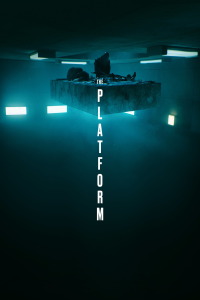
Unlike its predecessors, The Platform is not really interested in high budget cinematography: the sets are simple, unadorned, poorly lit cells steeped in shadow and drab prison garb, which makes the momentary presence of the platform’s feast all the more impressive and visually striking. And though our protagonist’s disgust with the feast and all it represents is a point of annoyance for the survivalists in the audience–Friend kept pausing to complain about how little Ivan Massague’s character Goreng eats–it’s a point of fun for me to be able to think about what a boon it must’ve been for these actors to be able to react honestly to the spread (or lackthereof) as it arrived on set from the ceiling. It’s also a point of genius for the director to be able to portray his protagonist’s abstinent liberalism as a kind of stupidity, an echo of that adage my grandfather used to say, “Democrats want to give away the store.”.
So, if The Platform‘s plot isn’t extraordinarily complex or even that original–a Stanley Milgram experiment with food–what makes the film exceptional are the ways that its structure feeds into our anticipation of events in future scenes: the suspense of discovering each new cell’s number and the way that this forms our expectations about will happen; the achronological cut scenes of food being prepared in a restaurant with care and precision; the Easter egg of discovering each of Goreng’s new roommates’ totems and the totems of the other inmates; the way that his roommates hover over his shoulder like malign Jiminy Crickets; the motif of snails; the way that Goreng assimilates the language of his compatriots, “obvio.”.
The totems especially feel like they deserve a shoutout, since Goreng’s choice seems so patently reasonable at the start, until we see how innocent and useless his choice was and how revelatory it is of his character. The totems give this extraordinarily crisp descriptor of each inmate from a single visual image: the sense of threat and foreboding when Trimagasi pulls out his As Seen On TV knife; the disarming frivolity of bringing your pet into isolation; the ingenious and risky optimism of a rope.
Which is all to say, The Platform is filled with these brilliant moments of insight about bleeding hearts and craven conservatism and wide-eyed religiosity in the face of cruelty and selfishness. And though the film ultimately aligns itself with a kind of cold utilitarian pragmatism, it’s not at all stuffy or high-brow, but rather explosive and violent and surprising. That political evolution that starts as a simmer and reaches a boil is at the center of this film.
Some questions that I’m still trying to untangle a few days out from this film, that I’m not entirely sure I’m happy with the film for posing are: I understand why the panna cotta is the message, but I don’t understand why anyone in charge of this facility is going to be phased by the appearance of a child. I get that future generations and the cruelty we’re inflicting on our children is supposed to be a greater motivator than the spiteful displeasure of the people, but in the specifics of this film, it doesn’t feel like the allegory fits, or explains why Goreng’s absence on the top floor will make that new message any more impactful or protect the child from danger. On this point, I’m not entirely sure of the significance of the Korean Marilyn Monroe’s search for her imaginary son and the subsequent discovery of a young girl instead. Is her child actually imaginary as Imoguiri claims? We don’t have any reason to believe that Imoguiri would lie to us about this, except that she seems unaware of the size of the facility or the extent of its cruelty. When she kills herself before Goreng can wake up in their second month together, it’s in part so that they don’t have to argue about food or lack thereof, but also because she never imagined there were so many more cells. And, after all, she’s wrong about the fact that there are no children in the facility.
This question about Korean Marilyn Monroe’s motivation cascades into other questions about why she never found her son, or if her son was fictional, why she never found the child, if her strategy for finding him was essentially the same as Goreng’s. And if the answer is simply that she’s murderous and mentally ill, that seems unsatisfying. But more than that particular question about Marilyn, why has no one previously attempted this plan? Why doesn’t Marilyn end up doing this exact thing every time she goes in search of her child? Why are we to believe that she descends the Platform and then stays on a lower level for the remainder of her month?
The question of the originality of Goreng’s plan doesn’t take away from the fact that it’s pretty badass and entertaining as hell.
This review of The Platform (2019) was written by Hnestlyonthesly on 27 Mar 2020.
The Platform has generally received positive reviews.
Was this review helpful?