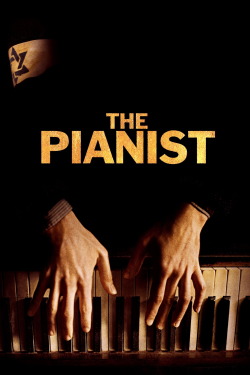
Review of The Pianist (2002) by Marty H — 04 Jun 2013
Roman Polanski's The Pianist is a crucial reminder for every human being of the atrocities that occurred during the Jewish Holocaust and the oppressive policies Nazi Germany inflicted upon the people in Poland. Polanski blends his own experiences as a young boy watching the German army destroy and occupy Poland during WWII along with the memoirs of the famous musician Wladyslaw Szpilman to create a realistic, horrifying depiction of life in Poland from 1939-1944.
Szpilman's tale of survival is truly incredible. Polanski along with the help of screenwriter Ronald Harwood bring Szpillman's story to life and do so in a way that doesn't take away from the overall message. Yes, Szpillman's memoirs makes for a nice plot, and Adrian Brody came out of nowhere to give the performance of his lifetime, but it was Polanski's handiwork that made this film a gem, one to watch with care, critically examine, and discuss with others.
So often at the end Polanski's films, a twist takes a deadly turn and our main character oftentimes gets killed. A twist of fate occurred for Szpillman as we thought he would finally be brought to his death. He began to play what seemed to be his final notes on a piano in front of a German officer. The passion and skill Szpillman produced captured this German officer and enticed him enough to spare his life. The empathetic German officer continued to supply Szpillman with food and water until he was finally forced to leave. But in the end, it was the German who would end up pleading for his life in a Russian POW camp. It was disclosed to us in the end that he was killed in one of these camps.
Polanski has a special way with horror. The executions, the whippings, and beatings, and dead and decaying bodies on the streets of Warsaw make this film horrific on its own and incredibly difficult to watch. Polanski is still able to bring these horors to life in a way that is scarier than any movie I have seen. There are a few scenes that are forever burned into my mind and creep into my subconscious when I sleep. The scene when the Nazi army interrupted a Jewish dinner, and wheeled an old man out onto the balcony and tipped him over to his death is hard to watch, and hard to even write about. The horrified family of the old man is herded out onto the street where they are told to run and sprayed down with machine gun bullets. Then the German soldiers load up into their car and run over the bodies, some of them still alive before impact. This kind of graphic violence is rarely allowed on screen but because this was a depiction of the Jewish Holocaust, it gets a pass.
The Pianist did a good job showing how oppressive policies from Germany's Dictatorship ultimately led to genocide. They made the Jewish people wear the Star of David on their elbows when they were out in public so they can be easily discriminated against. They limited the amount of income they could earn and the amount of money they could have in their household. They created a new district for Jewish people and packed more Jews in to total close to 400,000 people. This new district was in the poorest area of town. People were forced to live in the terrible conditions in dilapidated buildings. Eventually, these people were forced to get "work certificates" and provide harsh labor for the Germans. All those who were unfit to work or did not possess a work certificate were sent to internment camps. What is scary is that poor people and minorities still live in similar conditions today. Urban policies continue to isolate, discriminate, and oppress people to the point of extreme poverty. This poverty leads to addiction, mental illness, prostitution, crime, violence, and absent parenting. Nazi Germany knew how to exterminate the Jews. They had prime examples to learn from America's treatment of the Native peoples, Black slaves, and other people of color who were trying to make a living in our country during and before wartime.
A disturbing element of this movie is how heartless the German soldiers are. They are constantly humiliating, beating, and executing Jewish people whenever they can. This movie came out in 2002, right around the time when George W. Bush's War on Terror began to escalate in the Middle East. Pictures of our soldiers humiliating prisoners at Guantanamo Bay were leaked to the public. Inhumane torture methods were discovered to be a regular practice of the American army and brought to the public's eye. A new drone technology utilized by the Pentagon bombed countless villages killing innocent bystanders, women and children.
September 11th, 2001 gave us the right to invade, torture, and humiliate anyone who we didn't like over in the Middle East. Hitler and Bush had many things in common. They both thought it was their destiny to become a dominant world power and control the planet from every angle. Bush's war had more to do with profit than it did with conquest and retribution. But both Hitler's and Bush's army committed horrific war crimes, broke international war rules and treaties, and instituted unfair, oppressive policies that robbed people of their culture, community, and livelihood.
This film is very difficult to watch but I encourage people to sit down for two hours and try to follow along. I am not pleased to say that this is an accurate portrayal. The Pianist has more of a story/movie feel to it than Schindler's List, but both highlight some of the graphic details of Jewish Holocaust during World War II.
5/5.
This review of The Pianist (2002) was written by Marty H on 04 Jun 2013.
The Pianist has generally received very positive reviews.
Was this review helpful?