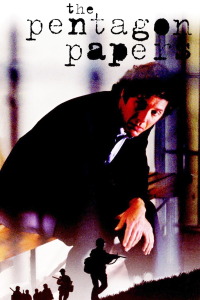
Review of The Pentagon Papers (2003) by Mel V — 08 Oct 2004
[I]Secrets: A Memoir of Vietnam and the Pentagon Papers[/I] traces Daniel Ellsberg?s personal and professional journey from committed Cold Warrior working for a government-funded think tank (he specialized in game theory, with a focus on decision-making and bargaining under imperfect conditions, specifically between nation-states armed with nuclear weapons) to anti-war activist during the Vietnam War willing to risk extensive jail time for the unauthorized disclosure of top-secret documents to the mainstream press ([I]The New York Times[/I], [I]The Washington Post[/I], and [I]The Boston Globe[/I], first among them). Ellsberg?s professional background makes him well suited to an exposé of government decision-making and deception during the Vietnam War. Over the course of more than a decade, Daniel Ellsberg was a Rand Corporation (a government-financed, defense-oriented think tank) analyst; a Defense Department official, under John T. McNaughton, assistant secretary of defense, international security affairs and Robert McNamara, Secretary of Defense in the Kennedy and Johnson administrations; a State department official who volunteered for service in Vietnam (he remained in Vietnam for two years); and later, after returning to the Rand Corporation as an analyst, the whistleblower behind the unauthorized disclosure of the Pentagon Papers, a top-secret, multi-volume, 7,000 page study of twenty-five years of American involvement in Vietnam, from the Truman administration to the Johnson administration.
Briefly surveying Ellsberg?s early life and career, from Harvard Ph.D. in Economics, interrupted by his decision to complete his military obligation as an officer in the Marine Corps during the Korean War, [I]Secrets: A Memoir of Vietnam and the Pentagon Papers[/I] quickly finds its focus: a behind-the-scenes history of the decision-making (and their consequences) that led to our escalating involvement in Vietnam. Ellsberg opens his memoir on August 4, 1964, when the North Vietnamese navy apparently attacked an American destroyer presumably in international waters off the coast of North Vietnam. The attacks (there were two, the second of which likely didn?t occur) have been commonly referred to as the ?Gulf of Tonkin Incident.? President Johnson used the attacks as the springboard to obtain a sweeping declaration and authorization of military force from the United States Congress, which led to the initial commitment of ground troops in February 1965. At its height, the United States had more than 550,00 ground troops in Vietnam. By the end of official U.S. involvement in Vietnam in 1973 (Saigon fell to the North Vietnamese in May1975), 58,000 American servicemen were dead, more than 300,000 injured, and approximately 1.5 million Vietnamese civilians dead.
As a Defense Department analyst under John T. McNaughton, Daniel Ellsberg received unprecedented access to confidential documents, top-secret cables, and private communications between and among various intelligence and military agencies. Despite a highly skeptical attitude toward military and political success in Vietnam, Ellsberg found himself accepting a position in the Department of Defense at the behest of John T. McNaughton, in order to study government decision-making made at all levels of the executive branch from inside the government as a major, long-term crisis unfolded. Ellsberg saw an important opportunity to pursue his research goals and interests in a practical setting. He quickly realized, however, that studying Vietnam from a purely academic perspective was impossible.
Daniel Ellsberg?s two-year stint as a Defense Department analyst confirmed what he had already learned as a Rand analyst: government decision-making was guided by an almost pathological need for secrecy and confidentiality in all matters, from the mundane to the top-secret. Secrecy meant that personal opinions remained private, or shared only between close, trust-worthy associates (and even there, information sharing was severely limited), but at no time was a direct, open challenge to a superior officer or official permitted. Top-down, hierarchical decision-making within the executive branch sharply limited internal debate and open discussion. Ellsberg implicitly understood that the demand for secrecy within the executive branch translated into deception to both the U.S. Congress and the American public. Every executive branch official internalized the need for secrecy, at least those who expected a long-term career in government service.
In 1965, Daniel Ellsberg transferred from the Department of Defense to the Department of State. From 1965 through 1967, Daniel Ellsberg volunteered to serve in Vietnam, ostensibly as part of a fact-finding mission working closely with the then ambassador to Vietnam, Henry Cabot Lodge, Jr. Ellsberg saw American strategy and tactics first-hand, and found both wanting. When he first arrived in Vietnam, he joined John Paul Vann, a Lt. Colonel working as a field advisor for the U.S. Army in Vietnam. Vann had a well-earned reputation as a maverick, often traveling alone, rifle in hand and driving at breakneck speeds, into areas partially under control of the Vietcong. He was able to obtain first-hand information about U.S. efforts to combat the Vietcong in the field, as well as efforts (mostly failing) to obtain rural support for the South Vietnamese army and the regime in Saigon. His field experiences led to become a vocal critic of the Vietnam War (an opinion he shared with American reporters). From Vann, Ellsberg learned both the need to obtain information directly, from combat units in the field, as well as skepticism toward field reports. Field commanders generated positive reports unsubstantiated by actual experience. For example, Ellsberg quickly discovered that reports of nighttime patrols by South Vietnamese army units, unprecedented at that time, were, in fact, false. While either U.S. combat troops or the South Vietnamese army controlled villages and hamlets in South Vietnam, nighttime patrols were exclusively handled by U.S. troops. The attempt to transfer responsibility for nighttime patrols to the South Vietnamese failed, and that failure pointed to a larger, underlying problem: the U.S. would not be able to extricate itself from South Vietnam until indigenous army units could fight for themselves, unassisted by U.S. combat troops. As a result, Ellsberg?s skepticism toward military and political success in Vietnam hardened into pessimism tinged with despair.
Ellsberg?s return to the United States, and a second stint with the Rand Corporation left him in a quandary. He had previously held to the conviction that he could best affect U.S. policy and decision-making toward Vietnam from his role inside the executive branch, either as a government employee or as a Rand analyst. Through exposure to anti-war groups, demonstrations, and discussions with anti-war resisters and leaders, Ellsberg became sensitized to the ideas behind civil disobedience, and the need to actively oppose unjust laws and unjust government actions. Almost simultaneously, Ellsberg participated in writing a volume of the Pentagon Papers, the 7,000-page top-secret study for then Secretary of Defense Robert McNamara that examined executive branch decision-making toward Vietnam over a twenty-five year period. Ellsberg obtained access to the complete, multi-volume study, including a personal copy he kept in a safe inside Rand Corporation facilities in Santa Monica, California.
Daniel Ellsberg?s detailed examination of the Pentagon Papers led him to some startling revelations, all of which contradicted the conventional theory behind U.S. involvement in Vietnam, the so-called ?quagmire theory.? According to Arthur Schlesinger, Jr. and David Halberstam, both writing in the 1960s with limited access to government decision-making, the United States became involved in Vietnam through ?optimistic operational reporting plus ill-founded assurances from advisors in Washington, especially military ones, had confirmed?mistakenly the adequacy of the course [President Kennedy] choose.? Furthermore, ?this was the policy of one more step-each new step always promising the success of which the previous last step had also promised but had unaccountably failed to deliver. Each step in the deepening of American commitment was reasonably regarded at the time as the last step that would be necessary. Yet in retrospect, each step led only to the next, until we find ourselves entrapped in the nightmare of American strategists, a land war in Asia which no president, including President Johnson, desired or intended.?
The ?quagmire theory,? however, functioned to reduce the burden of responsibility for each of the presidents involved in Vietnam decision-making and place that burden on their political and military advisors, and/or their defective perceptions and reporting. Ellsberg?s review of the McNamara study led him to an opposite conclusion: every president from Truman through Johnson had access to information and reporting that questioned the underlying assumptions regarding military and political success in South Vietnam. Further, Ellsberg found that each president rejected a political solution to Vietnam that included Communist involvement in South Vietnam, even as part of a power-sharing agreement. In fact, successive U.S. administrations acted in ?bad faith,? from Truman supporting French efforts to re-colonize Vietnam, to Eisenhower supporting a puppet regime in South Vietnam, while openly rejecting the 1954 Geneva Accords that called for general elections in 1956 to unify the country, to Kennedy openly deciding to break the ceiling on U.S. advisors in Vietnam as mandated by those same Geneva Accords. From personal experience, Ellsberg also knew that President Johnson had secret plans to immediately escalate the war, including the use of U.S. ground troops immediately upon his election in 1964 (he succeeded President Kennedy after Kennedy?s assassination in November 1963).
Almost as importantly, Ellsberg discovered that ?every critical decision was accompanied with realistic internal pessimism, deliberately concealed from the public. Presidential choice was not founded on upon optimistic reporting or on assurances of the success of his chosen course [of action.? Paradoxically, Ellsberg found that ?there were periods of optimism before or between years of decision-making, but they couldn?t account for subsequent escalation, which was always preceded and accompanied by a breakthrough of realism, including an internal consensus that the new commitment the president was choosing would probably be inadequate for success.?
For example, President Kennedy received pessimistic reports from his military commanders, several of whom argued for the commitment of ground troops, a position he rejected. Kennedy?s advisors warned him that without ground troops, U.S. goals in South Vietnam were likely to fail. Nonetheless, the increased number of U.S. military advisors, plus increased economic and material support for South Vietnam involved a danger to U.S. prestige in the international arena. Ellsberg later discovered the rationale behind President Kennedy?s decision not to commit ground troops in Vietnam from his brother, Robert Kennedy. Kennedy disclosed a 1951 fact-finding mission to Vietnam that, in effect, revealed the hopelessness of the situation there. As a corollary, Ellsberg was exposed to another, more insidious rationale, which colored (and distorted) decision-making on Vietnam made by the Kennedy, Johnson, and Nixon administrations: no sitting U.S. president wanted to be the first president to lose a war.
The combination of the two experiences led to a major epiphany for Ellsberg: the war in Vietnam was no longer wrong because it was doomed to stalemate or even defeat, but because the war was fundamentally an illegitimate exercise of U.S. power over another country, inhabitants, and their right to self-determination. Ellsberg awakened to another realization: the cost in human lives, American, but largely Vietnamese, could not be justified by U.S. policymakers, whether under the ?domino theory? (i.e., if South Vietnam fell to communism, the other countries in Southeast Asia would also fall), or general anti-communism. This lack of legitimacy led backward in time, to Truman?s support of French efforts to re-colonize Vietnam after World War II despite Ho Chi Minh?s pleas to the Truman administration for support of Vietnamese self-determination. Ellsberg also realized that Johnson?s call to win the ?hearts and minds? of the South Vietnamese had failed. Whether a majority supported the North Vietnamese or not, the South Vietnamese certainly supported an expeditious end to the war, regardless of the result.
With Richard Nixon replacing Lyndon B. Johnson in the White House, Ellsberg was, at first hopeful that the war would end quickly, with Nixon promising the American electorate that he had a ?secret plan for peace.? In fact, Nixon?s formulation for an end to U.S. involvement in Vietnam, ?peace with honor,? resulted in another five years of war, with protracted negotiations in Paris with North Vietnamese representatives used as a cover for a gradual decrease of U.S. troops in Vietnam and a gradual increase in bombing, in North Vietnam, Laos, and Cambodia (with both Laos and Cambodia invaded by U.S. ground troops during the Nixon administration). But with no end in sight, Ellsberg decided that only one course of action remained to him: to release the Pentagon Papers, at the risk of criminal prosecution and significant jail time. Ellsberg first attempted to release the Pentagon Papers through the U.S. Senate, specifically Senator William F. Fulbright, Chairman of the Senate Foreign Relations Committee and a staunch opponent of the war, but after several meetings, Fulbright decided against disclosing the Pentagon Papers through public hearings. Other attempts to disclose the study through other U.S. Senators also failed. After months of photocopying, Ellsberg finally decided to disclose the study to the [i]New York Times[/i]. After only a day, the U.S. Attorney General obtained a temporary injunction against the [i]New York Times[/i]. The case was quickly appealed through the judicial system, with the U.S. Supreme Court eventually ruling in favor of publication (and First Amendment rights) and against the nebulous argument of ?damage to national security? offered by the Nixon administration. As the case worked its way through the judicial system, however, Ellsberg continued to turn over portions of the study to other mainstream newspapers, first [i]Washington Post[/i], then [i]The Boston Globe[/i]. Injunctions were also obtained against those newspapers, but Ellsberg and his associates continued to turn over the study to other newspapers not already enjoined against publishing the study.
Despite successfully releasing the Pentagon Papers, Daniel Ellsberg had to face criminal prosecution and a trial for the unauthorized disclosure of top-secret documents. Ellsberg, along with Anthony Russo, another former Rand analyst who helped him photocopy the Pentagon Papers, faced the possibility of significant jail time (his career was already ruined). His trial, however, resulted in an acquittal on all federal charges, primarily because of the Nixon administration?s malfeasance. Nixon, anxious that Ellsberg had access to top-secret information about his own plans and decision-making in Vietnam (the Pentagon Papers concluded with the Johnson administration), ordered an investigation into Ellsberg?s personal life, including two break-ins of the offices belonging to Ellsberg?s psychoanalyst. Those break-ins involved the same or overlapping group of political operatives responsible for the Watergate break-in. The non-disclosure of this information led to a series of public embarrassments for the Nixon administration, followed by criminal investigations, and ultimately, the threat of impeachment (Nixon resigned before formal impeachment hearings could be held). Ellsberg?s case was dismissed with prejudice.
Ultimately, the Pentagon Papers did contribute to ending the Vietnam War, but not in the manner Ellsberg intended.
This review of The Pentagon Papers (2003) was written by Mel V on 08 Oct 2004.
The Pentagon Papers has generally received positive reviews.
Was this review helpful?