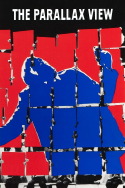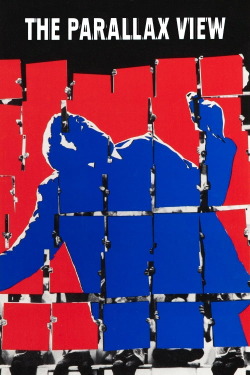
Review of The Parallax View (1974) by Paul Z — 05 Mar 2011
I don't know how to start this review of the second installment in Alan J. Pakula's virtuoso Paranoia Trilogy. I guess I'll start at the beginning. The brooding realism of the beginning is arranged with a keen sense of the vertical. The camera divulges Seattle's Space Needle tower behind a totem pole, where an assassination goes down amidst Independence Day pomp. A committee of officials, constrained by the frame, proclaims the lack of evidence of a wider conspiracy, yet these are Watergate times, and Alan J. Pakula marshals his investigation as a compulsory act of "irresponsible speculation." Gordon Willis' cinematography twists the menacing from the everyday with unreserved harshness: Overwhelming architecture, the bomb warning scrawled on a napkin, one character's last cup of coffee. All of the decade's political misgivings and introspection is concentrated into the merciless culmination, with Yankee Doodle trumpeting in the bare hall while unpleasant transactions imbue the catwalks above, a country awakening to methodical obscurity and transparency alike.
What happens to our muck-raking protagonist splinters the movie's straightforward standards and leaves the final 40 minutes or so as the most transcendent, impressionistic illustration of paranoia, not as a psychosomatic condition but more like the belief in it as an idea, that I've ever seen. The first half of Pakula's anamorphically shot impressionistic thriller is about paranoia, the second is paranoia.
The evolution is realized through what I sincerely consider to be one of the very central sequences in American cinema in the 1970s, Pakula's virtuoso showpiece of Kuleshov-style perception, the indoctrination slideshow, a celestial event of imagery and keywords shot through the viewer's brains. I could describe further, but the account would be dull and futile. It's simply a conquest of film language in a way that confounds textual explanation. Beholden in no insignificant portion to the Soviet montage theory, in which solitary snippets of imagery are given implication due to the images flanking it, this is shown to us from a character's precise point-of-view. We've become him, and are undergoing exactly what he is.
Pakula shoots on location to capture a careful texture of the outside world's danger much of the time. And he has a strong feeling for the bizarre, as in a scene where a character on a golf cart is shot in a vast banquet hall, and the cart strays, knocks over tables, until police cars arrive on the vestibule floor. There's also an endeavor to enforce the glare of modern American architecture throughout as a monumental backdrop, steel and glass edifices that look somehowâ¦oppressive.
The conclusion has a relentless common sense to it. Sans spoilers, I can merely say that it both insinuates how an establishment might get away with murder, and how the "unassisted loner" hypothesis of assassination has a convincing tidiness about it.
This review of The Parallax View (1974) was written by Paul Z on 05 Mar 2011.
The Parallax View has generally received positive reviews.
Was this review helpful?