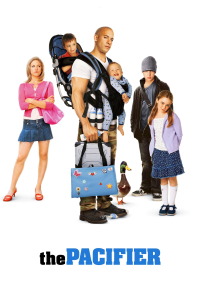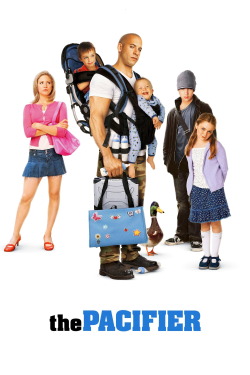
Review of The Pacifier (2005) by Fabio D — 20 Jul 2009
Although it's been the subject of dramatic hagiographic eruptions for nearly thirty years, analysis of Vin Diesel's 'The Pacifier' is far from over. In the wake of the NFT's definitive retrospective of his work last month, a special edition of one of his most beloved films, now restored to its full glory, is to be released in January. As Diesel once joked (purportedly over dinner on the Sunset Strip with Debbie Harry and Jean-Luc Godard), "in-spite of the film's grandiose title, it's actually the least politicised in my oeuvre". And this is its enduring charm: like Diesel himself, it bridged the gap between high art and entertainment.
Of course on initial release the film was vilified. People focused disproportionately on its lack of any discernible merit. It was nearly lost in the celluloid wilderness forever until Martin Scorsese declared it an undisputed masterpiece in 1969. Not since 'Citizen Kane' has a film boasted such a triumphant re-appraisal. Though it's a matter of conjecture, one can assume audiences of the 1940s failed to notice the film's transgression of cinematic motifs due to a lack of critical sophistication. Even with the slight underground following it did achieve, mainly on the drive-in-movie circuit in Hispanic neighbourhoods, it was only understood within the pantheon of 'the-so-bad-it's-good'. It was Scorsese and his followers who recognised its creation of a new paradigm: the 'this-film-is-so-bad-and-not-even-in-a-good-way-and-that's-WHY-it's-SO-good' paradigm. Over time it came to be regarded as the film which heralded the era of 'drip' cinema (known in France as 'cinema de drip'). It spawned countless (inferior) imitations and its impact resonates today in the work of Steve Carr (Daddy Day Care) and Raja Gosnell (Big Mumma's House 2), among others.
But debate rages in cinematic discourse over whether the film, which appears to echo the iconographies of Hulk Hogan's seminal 'Mr Nanny' (by Diesel's own admission, Hogan was a major stylistic influence on his acting), was a self-conscious progression of the genre, anticipating 'Kindgergarten Cop' by 22 years, or if this was a naive underestimation. Alternative scholars have argued that in its bold subversion of cinema's (at the time) conservative gender conventions, it should be construed as the first post-modern omarrge to American melodrama of the early 1950s. Certainly the premise of the film - the struggle of an ex-military man, Diesel (drenched in homo-erotic symbolism throughout), trying to assimilate within a foreign social milieu: the home - indicates the latter. There was another school of thought in the late 70s, led by effete critic David Thomson, suggesting earlier theories were far too literal. For a time the movement enjoyed minor popularity but, being comprised mostly of opium addicts and sex offenders, was soon discredited. Whatever ones intellectual fancy, it is undeniable Diesel embodies the emotional conflicts of the role with gut-wrenching pathos.
Sadly the film marked the end of Diesel's career as a serious actor. Though he did make a respectable number of films in his later years, he opted mainly for unchallenging b-pictures, in the vein of 'Fast and the Furious: Toyko Drift', none of which matched the joyous cavalcades of humour and emotion that crowned 'Pacifier'. But it was an ill-advised publicity stunt at the 45th Annual Academy Awards that sealed his fate as one of Hollywood's most notorious outcasts. Diesel, a long-time champion of camel rights, seeking to raise awareness of their plight, rode down the red carpet on his own pet camel, Morris. In a moment of glorious schadenfreude for the onlooking world, Morris shat on Nicole Kidman's head. It was a PR cataclysm. Diesel never worked in the industry again. Morris is now starring in a production of 'View from the Bridge' at London's Old Vic. Seminal - Esteban Comulet.
This review of The Pacifier (2005) was written by Fabio D on 20 Jul 2009.
The Pacifier has generally received mixed reviews.
Was this review helpful?