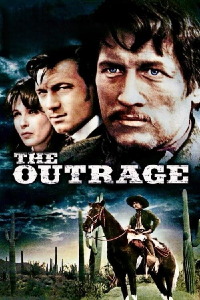
Review of The Outrage (1964) by Zack B — 14 Aug 2010
In terms of plot, dialogue and action, Outrage is a Xerox copy of Japanese director Kurosawa's legendary, innovative Rashomon (1950).
Outrage transplants a Western motif - samurai becomes former Confederate colonel, channeling medium becomes Indian medicine-man, Japanese bandit becomes Mexican bandito. Perhaps more palatable to American theatre-goers, but the migration muddles.
Rashomon's a much better fit with historical elements of Japanese culture such as samurai legend, kabuki and face-saving of honor. What Southern belle would ask her husband to kill her so he wouldn't be dishonored by the shame of her being raped?
More importantly, Rashomon's innovative cinematography is mostly missing here. Kurosawa broke the 180-degree rule as the witness walks into the forest to intentionally disorient the viewer. And defied convention by shooting straight into the sun, up through the thick canopy of trees. Both done to convey entry into another world. He swings the camera 270 degrees, pivoting on a face, more than once. Kurosawa shot B&W, creating incredible visuals. Faces, simultaneously covered with shadows of leaves and mirrored natural sunlight, symbolize the co-existence of good and evil in men. Kurosawa employed left-to-right wipes for certain transitions, unseen in Outrage. Kurosawa's evocative facial close-ups, where every single drop of sweat looks precision-placed, probably inspired Sergio Leone. And Rashomon's the first use of flashback as device; in fact, Kurosawa actually employed flashback inside flashback.
Outrage is all-but-forgotten due to such directorial shortcomings; ask even an avid film fan when Edward G. Robinson played a snake-oil salesman or Paul Newman played a Mexican bandito and see just how forgotten it is.
RECOMMENDATION: If you've seen Rashomon, take a pass. If not, spin them both as double-bill - and see how great direction can easily trump great acting.
This review of The Outrage (1964) was written by Zack B on 14 Aug 2010.
The Outrage has generally received mixed reviews.
Was this review helpful?