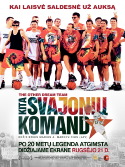
Review of The Other Dream Team (2012) by Leon B — 06 Nov 2012
Dave Zirin, one of Americaâ(TM)s most prolific political sportswriter, wrote that âthe very passion we invest in sports can transform it from a kind of mindless escape into a site of resistance.â? With all the pomp and circumstance we afford sports today - the 24-hour cycle of media coverage, greedy ownership, athletic merchandising and advertisements â" sports have become merely another cog in todayâ(TM)s economic globalization. For the younger generation, it may be hard to fathom that before the Michael Jordans, Lebron James, and Tiger Woods, it was the Muhammad Alis, John Carlos and Tommie Smiths that globalized their respective sports, not through commercial means, but political ones.
As an avid sports fan, I find that sports is at its most entertaining when it is infused with some sort of political implication. And anyone who dares to suggest that sports and politics should never coexist is mind-numbingly misinformed. While we still see the cultural and political resonance in international sports today, American sports has been politically starving for quite some time. Consider soccerâ(TM)s international stage, specifically the âEl Clasicoâ? matches between Spanish giants Real Madrid and Barcelona. The sport becomes a political means of contestation between divided factions within the nation. Imagine how great the NFL would be if their games had a hint of cultural and political significance. Why donâ(TM)t we encourage and cheer for the defeat of the Arizona Cardinals, a state that encourages racist policies and treatment of immigrants? We do not because this is a testament to how successfully corporate America has shielded us from the everyday concerns of this country. Sport is cheered because it comforts us from real worries. Donâ(TM)t worry about Hurricane Sandy. The New York Knicks and the Miami Heat are playing!
The reason I bring this up is because in Marius Markeviciusâ(TM)s new film âThe Other Dream Team,â? not only does it reveal how sports became a form of resistance but it is contrasted with the moment when sports was devaluing in American society. âThe Other Dreamâ? is a compelling and insightful documentary about the Lithuanian basketball team in the 1992 Olympics in Barcelona, Spain.
Before Lithuania was a sovereign nation, it was a tiny nation sandwiched between two oppressive countries, Germany and the Soviet Union. The film chronicles the extent to which the Soviet Union ruled this tiny population with an iron fist. At the center of the film are Sarunas Marculionis and Arvydas Sabonis, the two stars of the Lithuanian basketball team. The former was drafted by the Golden State Warriors and the latter played for the Portland Trailblazers. The film juxtaposes the extreme political conditions in which they lived under with the fact that they played for the USSR. In the â(TM)88 Olympics, four Lithuanian players made up the Soviet team and helped lead their oppressive rulers lift the gold. Despite their exceptional talent, the government hindered their progress as they made it difficult for them to play in the NBA.
After the end of the Cold War, Lithuania gained its independence. Then with the 1992 Olympics coming up, Lithuania saw a window of opportunity to present themselves in the worldâ(TM)s stage. With the funding from the Grateful Dead and sporting totally awesome psychedelic tie-dye shirts, the Lithuanian basketball team played for more than just victory. They played for resistance. They played for identity and nationalism. Although they eventually lost to the Dream Team in the semi-finals, it was the third-place match against the Soviet Union that was pivotal for the nation.
Markevicius does a very good job at always focusing on the political aspects of the story. He strays away from the typical norms in sports films. What I love most about the film though is perhaps unintended by the director. While the film is ultimately about the Lithuanian basketball team and how the sport served as a weapon of resistance, it conversely reveals the deterioration of politics in American sports. Although the film hardly focuses on it, the contrast is there. The formulation of Americaâ(TM)s Dream Team may have some political significance. With the Cold War nearing its end, their need to reclaim the gold from the Soviet Union is very much in the back of their minds. Yet, the dominance of the USA team always remained at a superficial basketball level. They were not playing for nationalization. They played for fame at a global level. I believe this set the trend for basketball, once Americaâ(TM)s most politically laden sport, to become part of the economic globalization.
âThe Other Dream Teamâ? is great in that it proves sport is inherently political, even when it is not.
This review of The Other Dream Team (2012) was written by Leon B on 06 Nov 2012.
The Other Dream Team has generally received very positive reviews.
Was this review helpful?