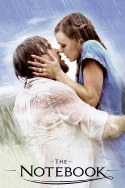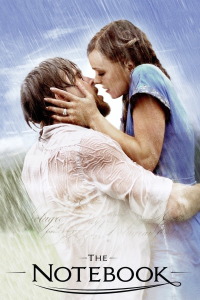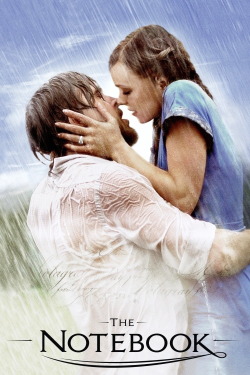
Review of The Notebook (2004) by Cameron J — 04 May 2013
By 2004, they had, like, twelve adaptations of Nicholas Sparks books, and it took them this long to get around to adapting his first one. Hey, whatever, I welcome it, because this film is actually pretty good, and we seriously need compensation for "A Walk to Remember", not just between 2002 and 2004, but still to this day, yet that didn't stop the critics from having some kind of bias that kept them from liking this. Hey, I can't say that I went into this film thinking, "From the director of 'John Q' comes an adaptation of a book by the author of 'A Walk to Remember' that I'm sure will not stink", nor did I walk away finding it awesome, but make no mistake, this film is better than they say, even though it does have its cheesy moments. Hey, when this film came out, Ryan Gosling had just got done playing a Neo-Nazi and some teenager who brutally murdered people... in two separate films, so it was about time for him to do something a bit fluffier, much like Rachel McAdams, who just had to have been an emotional wreck after getting off of such intense projects as "The Hot Chick" and "Mean Girls". I can think of some people who would say that they were more disturbed by "The Hot Chick" than anything that Gosling did before this film, so I guess the match works, yet Gosling still didn't immediately find his handsome, charismatic and talented self fired into the stardom that McAdams got by this film, probably because Gosling still had the integrity and, well, after this film, money to go back to doing stuff that middle-aged housewives aren't likely to even hear about. I mean, don't get me wrong, Gosling broke out eventually, but come on, it still took a while even after this film, though that might just be because of the mixed reviews, because, as you all know very well, the members of the pop culture who decide who becomes popular or not always listen to critics. Sarcasm aside, the audience is right in saying that Nick Sparks actually did something good before doing about 100 mediocre things, though you shouldn't completely disregard the critics, as their complaints are hardly completely invalid.
At just over two hours, the film is somewhat lengthy, and is certainly pretty meaty, yet its concept, in a lot of areas, holds too much meat to fully juice in two hours, as reflected by story structure's pacing's being, like the pacing of plenty of other Nicholas Sparks novel adaptations, uneven, having enough meditative points to compel thoroughly, but still taking advantage of its main story's being framed to all too often only hit highlights in exposition in a storybook, objective fashion that distances you from substance a bit, and thins out meditative value. The film will run a steady pace, only to suddenly jar things along, and while you're never quite jarred loose from the film, events are often awkwardly tossed at you, and such a formula proves to be detrimental to the momentum of substance's impact, whose blows are further softened by yet another hallmark in Nick Sparks stories: subtlety issues. There have been more histrionic interpretations of Sparks' questionable dramatic efforts, but when this film's genuineness slips, its subtlety lapses range from offputting to considerable, whether when it's slapping down a rather disconcertingly syrupy dramatic beat or going so far as to craft such borderline over-the-top characters as wealthy, disapproving parents antagonists, whose layers feel a particularly forced, yet are not the only questionable components to characterization depth. Our leads are at least well-portrayed enough to come off as layered and meaty, but when it's all said and done, there is only so much depth in this film, and I don't know if it's because of the superficiality in Sparks' story concept or because something got lost in translation when Sparks' story was brought to the screen, but either way, the point is that histrionics can be fought back only so much. Needless to say, the histrionics would be more forgivable if the storytelling beats that are somewhat cheesed up weren't so familiar, because if no other department in this effort feels somewhat lazy, it's the originality department, which turns over stone after stone, until predictability ensues. There's a twist to this film that is so easy to see coming that, before too long, the film even feels like it gives up trying to obscure it, and while that is the height in the final product's predictability, it's not the only predictable beat to the final product, which makes up for originality and dramatic shortcomings more often than not with considerable inspiration, but faces shortcomings nevertheless, falling short of its full potential. With that said, the final product doesn't quite fall so far from grace that it doesn't reward, having many a flaw, but ultimately quite a few more strengths, even in the photographic department.
The film isn't stunning, or at least not consistently so, yet when cinematographer Robert Fraisse's eye catches the right environment, the visual results range from striking or truly gorgeous, boasting a soulful grace that catches your eyes when it is infused in Fraisse's photography, as surely as it grips your attention when it is infused in Aaron Zigman's score, which is a bit formulaic and minimalist, but lovely and heartfelt, with a distinguished flavor that proves to be comfortably compatible with the substance that it compliments so well. Aesthetically, the film accels with a graceful taste that does a fine job of breathing soul into flawed substance, whose effectiveness is ameliorated a bit by the filmmakers' aesthetic punch-ups, but, quite frankly, doesn't need pretty visuals and nice tunes to gain your attention. Nicholas Sparks' story concept is, of course, flawed, being derivative and with its share of subtlety issues, but when you step back and see through all of the hiccups, you can find one of Sparks' most worthy concepts, and while such a concept is not fleshed out nearly as much as it could have been in execution, it's rich with endearing heart that cannot be ignored, especially when emphasized by what is, in fact, done right in Jeremy Leven's and Jan Sardi's script, and, of course, Nick Cassavetes' direction. Even outside of this film, Cassavetes isn't exactly notorious for his genuineness as a teller of a conceptually resonant tale, and sure enough, the histrionic value in the film is all too often milked for all its worth, yet for every somewhat overblown dramatic beat, Cassavetes delivers a resonant punch that gives you a taste of what could have been, and firmly reminds you of what ultimately is, a very compelling drama that, in spite of its shortcomings, wins you over time and again. By the time we reach the final act, the film really starts to pierce with sentimentality that is backed enough by genuineness and soul to all but move you to tears, and while this story concept deserves to have more of that punch, perhaps even at a greater intensity, golden occasions can be found the in midst of a compellingness that, while often diluted, never dissipates, being backed by much in the way of inspiration, both off of the screen and on the screen. The acting isn't killer, but it is strong across the board, with James Garner and Gena Rowlands ultimately delivering on sparkling chemistry and emotional range in their portrayal of good, but old and deteriorating souls, while the dashing Ryan Gosling and gorgeous Rachel McAdams carry most of the film with their distinguished charismas, bonded through powerful chemistry, and backed with a human emotional resonance that is more layered than the actual written characterization of the Noah Calhoun and Allison "Allie" Hamilton characters, who are well-defined enough by their portrayers to engross as worthy leads. Many are not likely to walk away loving this film, but it is rather underappreciated, being flawed something fierce, but ultimately with enough inspiration and rich soul to thoroughly engage and ultimately reward.
Overall, pacing unevenness keeps the film from soaking up its full depth, whose kick goes further diluted by subtlety issues and conventionalism, until you're left with a flawed final product, but one that still compels, using lovely cinematography and score work to compliment the taste within Nicholas Sparks' undeniably meaty story concept, which is brought to life well enough by Nick Cassevetes' direction and a strong cast for "The Notebook" to ultimately stand as a flawed, but quite good melodrama that rewards the patient.
3/5 - Good.
This review of The Notebook (2004) was written by Cameron J on 04 May 2013.
The Notebook has generally received very positive reviews.
Was this review helpful?