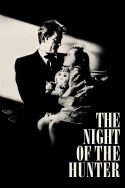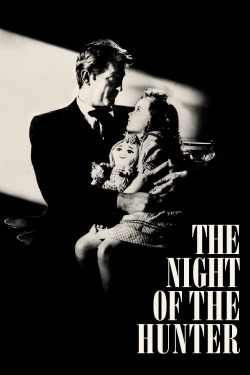
Review of The Night of the Hunter (1955) by Edith N — 26 Jun 2012
They May Endure, But Therapy Is Still a Good Idea.
Obviously, I first saw this film when I was taking that course about the American South in college. Fall quarter, an article had come out called, "Is There a Dead Mule In It?" The article speculated that the defining characteristic of Southern literature was the presence of a dead mule. And indeed, as the school year progressed, our class began noting the dead mules which appeared in just about every book, short story, or essay we read--every movie we watched unto the documentaries. And then, deep in the '30s, we came across this. It is not merely an intensely Southern film; it is a clear example of the Southern Gothic. And yet there is no dead mule to be seen. We as a class puzzled over this for some time. And then we came up with the solution, dubbed the Creepy Old Man Corollary to the Dead Mule Hypothesis of Southern Literature. Namely, if no dead mule can be found but you still think it's Southern, look for the Creepy Old Man.
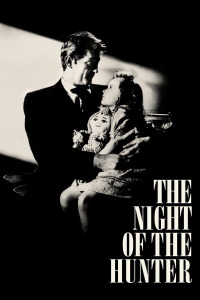
Ben Harper (a very young Peter Graves) has robbed a bank. Killed two men while he was at it, and he's on the lam. The police are in hot pursuit. But he makes it home, and he hides the $10,000, and he makes his children--John (Billy Chapin) and Pearl (Sally Jane Bruce)--swear that they will never tell where it is. Only in his last days before his execution, his cellmate is Preacher Harry Powell (Robert Mitchum). Harry is in for thirty days for stealing a car, but he has also wooed and killed more than a few women, and he thinks getting the money out of Ben's widow, Willa (Shelley Winters), will enable him to build a tabernacle to the Lord. Willa is a weak little thing, and she falls for Harry pretty much immediately, but John doesn't trust him even a little. She is also afraid of raising her children alone as the children of an executed criminal. And so she marries him, and it really doesn't go well for much of anyone.
I think this movie--and presumably the book on which it is based--is scariest for people who remember what it is like to be a child. The fear of this movie is only partially the fear of Robert Mitchum with a knife. Really, the fear of this movie is an inherently childlike fear--the fear that people will not believe you when you try to tell them that there is something wrong. Willa is willing to completely sublimate herself into what Harry wants from her. Icey Spoon (Evelyn Varden) is the one who pressures her mother into being willing to get married, and it isn't until it is too late for the Harper family that her husband, Walt (Don Beddoe), is willing to say that he doesn't quite trust that Harry Powell. Birdie Steptoe (James Gleason) might believe him, but he's a crazy old drunk (see above) and cannot help the children. Billy Chapin was twelve, and John is a child explicitly given adult burdens. He has sworn to protect Pearl with his life, and there is no one helping him. Even Pearl is won over by Harry!
The casting in this movie is really superb. Robert Mitchum exudes ominous sexuality. Shelley Winters is only just barely prettier than average, and she always sort of exuded a wish that you would walk all over her. When Willa goes to her death, Winters played her with an air of ecstatic sacrifice that I'm not sure any of the other suggested casting choices might have managed. Lillian Gish as Rachel Cooper was cast specifically to remind us of the great silent era, wherein she was a symbol of staunch womanhood. The first time I saw it, back in that class, we spoke with great admiration of how wonderful she is in the film's climax, standing guard over the children with a shotgun. Even the children are cast well. Sally Jane Bruce was seven, and this was her only feature. While it is also true that the film is beautifully filmed and staged, the skillful cinematography and set design would have meant nothing without the cast.
The film was controversial in its release; well, it would be. It was about a psychopathic preacher who married and then killed rich women. It's also a hard film to categorize, which meant marketing wasn't easy even to people who weren't instructed from the pulpit to avoid it. However, its weight in popular culture has only increased over the years. Harry Powell's knuckle tattoos have been referenced in [i]Do the Right Thing[/i] and [i]The Simpsons[/i], among others. (Of course, Sideshow Bob only has three fingers and a thumb and spells the words phonetically.) Contrary to Robert Mitchum's claims, James Agee's script was the main basis for what appears onscreen, and between him and Charles Laughton (who was meticulous in his direction, again contrary to Mitchum), a great work of art was produced. I can understand the people who were offended at the idea of a man of God who was so broken inside, but it's hardly as though the thing was unheard of even then. All in all, it really is one of the greatest films of the 1950s, if not of all time.
This review of The Night of the Hunter (1955) was written by Edith N on 26 Jun 2012.
The Night of the Hunter has generally received very positive reviews.
Was this review helpful?