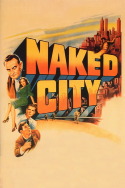
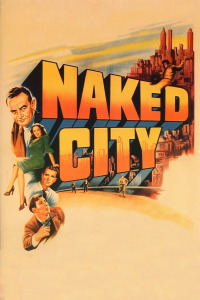
Review of The Naked City (1948) by Edith N — 25 Apr 2012
The Number of Stories in the Naked City Keeps Going Up.
The Criterion release of this includes a great deal of discussion as to whether the movie really counts as noir. Personally, I think people only consider it one because it is a crime movie made in the '40s which was influenced by Italian Neorealism. It is relatively stark, and it was filmed on the streets of New York, using the people of New York as extras. However, it is missing almost all the hallmarks of noir. Most of the story takes place during the day. Most people are pretty much exactly what they appear to be. The cops are unalloyed heroes. Between story and film style, they are much closer in feel, as one of the people interviewed points out, to [i]Law & Order[/i] and its own imitators. This is a police procedural; the cops are good guys who are doing their jobs the way they're supposed to. The movie led to the TV show of [i]The Naked City[/i], and from there [i]Dragnet[/i], [i]Law & Order[/i], and so forth.
Jean Dexter is dead. Chloroformed, hit over the head, and drowned in her bathtub. The detective assigned to the case is Lieutenant Dan Muldoon (Barry Fitzgerald), who quickly discovers that Jean Dexter was about the only person in the whole movie who wasn't what she seemed. She worked as a model in a dress store with the also beautiful Ruth Morrison (Dorothy Hart). Ruth is engaged to a man named Frank Niles (Howard Duff), who used to date Jean. He denies knowing either of them, which of course arouses Muldoon's suspicion. Not helped is the fact that a ring Jean was wearing when she was killed had been stolen some months previous--as had Ruth's engagement ring. Frank further fails to help his case by pawning a gold cigarette case--you guessed it, stolen--and buying a ticket to Mexico. The evidence also shows that Jean was killed by two men, which strongly implies that the thefts go beyond Jean and Frank.
Really, the star of the movie is New York. Location filming in New York had pretty much ended with the coming of sound, because New York is a very noisy place. However, without its location filming, this would have been a very different movie. Director Jules Dassin explores the city with his camera, showing us the homes of the wealthy, the homes of the poor, and everything in between. Everything from a Park Avenue doctor's office to a corner store surrounded by tenements. In many ways, the film works as a picture of New York as it was then. Almost, in fact, better than the detective story itself. The film's voiceover structure takes us inside the heads of ordinary New Yorkers who have nothing to do with the case. Their very distance from the case enables them to say things that no one involved with it can. It is more important to those people that she was beautiful and that she was found naked than who she was as a person. That's human nature for you, and New York is a very human city.
It was a little odd to see Barry Fitzgerald as a New York City detective, I'll admit. In my head, he is Michaleen Flynn from [i]The Quiet Man[/i], and that's all he's ever going to be. Oh, he did a fine job at solving the case, and it's certainly true that there is a long tradition of Irish policemen in the United States, but it was still odd. But one of the things the movie touches on is the ethnic diversity of New York. The woman who runs the store where Jimmy Halloran (Don Taylor) buys his root beer is very obviously Jewish, and there are several other ethnicities mentioned. The city is shown as being a melting pot, just as it ought, full of people from all over. There are Asians, even, and that doesn't show up much in street scenes of the era. Not filmed ones, anyway. I'll admit I don't remember seeing them myself, but they were definitely mentioned in the special features. I don't remember blacks or Hispanics, either, but it's hardly as though it's impossible that I missed them as well.
I suppose one of the defining characteristics of a police procedural is that it does not, in the end, entirely matter who killed Jean Dexter. In most variations on the detective story, the victim is carefully drawn before their death. The suspects are all known to one another, or at least obvious to the detective. And so forth. But Jean Dexter is dead at the beginning of the film; she doesn't even get any lines. The point is not to guess who killed her before the detectives find out, because we don't get any clues they don't have. The point is to follow the trail of evidence as they do, finding out about suspects as they do. Oh, we know that one of the killers will be found floating in the river before the cops do, but we don't know who he is or what caused the falling out. We learn why Jean Dexter was killed along with the detectives, and the only thing that makes us really care who killed her is that we want to see these people doing their jobs.
This review of The Naked City (1948) was written by Edith N on 25 Apr 2012.
The Naked City has generally received very positive reviews.
Was this review helpful?