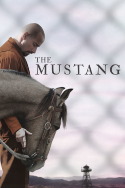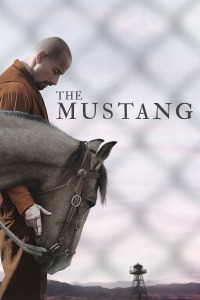
Review of The Mustang (2019) by Bertaut1 — 08 Sep 2019
Nothing you haven't seen before, but it's very well-made and genuinely moving.
The pitch for The Mustang is as hackneyed as it gets – a dangerous convict given a shot at redemption by working with a dangerous horse, and as the man tames the animal, the animal tames the man. However, despite its derivative underpinnings, The Mustang has been made with such craft that it transcends the clichés. And yes, chances are everything you think might happen does, but the acting, the emotional beats, and the authenticity all contribute to the whole, wherein it turns out the familiarity of the destination doesn't matter so much when the journey is so well executed.
In a Nevada jail, the emotionally shut down Roman Coleman (Matthias Schoenaerts) is serving a 12-year bit and upon being released from solitary, he's assigned to clean up the horse dung from the mustangs used in the Wild Horse Inmate Program (WHIP), wherein the inmates "gentle" the animals – essentially, tame them so they can be sold at auction. Given the chance to work with an especially unruly horse that's considered unbreakable, Coleman names him Marquis (although he mispronounces it as Marcus), and sets about trying to connect with the horse in a way he hasn't connected with anyone or anything in many years.
Written by Laure de Clermont-Tonnerre, Mona Fastvold, and Brock Norman Brock and based on de Clermont-Tonnerre's short Rabbit (2014), The Mustang is her feature directorial debut. As the opening and closing legends tell us, WHIP is real, with prisons in 13 states adopting it, and research showing there is a significant dip in recidivist rates amongst inmates who have worked with the horses.
Despite the narrative outline suggesting otherwise, The Mustang is not a sentimental film. De Clermont-Tonnerre avoids, for example, romanticising the relationship between Coleman and Marquis; they don't have a psychic bond, rather they connect emotionally, nothing more. Their relationship is not an opportunity for glib esotericism regarding the human condition, it's a simple friendship.
In terms of acting, this is Schoenaerts's film. We've see him do quiet brooding intensity before, in films like Rundskop (2011), De rouille et d'os (2012), and Maryland (2015), but he's exceptionally good at it and is rarely less than mesmerising to watch.
Aesthetically, Coleman is repeatedly connected with Marquis. For example, the film opens on a close-up of a mustang's eye, and the first time we see Coleman, it's a BCU of him opening his eyes. Later, there's a shot in which he's reflected in Marquis's eye and a scene where they are both pinned to the ground, facing one another. Also, when Coleman is confined to his cell, we see him pacing back and forth and punching the wall, recalling Marquis's earlier behaviour in his stall. Sure, none of this is subtle, but it is effective, with de Clermont-Tonnerre communicating emotions and themes visually.
A major theme is the danger of losing self-control. An anger management class sees the prison psychologist (Connie Britton) ask each prisoner how long passed between the thought of their crime and its execution, and how long have they been in jail. None say there was more than a few seconds between thought and deed. The point is clear; a split-second decision has landed then in prison for years. It could be a scene out of any prison documentary (it would have fit right into The Work (2017), about the Inside Circle program in Folsom), and it's a good example of de Clermont-Tonnerre hanging back when she needs to.
Of course, the film is not perfect. We've all seen pretty much everything in The Mustang, and for some, the familiarity will be off-putting. A bigger issue is a subplot involving Dan (Josh Stewart), Coleman's cellmate, who blackmails him into smuggling ketamine into the prison. This subplot feels like it's been imported from another film entirely, and these scene are the weakest and the most inauthentic in the film. The narrative needs Coleman to be at a certain place at a certain time, and de Clermont-Tonnerre uses this storyline to facilitate that. But there were far more organic ways to have accomplished this without resorting to a subplot that is so tonally divorced from everything around it.
On paper, this is a clichéd social protest film with a standard redemption arc, but de Clermont-Tonnerre fashions it into something emotionally authentic. She embraces, for the most part, non-judgmental restraint, simplicity, and sincerity, and more than once communicates meaning visually. Her intimate direction and Schoenaerts's committed performance allow the film to remain always genuine and respectful, as she suggests that when you treat someone like a human being, you may find their humanity. And the most fascinating and beautifully handled trope is that Coleman's humanity could only be found, drawn out, and nurtured by an animal.
This review of The Mustang (2019) was written by Bertaut1 on 08 Sep 2019.
The Mustang has generally received positive reviews.
Was this review helpful?