Review of The Men Who Stare at Goats (2009) by Edith N — 27 Jul 2011
Of Course, It All Starts in California.
There's this curious mindset in certain people that, just because the US military worked on something, that means it worked. A brief examination of military history makes it quite clear that this isn't true, and indeed makes it quite clear that the military is perfectly willing to waste a lot of money investigating or building or what have you somebody's baby, even if all the evidence is against it. The movie's own IMDB page points out that none of the real people the movie is loosely based on ever went out for James Randi's million dollars. And you can't even use the dodge that the whole thing is classified, because of course everyone knows the project existed, and it would be entirely possible to claim the million dollars without ever mentioning any military connection. But in any discussion of "remote viewing" or what have you, someone will point out that the US military was working on it, so [i]of course[/i] it's real.
Bob Wilton (Ewan McGregor) is a reporter whose life is falling apart. His wife (Rebecca Mador) is leaving him for his editor. So he decides that he's going to do something daring, and he goes off to the Middle East to be a war correspondent. Only he spends his time sitting around in a bar in Kuwait City, waiting to get approval to cross the border. One night, he encounters Lyn Cassady (George Clooney), whose name he has heard before. Bob interviewed one Gus Lacey (Stephen Root), a man who claimed he has been involved in psychic warfare for the army, and he mentioned Lyn Cassady as the best they had. A man who could stop a goat's heart by staring at it. And indeed, Lyn spins a story of the military's top psychic research program, the New Earth Army. It had been created by Bill Django (Jeff Bridges), who had been in Vietnam when he discovered that soldiers don't want to shoot the enemy. So Django decides that he will find other ways of fighting wars, ways that are actually about peace. And things go kind of crazy from there.
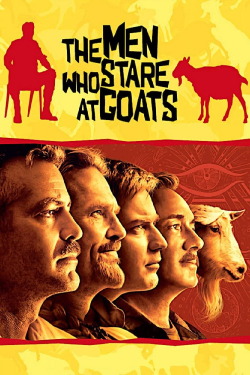
A lot of people have written about George Clooney in this, for the excellent reason that he's ideal for the character. However, I think all four of the stars were perfectly cast, which I understand is a bit of a minority opinion. Then again, that I liked it as much as I did is also minority, so there's that. But I mean, who else could they have cast as Django but Jeff Bridges? (Graham, who is home sick, suggests Dennis Hopper, but I think he was too menacing.) Jeff Bridges gives off the perfect aura of the hippie burnout, but he is a talented enough actor to make it appear as though a bad experience with the military was what caused the burnout as much as the, um, extensive experience in narcotics. (Here, I refer exclusively to the character; I have no personal knowledge of how much experience Jeff Bridges does or doesn't have with narcotics.) What's more, Kevin Spacey as Larry Hooper projects weary self-interest, and Ewan McGregor is the figure on whom we imprint our own views.
To be fair, there is a lot about this movie which is not for everyone. I think the best way to look at it is with an assumption that these people really believe what's going on but are wrong. If you look at it as a treatise on the nature of belief, as opposed to a commentary on US military policy in general, I think you come closer to its intention and are less likely to get tangled in politics. It leaves you to be amused, or not, by the inherent humour of the resulting situation. After all, Bob believes Lyn and trusts him to get them out of the ridiculously dangerous situation they've gotten themselves into, and if he's wrong, that means he's in trouble. A lot more trouble than he thought. And with a single exception, nothing in the movie really requires the various psychic powers to be real in order to happen or even make sense. What's more, that single exception may be seen, if you like, as metaphorical.
If this movie is about politics, it is largely about office politics. In theory, these men are all on the same side. We see Iraqis, and of course there is a scene where Django is fighting in Vietnam, but enemy soldiers are scarcely more evident in this movie than women. (There are two credited female characters and one uncredited; they have perhaps two or three lines among them.) The simple fact is, the main conflict in this movie is between the boss's favourite and the boss's least favourite. Hooper wants his boss's job, because he thinks he can do it better. Lyn thinks Hooper has destroyed everything which was great about the New Earth Army. What enemy the United States Army is fighting at the time is, to them, largely immaterial. The battle against Communism got them started, and their "work" is continuing into the war on terror, but broadly, they don't care. In fact, Lyn thinks that, if you are fighting, you have lost. All the same, he wants to get that little twerp Hooper.
This review of The Men Who Stare at Goats (2009) was written by Edith N on 27 Jul 2011.
The Men Who Stare at Goats has generally received mixed reviews.
Was this review helpful?