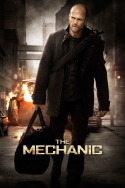
Review of The Mechanic (2011) by Shiira — 09 Feb 2011
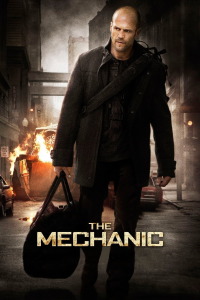
The hitman wants some information and he won't accept silence as an answer. During a home invasion, it appears as if Arthur(Jason Stratham) will bring harm to an innocent girl, which runs contrary to his proclamation that he only goes after people who had it coming, but now, in a strange kitchen, we find the self-described mechanic threatening to grind a young woman's hand down the garbage disposal, unless her father fails to divulge the whereabouts of their duplicitous boss, Dean Sanderson(Tony Goldwyn).
"You bastard!" screams the prostrated mother, held down, face first, at gunpoint by Steve McKenna(Ben Foster), Arthur's apprentice(and receptacle for penitence). Surely, there's no need for names, since the mechanic, under normal circumstances, eliminates any chance for collateral damage via his meticulous planning, largely because he's a sociopath with ethics, an honorable killer.
The father, the man on the spot, slow to react, as a result, prompts Arthur to make good on his threat, and for a couple of agonizing seconds, he has us going, has us believing that the girl will be needing a prosthetic, but it's steak, not phalanges and worse, that creates the pulverizing noises.
This mean streak, albeit a fake one in service of a hoax, evokes Stratham's predecessor, the late Charles Bronson, whose minimalist take on Arthur Bishop in the 1972 original differs in that his hitman, a mustached hitman, largely acts apathetically toward the murdering of innocent bystanders.
The wordless sixteen minute opening to the Michael Winner film climaxes with a fiery apartment complex explosion, destruction on a scale wide enough to have claimed additional lives, on top of the original target.
Compare that to the beginning of the remake, in which the clean shaven assassin takes out the Colombian druglord without having to molest one member of the kingpin's minions who occupy the opulent mansion.
And unlike the assurance he gives Steve(during his on-the-job training) that the man they had just killed was an unscrupulous arms dealer, the Bronson vehicle never makes reference as to why the incinerated man was selected for removal.
On another job, the underrated actor breaks the neck of a hapless fast food worker, for no other reason but to steal his Chicken Lickin' vehicle. Whereas Stratham's mechanic derives no gratification from his outlaw profession, Stratham's forebearer takes delight in seeing a man squirm for his life, even if that man is a confidant.
In the hyperkinetic remake, Arthur shoots an incapacitated Harry McKenna(Donald Sutherland), his wheelchair-bounded mentor, in a parking garage without any histrionics, or sense fun and games. To the mechanic, killing a man in cold blood is business, not pleasure.
But the seventies era original has its namesake torturing his prey, prolonging the inevitable on a deserted beach where McKenna is repeatedly shot at, near-misses meant to provoke a spontaneous coronary attack.
Modeled after James Bond, the mechanic, in actuality, seems closer to the Bond villain, who often toyed with the secret agent rather than simply killing him. Alas, McKenna doesn't escape; he dies, but the mechanic's impish spirit could have easily resulted in McKenna's bolting, due to the hired killer's penchant for drawing things out.
He has no scruples, this mustached mechanic; he enjoys his work, as opposed to the remodeled Arthur Bishop, who expresses remorse for the systematic execution of Steve's father, most explicitly, in a scene where the mechanic can't bear to glance at a picture of the murdered man which the son, his future protege, hands him.
In Winner's film, the moviegoer never gets the sense that Bronson cares, one way or the other, about orphaning Jan Michael Vincent. The Lithuanian gives away nothing. Stratham, on the other hand, gives away too much.
The spirit of Bronson, or more pointedly, the spirit of the justified homicide that ran through the films Winner made with his muse, lies within Steve, who attacks a would-be carjacker and a would-be rapist, which are the sort of violent counter-attacks against minorities(black) that got "Death Wish" charged with racism, and also, galvanized sold-out audiences, who couldn't get enough of vigilante justice, back in the politically incorrect days of the early-seventies.
The ending, predicated on the notion that the mechanic has no conscience, is duplicated in the remake, but it's rendered nonsensical by Stratham's attempt at a thoughtful performance. As a result, the mechanic seems too sensitive, too self-reflective to begrudge a son's right for vengeance against his father's murderer, by inflicting some unmotivated vengeance of his own.
This review of The Mechanic (2011) was written by Shiira on 09 Feb 2011.
The Mechanic has generally received mixed reviews.
Was this review helpful?