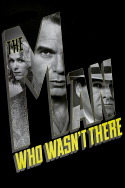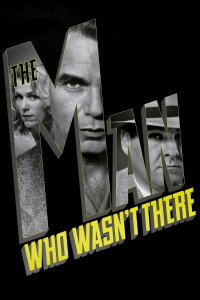
Review of The Man Who Wasn't There (2001) by Edith N — 28 Apr 2011
Flatness of Affect Theatre.
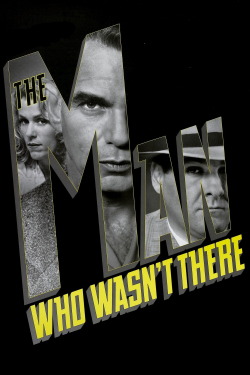
I am constantly amazed at the performances the Coens get out of people I don't really like very much. And it is both of them; not long after this, they started acknowledging in the credits that the movies aren't written by one and directed by the other. (Though Roderick Jaynes hangs on.) I have a hard time imagining a film made by a single Coen brother, though I suppose that might help me remember which is which. Scarlett Johansson still isn't doing very much in this movie. Still no data point where she's actually acting. However, I really don't like Billy Bob Thornton very much. Part of it is that he comes across as just an inherently creepy person in his personal life, and that does tend to bleed into his acting. But I think it's also as much that he tends to play one character. He plays that character just as much and as forcefully as he can. And the character is unpleasant, unlikeable, and undesirable as part of your day-to-day life. But where the Coens excel is taking actors we think we know and transforming them. Or one of the ways--they also take people we don't know at all and make us wonder why we didn't.
Ed Crane (Thornton) works in a barbershop, though he doesn't think of himself as a barber. He works for his brother-in-law, Frank (Michael Badalucco). His wife, Doris (Frances McDormand), works at the town's department store as a bookkeeper. One day, a customer (Jon Polito) comes into the barbershop. He is Creighton Tolliver, and he has a proposition for Ed. If Ed gives him $10,000, he can be Tolliver's partner and get in on the ground floor of the soon-to-be-booming dry cleaning industry. Ed doesn't have $10,000. Doesn't know where he can get $10,000. He decides that the obvious solution to the problem is blackmail. Doris, he believes, is having an affair with Big Dave Brewster (James Gandolfini), the husband of Ann Nirdlinger Brewster (Katherine Borowitz), whose family owns the department store. If he gets into dry cleaning, he won't have to cut hair anymore, which is appealing to him. Only through a convoluted series of events, Big Dave ends up dead and Doris ends up on trial for his murder. Ed killed him in self defense, but he still has no real inclination toward coming forward to save Doris's life.
Honestly, this may be because life doesn't really mean much to Ed. It's not "life is cheap." I don't think Ed would have ever considered killing Big Dave as a solution. It really was a matter of life and death for him. And he certainly is willing to find the money if possible to hire Freddy Riedenschneider (Tony Shalhoub), a high-powered criminal attorney from Sacramento, where actual crimes are committed. It's just that Ed would be happiest if he didn't have to do anything. Not cut hair. Not run a dry cleaning establishment. Not have the Brewsters over for dinner. Not do any of the things we see him do over the course of the movie. In [i]Manhattan Melodrama[/i], Clark Gable expresses horror at the idea of spending life in prison, and Riedenschneider doesn't think Doris would like it much, either, but I don't think it would bother Ed a whole lot. I think he'd even do pretty well with solitary confinement, since he thinks he's all alone inside his head all the time anyway. He sees people, but as if through a pane of glass. It's not much of a life.
To be perfectly honest, I don't think all directors--even all great directors--have a style you can determine on sight. Some of them just build up in ways which show great skill, though their style is eclectic enough so that some terrible directors are more distinctive. William Wyler was a greater director than Ed Wood, for example, but Ed Wood movies are easier to pick out of a crowd of similar movies of similar quality. With the Coens, it's not entirely the visual aesthetic. For example, while both [i]Fargo[/i] and [i]True Grit[/i] do a lot with the emptiness of the land where they're set, this movie does a lot more with interiors. I've been to Santa Rosa; it's lovely, but it's not striking. But Ed lives in a claustrophobic world, and it's that which is more important. The Coens understand that, because where they are distinctive, as I said, is what they do with the characters. Coen characters aren't merely quirky. Some of them are actually quite normal people who have found themselves in astounding circumstances, but the Coens understand them as well as the wacky ones and draw them as finely.
We could discuss the choice of filming this in B&W (which they technically didn't, it seems; that was done in post as was the sepia in [i]O Brother[/i]), but I don't think "choice" is the right word. I think the Coens knew that colour would have overwhelmed the story. Ed Crane is a quiet man living a quiet life. There is so little of interest in it that, when interesting things happen, he doesn't belong there. Interesting lives happen to other people, and any colour would only serve to distract from what little he presents us with. It isn't just that this is a tribute to noir with a Coen twist. It's that the problem with the idea that Film Is in Colour Now is that some stories belong in B&W. B&W gives Ed shadows in which to hide, not out of any desire not to be seen but because not being seen is just part of who Ed is. In the deleted scenes, we see that the clapper is for "untitled barber movie," but indeed, it is the story of a man who, even when there, isn't there.
This review of The Man Who Wasn't There (2001) was written by Edith N on 28 Apr 2011.
The Man Who Wasn't There has generally received very positive reviews.
Was this review helpful?