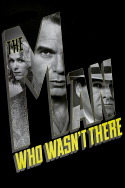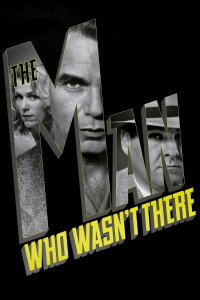
Review of The Man Who Wasn't There (2001) by Jim F — 08 Aug 2012
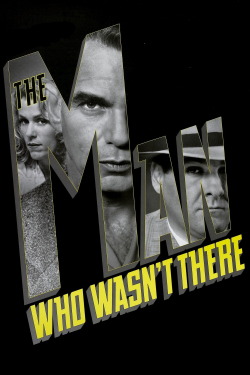
Ed Crane, the man whose weight holds the center of The Coen Brothers' film noir homage The Man Who Wasn't There, is a man of no significance. In his own sad way he disappears into the woodwork, a man one hardly seems to notice. As played by Billy Bob Thornton, he is tall and lean with a deeply-lined face and a quiet, passive demeanor. His eyes drop down, his face isn't quite elderly but is beginning to lose its youth.
This is the 1950's and Ed is a barber, working the second chair in a two-chair shop. He stands behind his customers, working his magic on their hair, a cigarette hanging from his lips almost as an afterthought. His brother-in-law Frank (Michael Badalucco) works the first chair and talks all the time. Ed seems to have gotten use to it, he is lost in his own little world. He doesn't talk much, except to through narration. His thinking is abstract, especially when he is spooked by the pattern of the hair on a kid's scalp. He regards the pattern like a crop circle.
All around Frank are people that he seems to have been chained to for years. Not least is Doris (Frances McDormand), his wife, who works at Nirdlinger's department store and drinks all the time. Frank is convinced that she is having an affair with Big Dave Brewster (James Gandolfini), her boss, a loud-mouth who comes over for dinner, tells stupid stories and makes Doris laugh. Also skulking about is Ann (Katherine Borowitz), Big Dave's wife who seems to always wear expression of a woman who has just seen a large rat. Only later do we understand why.
Something under the surface is eating away at Ed, a long repressed and deeply buried irritation that are brought to a head by two major events: First, he is approached by Creighton Tolliver (Joe Polito) a traveling businessman who is trying to get money to start a crazy new kind of venture called "dry cleaning" - good luck with that. The other comes when he decides to blackmail Big Dave by sending an anonymous letter stating that he knows what's going on with Doris.
Both of these things are brought about when Ed decides to go against his own better nature and do something about a situation he might otherwise have left alone. Both of these events come back to haunt him in the end. More I should not say, except that since this is a Coen Brothers' film we know that it isn't going to go as we think it will.
Shot in glorious black and white, with a quietly deliberate pace, The Man Who Wasn't There is a movie that recalls great film noir. The hero doesn't win, gets himself in too deep and doesn't get out when the getting is good. Ed is a man who is part of the furniture, sitting, thinking, smoking. When he steps away from that station, his world goes topsy-turvy. He falters in his dealings with Tolliver, with Big Dave and with Doris. Having failed there he tries to do right by a sweet kid named Birdy (Scarlett Johannson) who makes beautiful music on the piano. That venture too falters and seems to get him in deeper and deeper.
As with all of Joel and Ethan Coen's pictures, what happens in their films isn't half as interesting as how it is presented. His characters in this film have a unique way of speaking - here in early 1950s vernacular. The world presented here is stuffed with a showcase of interesting characters, cast because of their memorable faces. No one is more memorable to us (ironically) than Ed. As played by Billy Bob Thornton, he is a man who has a deep, buried fear of the world around him. He likes to keep it quiet and calm because when he makes waves, he finds that himself in danger of drowning.
This review of The Man Who Wasn't There (2001) was written by Jim F on 08 Aug 2012.
The Man Who Wasn't There has generally received very positive reviews.
Was this review helpful?