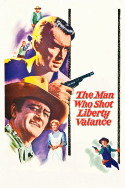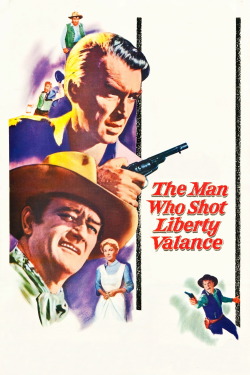
Review of The Man Who Shot Liberty Valance (1962) by Edwin A — 25 Sep 2008
John Ford was one of the few directors who could deftly balance entertainment with more ambitious elements in the undercurrent. Because of that, his appeal to mainstream audiences was as wide as deep his reverence among aficionados. His films are among the favorites of many great directors, from Scorsese to Kurosawa.
Ford made great films throughout his long and illustrious career. One of those was The Man who Shot Liberty Valance. That film, like many of his others, is skewered with problems and elements of period melodrama acted sometimes by not so great actors. But nevertheless, those films, and this one, survive and thrive in spite of them.
James Stewart plays Rance Stoddard, a big wig senator, once a small time lawyer. His fame came as a result of his killing of a notorious outlaw, Liberty Valance. Rance tells his story to a group of reporters when he returns with his wife Hallie (Vera Miles) to the small town where he found fame for the funeral of a man - Tom Doniphon. Lee Marvin plays Valance, who's gang holds up Rance's coach, then mercilessly beats him. He's found by Tom, a rugged wild man played with ferocity by John Wayne. He has a side kick, Pompey, a towering African American.
The two men get along, but there is conflict under the surface. At this stage in the game, Hallie appears to be in line for Tom, not Rance. Rance preaches the word of the law, while Tom insists the only way to survive in this essentially lawless land is through the word of the gun. He frequently stands up for Rance when Liberty rides into town, and though never outwardly stated, seems to emasculate Rance with his protection of him. In the mean time, Rance is persuaded to start teaching the townsfolk to read and write, and starts working for the local paper. He is a jack of all trades but the gun.
When the town decides to elect two delegates to head to the territorial capital city to press for statehood, Liberty tries to bully the people into elected him. Embarassingly, they elect Rance and the local newspaper editor, Dutton Peabody, as their representatives. Soon after, Liberty orders Rance to meet him in the streets, guns drawn, or leave town. They meet, Liberty toys with Rance, then on the final draw is inexplicably shot dead. Rance is celebrated for killing the outlaw, but all is not as it seems in the end.
The first two thirds of Liberty Valance play fairly standard. What keeps it really going is Stewart's fearless wimpishness, Wayne's commanding and quite enthralling screen presence, and Lee Marvin's eccentric and dandyish portrayal of Liberty Valance. His performance, I think, is one of the big highlights of the film. He has such a wildness about him that when he's intimidated by Tom, the scene jumps off the screen.
Ford's direction is characteristically meticulous and understated. The film's best scene comes after Valance has been shot, with Rance and the other townsfolk at the territorial meeting. It's one of the best examples of the 19th century political meeting and their elaborate goings on. Horses ride in as signs are raised and slogans shouted. Wayne makes his reappearance here, after a curious absence during the street gunfight. It's the scene that I remember most vividly from the film, and its crude elegance is enthralling to watch.
As noted, Ford's film's tend to suffer with age due to some period hamminess. His shifting of genre's sometimes can confuse modern audiences, and the melodrama is occasionally thick enough to choke a bull. John Qualen is there again doing his almost insultingly embarrassing Nordic impressions. His foolishness is often charming though. Some have also pointed out that both Stewart and Wayne were far too old to play their characters, but to their credit, they succeed anyway in their portrayals.
Nevertheless, The Man who Shot Liberty Valance, because of what it is, is a great film, in spite of what it is. It is a classic example of the Hollywood Golden Era, coming in its dying days. The final revelations of the film and the understated feeling of resentment Hallie seems to have for Rance in the present tense heighten the film. When asked who placed the cactus rose for Tom, Hallie responds, almost defiantly, I did. He was his friend, almost her lover. Their relationship exists only because Tom saved Rance - more than anyone else really ever knows. As the man says, when the legend becomes fact, print the legend.
This review of The Man Who Shot Liberty Valance (1962) was written by Edwin A on 25 Sep 2008.
The Man Who Shot Liberty Valance has generally received very positive reviews.
Was this review helpful?