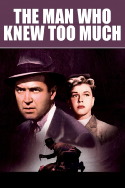
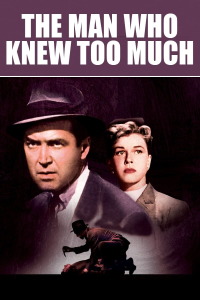
Review of The Man Who Knew Too Much (1956) by Jake C — 24 Apr 2018
Unlike its predecessor, which crammed through its first act and barely made notice of its "exotic" location in the Swiss Alps, Hitch here dwells in the seediness and foreign feel of Morocco. For the first act, the story crawls and scenes are so clearly delimited that they often end by fading to black-this is not a criticism, but illustrates how mundane a narrative (and a set of characters) the movie begins with: Just a midwest doctor on vacation with his family, doing nothing special, being no one of real note (though his wife is, as we will discover, Day making for one of Hitch's strongest heroines).
But this, as so often with Hitch, is all a ruse, and we find the wool pulled over our eyes: There is much more going on here that we just can't see, and the film works as a slow burn of discovery as we, alongside the protagonists, learn only what little we need to (just enough, only as much as will keep us involved and moving forward) to keep us interested and to keep the tension tightening.
Perhaps we would do better to close our eyes and listen, for while the original film has some of the most stunning camerawork of its era, here the sound design stands out for those with ears to hear. The deafening roar of a plane engine, a ghostly/ghastly foreign voice on a telephone, steps echoing down an empty alley, the song of a mother that barely hides the whistle of a son, the crash of symbols which might hide a murder-danger comes in the ear, which unlike the eye, cannot be closed, forever imposing upon us.
All this leads to a most magnificent and tense climax set within the Albert Hall, where voices are silent and eyes watch on helplessly for over ten minutes as the magnificent and menacing cantata (same as in the original) swells as if nothing could stop it once put in motion.
This review of The Man Who Knew Too Much (1956) was written by Jake C on 24 Apr 2018.
The Man Who Knew Too Much has generally received very positive reviews.
Was this review helpful?