Review of The Man Who Cried (2000) by Souha K — 10 Apr 2008
[i]The Man Who Cried.
[/i]dir. Sally Potter.
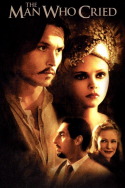
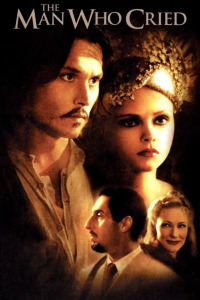
In this film, every element works together to create a seamless whole of lasting depth and potent, intense emotion. The film features Harry Dean Stanton, Cate Blanchett, Johnny Depp, Christina Ricci, and John Turturro and they all give one of their best performances in this epic, character driven period piece.
The story begins with a little girl (Claudia Lander-Duke) riding on her father's shoulders. It is Russia, 1927. She adores her father who sings to her to sleep and she is crestfallen when he is forced to leave for America in search of new opportunities for work. He is a composer and his daughter has inherited his singing talent. The little girl is soon sent to England after her village is razed and is adopted by an English couple who give her the name Suzie. She initially resists learning English and there is a mournful scene when she is standing at a gate watching a caravan of refugees pass. She sings a melancholy Russian song and is overheard by an administrator who chastises her and explains that she must learn English and flashes a ruler which he threatens to use on her if she doesn't comply. She is rewarded for her voice and sings songs in English for the school. The film moves to an adult Suzie played by Ricci who is shy, unassuming and distant. She moves to France where she meets the elegant Lola (Blanchett) with dreams of Hollywood flashing in her eyes. Suzie dances f or a while before befriending Dante Domino (Turturro), a charismatic opera singer with Fascist leanings and an abhorrence of gypsies and Jews. Dante also meets Lola and the two of them begin a frantic romance so that Lola becomes convinced she has landed the right man.
The film plays out against the backdrop of German agitation preceding WWII. There is a sense of doom hanging over every frame as German troops march on first Poland and then France. Each character is effected by the changing landscape and Suzie's plight is at the center of the film as she is a Jew who has been able to keep her ethnicity secret while attempting to carve out a life for herself in France via England. She is discovered by Dante who uses the information to rat her out to the German authorities. Dante prays to Mary for Germany to win if there is a war as he is an Italian living in France and would be entirely unwelcome. Each scene in this film is exquisitely photographed by Sacha Vierny. There is a haunting quality to each scene and Vierny captures the natural beauty of the film's female leads. There are several shots that linger on Ricci and the effect is devastating. Similar treatment is applied to Blanchett who has never looked so radiant, so impossibly alive. Music dominates the film through the opera company owned by Felix Perlman (Stanton) who is eventually forced to terminate a production because half of France has fled the occupation. There are also several Russian songs and Gypsy music played by the Romanian music group Taraf de Haidouks.
The mood of the film is decidedly downcast as refrains of "Gloomy Sunday" are used; later Ricci sings it in a club. While the Gypsies are being attacked, Dante sings for the Germans with a disturbed Lola sitting at his side. Lola is aware of the situation and leaves Dante so that she and Suzie can go to America. Blanchett and Depp do more with their eyes than any other actors working today. Turturro commands the screen as an immense physical presence as his character belts out a series of operatic works that lend the film a classicism that potently underscores the gravity of the production. Stanton simply does that thing he does and is solid in every scene. The music of the gypsies is simply heartbreaking as Cesar decides to stay behind and fight for their unity, their preservation. This is a film about distances between nations, lovers, and ones dreams versus the stark reality of the present moment. Each character is fighting for something tangible and elusive. Suzie wants to see her father, Lola wants to be a star, Dante wants to enhance his legacy, and Cesar seems to want nothing more than to remain with his family despite all the enmity that would threaten to tear them apart.
Overall, this film manages to evoke deep wellsprings of emotion out of its material. Potter orchestrates the scenery with a sharp eye for detail and an immeasurable focus. Each player cements their positions as a few of the most effective actors working today. Despite the essential gravity of the film there are moments of distinct color and exuberance. There is something profoundly moving about the Gypsy plight and their devotion to playing music that reflects the state of their souls. Dante believes that the Gypsy music lacks depth of feeling. He is convinced that Opera, his forte, is superior in every way to the plaintive wails he hears coming from the Gypsy players. He champions Mussolini and believes strongly that they are a necessary force for good in Italy. He is convinced they will restore order in his homeland where it has sorely lacked for many years. Dante is not an intellectual but he speaks for a state of mind that welcomed Fascism and believed strongly in its precepts and program. Ultimately, the film leaves Europe and lands squarely in America, a daunting presence throughout the film. It is depicted as a land of refuge, of opportunity, of shelter from the forces percolating in Europe threatening to explode every concept of civility and order for those caught in the crosshairs.
This review of The Man Who Cried (2000) was written by Souha K on 10 Apr 2008.
The Man Who Cried has generally received mixed reviews.
Was this review helpful?