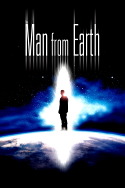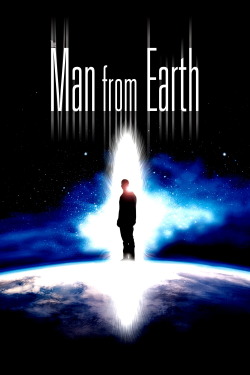
Review of The Man from Earth (2007) by Sven L — 03 Aug 2014
This review contains spoilers.
This is one of those movies I didn't hear about until six or seven years after its release, but it had a good IMDb/RT score and an intriguing premise, so I decided to give it a shot. In short summary, I would group it with The Invention of Lying and Year One as "movies whose obsession about religion dramatically lowered my ability to enjoy them." I do identify as a Christian, but I don't condemn all work which questions the Biblical narrative; in fact, I find most of them entertaining or intriguing. That's why I found this film so disappointing: it was a wonderful premise with bountiful possibilities, but in the end, it had nothing poignant to say about its primary topic.
The Man from Earth starts out with an interesting setup: during an intimate farewell party with several colleagues, an everyday college professor reveals himself as a man born near the end of the Stone Age who has witnessed the entire rise of human civilization from a limited individual perspective. The number of facets of human life which could be explored within such a framework are nearly limitless, and my hopes were buoyed by the inclusion of professors of various disciplines (biologist, anthropologist, historian, archaeologist, etc.), a convenient arrangement at which the movie makes a subtle wink.
The first third of the movie is spent introducing the characters and scenario, with the focus on getting the seemingly-normal protagonist (John) to spill the beans about where he's going and why he's chosen to leave so suddenly. There is some heavy-handed foreshadowing featuring ancient pieces, and the group eventually gets him to start telling his story in an initially abstract, but increasingly personal, way.
Of course, they are incredulous, so we get the requisite pseudo-scientific explanation from the biologist and a flimsy explanation from John why he won't submit tissue samples to prove his claim. Eventually, everyone agrees to treat it as an academic exercise to avoid having to make a final judgment on its validity, and we're treated to about half an hour of fairly interesting conversation regarding memory limitations, relationships, cultural definitions, varying personal reactions to such a man, and other topics which I hoped would be at the core of this film. During this middle third, references are made to the Biblical account of history, but it is treated like other academic inquiries by all characters but one, and the story manages to flow along to other topics in a fairly naturally way.
That all comes to a screeching halt when John claims to have been "the one they call Jesus." For at least the last third of the movie (which felt far longer than the first two-thirds), that claim is the only topic of conversation; gone are questions about Columbus, Van Gogh, the Roman Empire, transition from hunter-gather groups to agrarian villages, the struggles of watching all one's friends age and die over and over, John's unique perspective on human nature, and the hundreds of other interesting topics which could fill ten movies. It's all Jesus.
While completely natural given the weight of the claim, it was off-putting to have the movie swerve so suddenly and totally. In addition, if you're going to introduce such a polarizing concept, shouldn't you try to say something profound? Many of his claims regarding the current fundamentalist, legalistic, and misguided iteration of Christianity would be at home in progressive Christian literature, so they can't even be counted as proper satire. Characters casually dismiss any archeological findings which support the Biblical narrative like an evangelical atheist in a first-year philosophy course. As is so often the case in stories of ancient times, his travels and lessons from "the East" are used as putty to fill in the cracks and incongruities in the story. It's all so cliché as to be boring, doubly so for me since I've read the comedic Christopher Moore book which built a much more cohesive and entertaining narrative on the same topic.
Things eventually come to a head regarding both the new Biblical narrative and John's state of sanity for telling and believing it. He chooses to portray it as a hoax to avoid a straightjacket, and the ones who don't want to believe are given an out. The others continue mulling it over, with at least one fully believing him. This would have been an appropriately even-handed ending, but we're then given a clunky and unnecessary twist where one of the characters ends up being John's child from a previous identity who promptly dies from the shock of the news. I think this was meant to bring out something in the main character and assure the audience the story was true, but it was so forced that it completely overshadowed a major character decision and left me with an even worse impression of the film overall.
Aside from the intent and content, the mechanics and execution of this film were mediocre at best. It's essentially a "bottle movie," taking place at one locale and only using a handful of characters who are present nearly all the time. The acting varies among the characters, from decent (William Katt) to overly dramatic (Tony Todd) to awful (Ellen Crawford), with the main character (David Lee Smith) swinging around depending on the scene. Except for one flimsy explanation, the biologist's only role is to lend humor, and it's always flat and unbelievable. The dialog is a mixed bag: it is natural and conversational at times, but at others, it's overly prosaic to the point of eye-rolling; as someone who has worked in academia, I'd say most college professors aren't nearly as eloquent as screenwriters think they are. Dwindling lighting is used to show us the passage of time, but it becomes distractingly dim as the film goes along.
At the end of the day, it looks and feels like the $200,000 movie it is, and although some might call it sacrilegious, I think its most damning offense is it couldn't use the unique viewpoint of its protagonist to actually say anything original.
This review of The Man from Earth (2007) was written by Sven L on 03 Aug 2014.
The Man from Earth has generally received very positive reviews.
Was this review helpful?