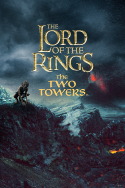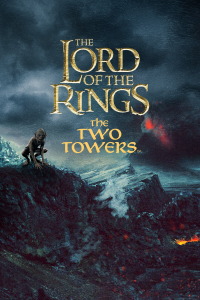
Review of The Lord of the Rings: The Two Towers (2002) by Moviemastereddy — 16 Apr 2016
Certainly there can be few films so replete with images of death and portents of doom as is “The Two Towers.” At virtually every step, the mostly separated main characters are threatened with extinction, and looming over all is the specter of the gathering army of the dark wizard Saruman, whose victory would eliminate the last remaining bastion of significant resistance to his quest for total dominance over Middle-earth.
“It’s getting heavier,” laments Frodo (Elijah Wood) about the Ring to his genial companion Sam (Sean Astin) as they make their way across some imposing mountains en route to the dreaded Mordor, the only place the Ring can be destroyed so as to prevent the Dark Lord Sauron from establishing an empire of evil. The two Hobbits aren’t alone for long, however, as they apprehend the strange, vaguely threatening but ultimately pathetic creature named Gollum that’s been following them and now offers to guide them to Mordor.
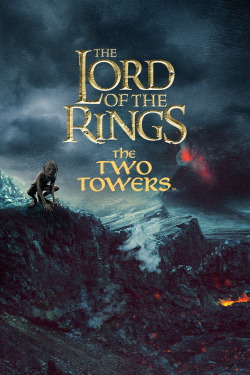
But Gollum is an unsettling critter to have around. Naked save for a diaper-like loincloth, fidgety, skinny but large of hands, feet and skull, with strings of black hair and bulging, haunted blue eyes, Gollum looks like a preternatural Peter Lorre, a permanently scared and worried soul who’s compellingly revealed later on to be a hopeless schizophrenic, one twisted by his previous experience as a Ring bearer. “Acted” initially by Andy Serkis and subsequently reworked into exaggerated humanoid form via a dexterous CGI makeover, Gollum is a startling creation that constitutes one of the film’s major talking points.
All the same, this odd group doesn’t actually get very far in “The Two Towers,” as matters focus more on the heroic efforts of the warriors Aragorn (Viggo Mortensen), Legolas (Orlando Bloom) and Gimli the Dwarf (John Rhys-Davies) to help King Theoden of Rohan (Bernard Hill) in his seemingly hopeless defense of Rohan against Saruman’s army of 10,000 specially bred fighting beasts. All things considered, the handsome Aragorn would rather be back with his lady love, Arwen (Liv Tyler), but when duty calls, a man such as he has no choice.
Throughout, the film intercuts among a trio of story strands, the third recounting the strange detour of Frodo’s errant pals Merry (Dominic Monaghan) and Pippin (Billy Boyd) into Fangorn Forest, where they are snatched up by an ancient walking-and-talking tree called Treebeard (wonderfully voiced by the busy Rhys-Davies), who takes his own sweet time deciding what to do with the anxious Hobbits.
Without pausing to recap past action, Jackson and his co-screenwriters Fran Walsh, Philippa Boyens and Stephen Sinclair (the latter a new addition to the “Fellowship” trio) pick things up where they left off a year ago, and audiences will at once settle in for the yarn’s continuation in full confidence that there will be no let-down in storytelling sweep and spectacle.
Because of the pressure of momentous events and the lessened need for expository character delineation, the dialogue this time around tends toward the utilitarian and declamatory; with hardly an alteration, the very same words, given a different spin by the likes of John Cleese or Michael Palin, could be quite funny. But the grim mood established by the clouds of war and the muted blues, greens, grays and earth tones of Andrew Lesnie’s grand but mobile cinematography keep the proceedings sober as King Theoden and his people abandon their homes for the presumed safety of a mighty fortress, Helm’s Deep.
After a haunting march across the Dead Marshes, beautifully realized by production designer Grant Major and his team, Frodo, Sam and Gollum are captured by Gondor leader Faramir (David Wenham), which effectively sidelines them for most of the remainder of the picture. Over in the forest, the dawdling Treebeard eventually calls a conference of his branchy brethren; when the ambulatory ancient trees at the last minute decide to take action, it’s quite a sight to see.
But the final half-hour is largely and rightly given over to the battle at Helm’s Deep, an event that never could have been presented as vividly or on such a scale in the pre-CGI era. Jackson stages the logistics with admirable clarity; Saruman’s Uruk-hai soldiers, ferocious hulks that are half-men, half-monsters, gather in such numbers on the plains that death seems certain for everyone inside the heavy stone fort. Heroics abound on the parts of Aragorn, Legolas and Gimli, with the latter’s bemused reactions in the face of repeated endangerment a continued source of humor. A promised deus ex machina arrives in the form of Gandalf, but while the battle may be won, the war against the occupants of the titular towers, Saruman and Sauron, remains to be pursued a year hence.
Once again, Howard Shore’s vigorous score, seemingly somewhat altered and darkened, and sans the Enya contributions, provides valuable support.
All the same, it’s hard to imagine a much better version of this material onscreen.
This review of The Lord of the Rings: The Two Towers (2002) was written by Moviemastereddy on 16 Apr 2016.
The Lord of the Rings: The Two Towers has generally received very positive reviews.
Was this review helpful?